The Sea of Azov is no longer a secure Russian rear area – and for the first time since Moscow seized control of its coastline, the disruption is hitting Russia’s export economy as well as its military logistics.
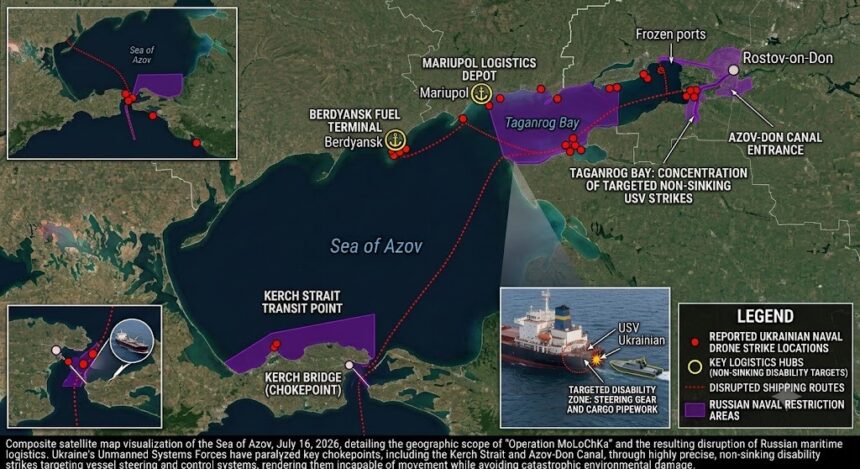
Over nine days ending July 14, Ukraine’s Unmanned Systems Forces said their sea and aerial drones struck 116 Russian-linked vessels operating in the Sea of Azov, most of them fuel tankers supplying occupied Crimea. Commander Robert “Madyar” Brovdi said the campaign unfolded in stages, with the total rising from 90 vessels on July 12 to 105 a day later before reaching 116 by the end of what Kyiv described as the first phase of the operation. Ukraine’s figures have not been independently verified, but Russian regional officials have acknowledged repeated drone attacks on ports and waterways in the Rostov region, while commercial traffic through the Sea of Azov appears to have fallen sharply.
According to maritime security firm Ambrey, the operational tempo of the campaign may now exceed that seen during the Iran-Iraq “Tanker War” of the 1980s, when roughly 450 attacks on commercial shipping were recorded over seven years. Ambrey analyst Thomas Alexa told the Financial Times he had never observed such a concentration of attacks anywhere in the world. Independent vessel tracking cited by open-source analysts also suggests maritime traffic has fallen dramatically, with daily ship movements reportedly dropping from around 132 on July 6 to 43 by July 12.
A Mechanism Built to Disable, Not Sink
The campaign’s tactical logic distinguishes it from earlier phases of Ukraine’s naval war. Rather than sinking vessels – which risks fuel spills, casualties and the kind of ecological or diplomatic fallout that could draw international criticism – Ukrainian drones are reported to target ships’ bridges and the external pipework used to load and discharge liquid cargo. The effect, according to Ambrey’s assessment, is to leave tankers unable to steer or communicate while remaining afloat, since most are built to survive significant hull damage.
Disabled vessels then require towing to port for repair, and the ocean-going tugs used to recover them have themselves become secondary targets, extending the campaign from the tankers themselves to the infrastructure needed to restore maritime traffic. Ukraine’s General Staff has said the targeted ships were transporting both sanctioned Russian oil and military cargo bound for occupied Crimea, while dry cargo vessels and ferries supported Russian military logistics in southern Ukraine.
The specific drone types used in the Sea of Azov campaign have not been officially confirmed by Kyiv. Reporting has variously pointed to naval drones operated by the Unmanned Systems Forces and to long-range strike drones produced by Ukrainian manufacturer Fire Point, though neither has been officially identified for these operations.
Why the Sea of Azov Matters
Before Russia’s full-scale invasion, the Sea of Azov was primarily associated with Mariupol and Ukraine’s steel exports. Since Russia occupied both shores, however, it has become one of Moscow’s most important internal logistics corridors. Fuel, ammunition, construction materials, grain and military supplies move through this network between southern Russia, occupied Crimea and the wider Black Sea.
That transformation helps explain why Ukraine increasingly views commercial shipping not as a civilian economy separate from the war, but as infrastructure supporting Russia’s military campaign. The latest strikes reflect an effort to degrade Russia’s ability to sustain operations by attacking the transport system that underpins both military logistics and export revenues.
The Canal Closure and the Grain Chokepoint
The clearest sign of how far the disruption has spread came on July 10, when Russian border guards stopped accepting new transit requests through the Kerch Strait after Ukrainian drones struck 13 vessels in the Sea of Azov that day, according to Reuters. Russia’s Azov-Don Canal, which links the Don River basin to the Sea of Azov, was also closed to new traffic. Reuters reported that neither Russia’s Transport Ministry nor its Agriculture Ministry responded to requests for comment.
The restrictions have effectively isolated the ports of Azov, Rostov-on-Don and Taganrog – three of southern Russia’s most important export hubs. Together they handle roughly one-quarter of Russia’s seaborne grain exports, making the disruption particularly significant as the country’s annual harvest reaches its peak.
Eduard Zernin, chairman of the agricultural company Bio-Ton, warned that the closure had trapped grain exports at the height of the harvest season. Sovecon director Andrey Sizov said Russia could withstand a brief interruption but that a prolonged shutdown would likely force downward revisions to export forecasts because there is no alternative route capable of handling comparable volumes. Russia’s Baltic grain terminal at Vysotsk can process only around four million tons annually – well below the throughput of the southern ports.
Global grain markets reacted quickly. Wheat futures on Euronext rose about 4% on July 10, while September wheat contracts on the Chicago Board of Trade climbed more than 3%, reflecting growing concern over disruptions to one of the world’s largest grain exporters. Russian officials have suggested bulk cargo could be shifted onto the country’s rail network if necessary, but those rail corridors are already under pressure from Ukraine’s long-range strikes against refineries, fuel depots and logistics infrastructure.
A Widening Definition of Maritime Denial
Ukraine still lacks a conventional navy capable of matching Russia ship for ship. Instead, it has built a campaign that makes contested waters sufficiently dangerous and unpredictable that Russia’s own authorities have restricted maritime traffic through waters they have long presented as effectively under their control.
The Azov closure has effectively become a self-imposed blockade. A state that spent years portraying the Sea of Azov as secure internal waters has suspended large parts of its own maritime traffic because it can no longer guarantee safe passage.
The campaign also demonstrates how modern sea-denial operations can extend beyond military targets into an opponent’s wider economy. A campaign initially aimed at fuel tankers supporting occupied Crimea has begun affecting grain exports during Russia’s peak harvest season, illustrating how military logistics and commercial trade can become inseparable in wartime.
What to Watch
Whether this campaign becomes a lasting strategic shift will depend on several indicators. The first is the duration of restrictions through the Kerch Strait and the Azov-Don Canal. A prolonged closure would increase pressure on Russia’s export sector and force greater reliance on already strained rail networks.
The second is Russia’s ability to adapt. Expanded patrols, anti-drone barriers, electronic warfare systems and revised shipping procedures could reduce the effectiveness of future attacks but would also require significant military resources to protect what was once considered a secure rear area.
Finally, Ukraine’s ability to sustain the operational tempo will determine whether the Sea of Azov becomes a permanently contested battlespace. If Kyiv can continue combining relatively inexpensive unmanned systems with persistent pressure on maritime logistics, the campaign may become one of the clearest demonstrations yet that modern naval power is no longer measured solely by the size of a fleet, but by the ability to deny an adversary the safe use of the sea.