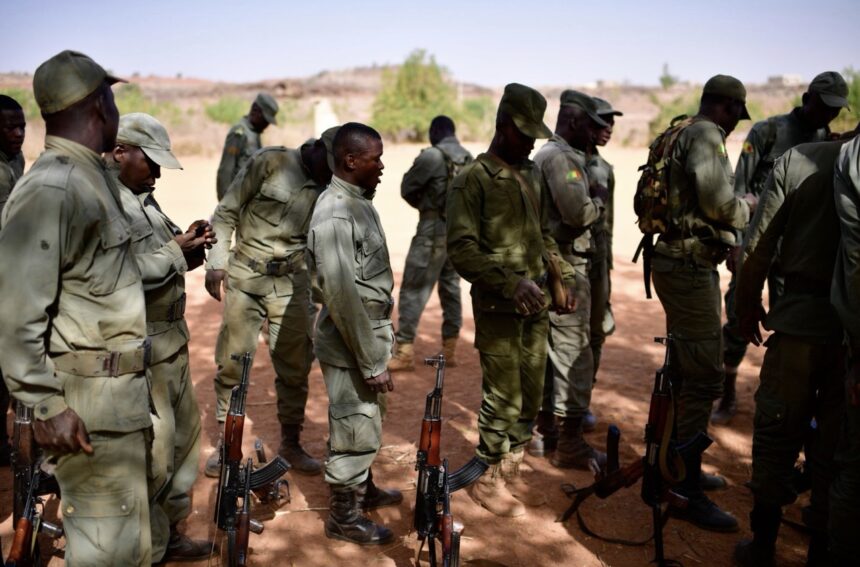
Russia changed the name of its military presence in Mali. It changed the command structure. What it has not clearly changed is the pattern of violence that followed Wagner into the Sahel.
The latest allegation concerns Kyrnia, a village in Mali’s central Mopti region. Eight civilians, including three children, were reported killed in Russian-linked air strikes there on June 15. Investigators cited by Reuters said the strikes hit the village chief’s home and a cattle market and that no militants were identified among those killed. The Associated Press reported the same findings and said Russia’s Defence Ministry did not comment. The attribution remains an allegation rather than an independently verified finding.
But the incident matters because of what Russia has changed around it.
Wagner Left. Moscow Took More Control
Wagner formally withdrew from Mali in June 2025 and was replaced by Africa Corps, a force operating under much closer Russian state control. ACLED’s Africa overview described the transition as a shift toward more direct organizational supervision by Moscow. Unlike Wagner, whose corporate structure gave the Kremlin a degree of formal distance from its operations abroad, Africa Corps places Russia’s intervention more openly within the state’s military apparatus.
That distinction matters for accountability. Bringing Russian personnel under clearer state military control strengthens the connection between their conduct and the Russian state. But it does not automatically establish individual command responsibility for alleged violations. That requires evidence about who exercised effective command, what commanders knew or should have known, and whether they took reasonable measures to prevent violations or punish those responsible. The Kyrnia strike itself remains an allegation, and no such individual responsibility has been established.
What is clearer is that the institutional shift has not produced a visible reduction in civilian harm. According to ACLED data cited in reporting on Sahel civilian tolls, Malian forces together with Wagner and Africa Corps killed 918 civilians in 2025, compared with 232 civilians killed by Jama’at Nusrat al-Islam wal-Muslimin (JNIM) and Islamic State Sahel Province. The figures do not make the actors equivalent – jihadist groups have carried out massacres, blockades and kidnappings across the region – but they show how heavily civilians have paid under the counterinsurgency model pursued by Bamako and its Russian partners.
Russia’s Security Promise Is Under Pressure
Mali’s military rulers turned to Russia after progressively pushing out France and the United Nations mission, presenting Moscow as a partner that would restore sovereignty and territory without Western political conditions. Wagner and Malian forces recaptured Kidal in 2023, one of the junta’s most important symbolic victories.
But Russia’s intervention faces a problem familiar to counterinsurgencies: helping government forces seize or defend strategic positions is not the same as creating the security and political presence needed to hold territory over time. Africa Corps can provide combat power, protect routes and support Malian operations, but lasting control ultimately depends on the state’s ability to maintain security and authority after an operation ends.
That weakness became visible in April 2026, when JNIM and the Azawad Liberation Front launched a coordinated nationwide offensive against cities and military positions. ACLED says the offensive recaptured Kidal and forced Malian and Russian forces to withdraw from much of the surrounding region, reversing one of the government’s most celebrated achievements. Mali’s defence minister, Sadio Camara, was also killed during the assault on Kati.
Militant pressure has continued. In July, insurgents launched coordinated attacks on army positions from Gao and Sevare to areas in southern Mali. Reuters reported that the fighting again demonstrated the ability of armed groups to operate across several fronts despite years of expanding Russian military support.
The problem for Bamako is therefore not simply whether Russian forces can win individual engagements. It is whether those operations produce durable security. Retaking territory loses much of its strategic value if militants can return, reopen fronts elsewhere or continue threatening the roads and communities connecting government-held areas.
Civilian Harm Can Become a Battlefield Liability
Counterinsurgency succeeds or fails on more than battlefield attrition. The state must also protect civilians, sustain authority and prevent armed groups from exploiting local grievances. That is where civilian abuse stops being only an accountability question and becomes a strategic one.
Operations that kill civilians or treat communities suspected of supporting militants as extensions of the insurgency can deepen distrust of the government and its foreign partners. JNIM has combined violence and coercion with taxation and forms of parallel authority in areas where state presence is weak. Civilian harm by government-aligned forces gives such groups another grievance they can exploit, even when the militants themselves remain responsible for extensive violence against civilians.
Africa Corps therefore confronts the same contradiction that followed Wagner. Heavy firepower can help seize an area or protect a route, but abusive or indiscriminate operations can undermine the political control those military gains are supposed to create. A force can win an engagement while making the longer contest for civilian cooperation harder.
ACLED assesses that Russia’s military partnership with Sahel governments has produced limited strategic results. Africa Corps has helped defend routes, escort convoys and support government forces, but militant groups have continued to expand or recover ground across parts of the region.
That is the larger significance of Kyrnia. Africa Corps is not simply Wagner under another name. Its structure is different, Moscow exercises more direct control, and Russia has taken clearer ownership of a military intervention once conducted through a nominally private organization.
The harder question is whether the underlying security model has changed with it. The evidence from Mali so far points to substantial continuity: close Russian support for military rule, aggressive counterinsurgency operations, serious allegations of civilian harm and battlefield gains that have repeatedly proved difficult to convert into durable security. Russia replaced Wagner with a force more closely tied to the state. It has yet to show that the new structure can deliver a different result.