For decades, governments measured energy security by asking whether oil and gas could move safely across oceans and pipelines. The principal threats were conventional wars, naval blockades, piracy or attacks on a handful of high-profile facilities. Protect the sea lanes, defend a few critical chokepoints and maintain strategic reserves, the thinking went, and global energy markets would remain resilient.
That assumption no longer holds.
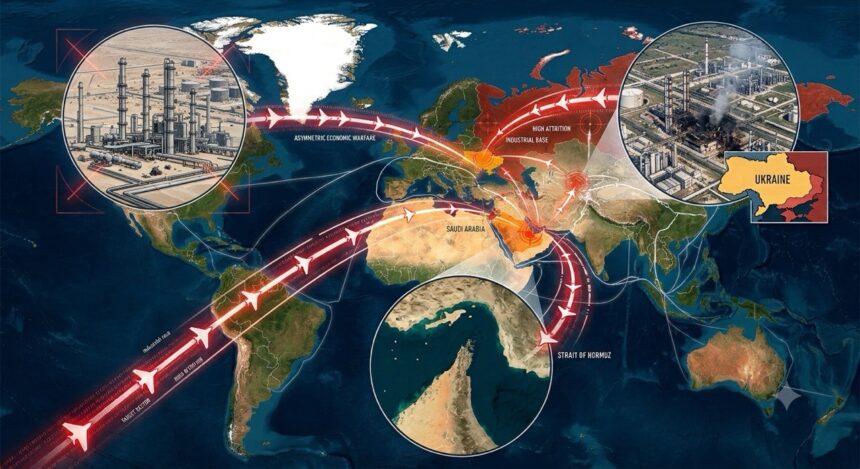
Evidence from Ukraine, Russia and the Middle East points to a broader transformation: energy infrastructure has become an operational objective in its own right, not merely a backdrop to military campaigns. Cheap drones capable of striking targets hundreds or even thousands of kilometers away have removed one of the greatest barriers to strategic warfare – the need for an advanced air force or a large arsenal of cruise missiles.
Refineries, pumping stations, export terminals, electricity substations and fuel depots are no longer simply assets that support military operations. Increasingly, they are the battlefield itself.
This shift represents more than another chapter in the evolution of drone warfare. It is changing how governments think about deterrence, infrastructure investment and economic security.
Ukraine Demonstrated the New Model
Russia’s full-scale invasion of Ukraine has become the world’s largest laboratory for long-range drone warfare. While drones first gained prominence as tactical reconnaissance and battlefield strike systems, Ukraine has steadily expanded their role into a campaign aimed at Russia’s industrial base.
Since early 2026, Kyiv has conducted what Ukrainian officials describe as a coordinated strategic strike campaign targeting defense industries, logistics hubs and oil infrastructure. According to Financial Times data cited by UNITED24 Media, Ukrainian long-range drones struck Russian oil refineries at least 194 times during the first half of 2026 – an elevenfold increase over the same period a year earlier. By early July, every one of Russia’s ten largest refineries had reportedly been targeted at least once.
The objective has not been to destroy Russia’s energy industry outright. Instead, Ukraine has sought to impose cumulative economic costs by disrupting refining capacity, increasing repair expenses, forcing the relocation of air-defense assets and complicating military fuel logistics. Even facilities that return to operation often require expensive protective upgrades, redundant systems and lengthy maintenance, reducing efficiency long after the explosions have faded.
Russia has pursued the mirror image of that strategy. Since late 2022 it has repeatedly targeted Ukraine’s electricity generation, substations and transmission networks with missiles and drones, seeking to degrade industrial production and civilian resilience during successive winters.
The political objectives differ. Ukraine aims to erode a revenue stream and military logistics network. Russia has sought to weaken Ukraine’s economy and civilian endurance. Yet both campaigns rest on the same strategic conclusion: disrupting energy systems produces effects that far outlast the immediate physical damage.
Strategic Bombing Without Strategic Bombers
Perhaps the most significant military change is not the drone itself but what it has made possible.
For much of the twentieth century, only major powers possessing fleets of strategic bombers or sophisticated cruise missiles could conduct sustained attacks against another country’s industrial infrastructure. Building and maintaining such capabilities required enormous financial and technological resources.
Cheap drones have dramatically lowered that threshold.
Today, states with relatively modest defense industries can repeatedly threaten refineries, pipelines and export terminals hundreds of kilometers beyond the front line. Instead of seeking complete air superiority, they can pursue strategic disruption through persistent, low-cost attrition.
This marks one of the most important shifts in offensive warfare since the spread of precision-guided munitions in the 1990s. Strategic bombing has not disappeared; it has become cheaper, more accessible and increasingly difficult to deter.
The Middle East Confirms the Pattern
The U.S.-Iran war has demonstrated that this transformation is no longer confined to Eastern Europe.
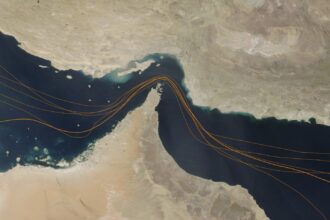
As fighting spread across the Gulf, attention quickly shifted beyond missile exchanges and naval deployments to the vulnerability of energy infrastructure supporting global oil exports. Refineries, export terminals and offshore facilities became as strategically significant as the Strait of Hormuz itself.
The lesson was not entirely new. The 2019 drone and cruise missile attack on Saudi Arabia’s Abqaiq and Khurais facilities temporarily removed roughly half of the kingdom’s oil production from the market, showing that relatively inexpensive unmanned systems could disrupt some of the world’s most heavily protected energy assets.
At the time, many analysts viewed the strike as an exceptional event.
Today it looks more like a preview.
Diversification Also Expands the Target List
Governments are responding to geopolitical instability by seeking alternative export routes around traditional chokepoints. Iraq and Syria’s agreement to rehabilitate the long-dormant Kirkuk–Baniyas pipeline is one example of a broader effort to reduce dependence on the Strait of Hormuz.
Diversification undoubtedly strengthens resilience against naval blockades or disruptions at sea.
But it also creates an unintended consequence.
Every new pipeline, pumping station, storage terminal and export port adds another fixed asset that must be protected against precision strikes. The challenge is no longer safeguarding a handful of strategic chokepoints; it is defending an increasingly dispersed network of critical infrastructure.
The geography of energy security is becoming simultaneously more resilient – and more vulnerable.
The Economics Are Changing Faster Than the Battlefield
Drone warfare is transforming not only military planning but also the economics of energy.
Historically, insurance premiums reflected risks such as piracy, terrorism or interstate war. Increasingly, they must account for persistent drone attacks against infrastructure located hundreds of kilometers from active front lines.
The implications extend well beyond insurance markets. Investors considering LNG terminals, pipelines or refinery expansions must now factor in the long-term cost of hardened construction, layered air defenses, electronic warfare systems and rapid repair capabilities. Governments planning new export corridors face similar calculations. Infrastructure resilience has become a financial question as much as a military one.
In this environment, the cost of protecting an asset may become as important as the cost of building it.
A New Cost-Exchange Problem
The economics of attack and defense are diverging.
Iranian Shahed-type drones are widely estimated to cost tens of thousands of dollars each. Intercepting one with a Patriot PAC-3 missile may cost several million dollars, creating an exchange ratio heavily favoring the attacker.
Ukraine has confronted the same imbalance during Russia’s long-range strike campaign. Rather than relying exclusively on expensive missile interceptors, Ukrainian forces have increasingly introduced low-cost interceptor drones costing only a fraction of traditional air-defense missiles.
That evolution points toward the next stage of the competition.
The future is unlikely to be defined by drones versus Patriot missiles. It is increasingly becoming a contest between inexpensive attack drones and equally inexpensive autonomous interceptors, supported by electronic warfare, artificial intelligence and layered defenses. Success will depend less on deploying the most sophisticated weapon than on achieving the most sustainable cost ratio.
Energy Security Is Becoming Air Defense
The consequences extend far beyond today’s wars.
For decades, energy security meant diversifying suppliers, maintaining strategic reserves and protecting shipping routes. Those priorities remain essential, but they no longer define the entire problem.
Governments and energy companies increasingly have to think like military planners. Air defense, electronic warfare, hardened infrastructure, redundancy, autonomous surveillance and rapid repair capability are becoming integral parts of national energy policy rather than emergency contingencies.
The line between civilian infrastructure and military objectives is narrowing accordingly. Refineries, LNG terminals, power stations and export pipelines support national economies as well as military operations, making them attractive targets in prolonged confrontations.
As inexpensive precision drones continue to proliferate, more states – and eventually more non-state actors – will acquire the ability to threaten infrastructure once considered secure by default.
During most of the twentieth century, energy security depended on controlling oil fields, sea lanes and pipelines. In the twenty-first, it increasingly depends on controlling the airspace above them.
The world’s energy system was built for an era when only advanced militaries could strike strategic infrastructure from the sky. Cheap drones have ended that era. Governments are now racing to redesign energy security for a world in which the greatest threat may no longer be a fleet of bombers, but swarms of inexpensive autonomous aircraft capable of imposing strategic costs at a fraction of the price required to stop them.