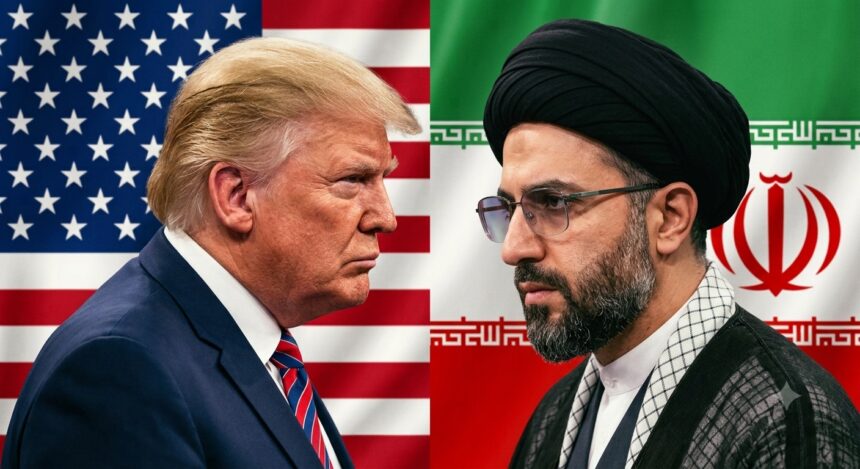
The United States can almost certainly destroy more of Iran’s military than Iran can destroy America’s. That, however, does not answer the question now confronting Washington: can overwhelming military superiority produce political victory without putting American troops inside Iran?
- Air power can cripple Iran’s conventional forces
- Coercion is possible, but objectives matter
- Time favors the defender
- Regime change cannot be delivered reliably from the air
- Nuclear destruction is not permanent disarmament
- No ground war does not mean no ground operations
- The answer depends on the war Washington chooses
- Can Iran truly be defeated without a ground war?
After eleven consecutive nights of strikes, U.S. forces have demonstrated that they can penetrate Iranian airspace almost at will, repeatedly attacking command centers, missile infrastructure, air-defense systems and military facilities across the country. Yet every additional wave of bombing exposes the same strategic dilemma. Destroying targets is relatively straightforward. Deciding what political outcome those strikes are meant to achieve is considerably harder.
Whether Iran can be defeated without a ground war depends almost entirely on what Washington means by “defeat.”
The answer changes depending on which objective the United States is pursuing.
Defeating Iran could mean:
destroying its conventional military;
forcing political concessions;
overthrowing the Islamic Republic;
permanently eliminating its nuclear and missile programs.
Only the first objective is clearly achievable through air and maritime power alone. Every step beyond that requires progressively greater political leverage, intelligence access or physical control on the ground.
CENTCOM announced that U.S. forces completed an eleventh consecutive night of strikes on July 21, targeting military operations centers, maritime capabilities, aircraft hangars, drone storage sites and logistics infrastructure. The campaign has been framed as an effort to reduce Iran’s ability to threaten U.S. forces and commercial shipping through the Strait of Hormuz. Yet Iran continues launching missiles and drones against American positions and regional infrastructure – a reminder that its retaliatory capability has been weakened, not eliminated.
Air power can cripple Iran’s conventional forces
The narrowest definition of victory is the destruction or suppression of Iran’s conventional military capability.
This is also the outcome most realistically achievable without a ground campaign.
American and allied aircraft can strike air-defense batteries, command centers, naval facilities, airfields, ammunition depots, radar stations, missile-production plants and exposed launchers. Naval forces can intercept vessels, enforce blockades and attack coastal infrastructure. Such operations can dramatically reduce Iran’s ability to wage coordinated conventional warfare while forcing surviving units to disperse, hide equipment and operate under constant pressure.
Military degradation, however, is only the first – and arguably the easiest – definition of victory.
Iran has spent decades preparing for precisely this kind of conflict. Rather than matching the United States technologically, it built a force designed to survive against a technologically superior opponent through dispersed command structures, underground facilities, mobile launchers and overlapping logistics networks.
The Institute for the Study of War reported on July 18 that Iranian forces have already begun adapting by employing faster, more maneuverable missiles intended to complicate American layered air defenses rather than overwhelm them through sheer numbers. The objective is not necessarily to defeat Patriot or THAAD batteries outright. It is to reduce interception rates enough to ensure that some warheads continue reaching their targets.
That points to the deeper asymmetry of an air-only strategy.
Every successful Iranian launch forces the United States to expend expensive interceptors against missiles and drones that are comparatively cheap to manufacture and easy to disperse. The strain is not primarily financial. It is industrial.
Modern wars are increasingly becoming competitions between production lines rather than individual weapons. Every Patriot, THAAD or SM-series interceptor fired today must eventually be replaced by factories operating months or years later. Iran cannot compete with American technology, but it does not necessarily have to. Its strategy is to keep enough launchers, missiles and drones in the fight to test how quickly the United States can replenish its magazines. The strategic competition therefore shifts from battlefield exchanges to industrial endurance.
Iran does not need to control its airspace to continue fighting. It only needs enough surviving missiles, drones, naval mines and coastal-defense systems to impose casualties, disrupt shipping and steadily increase the political and economic cost of the campaign.
An air campaign can therefore leave Iran conventionally weaker while still allowing it to wage an effective war of attrition.
Coercion is possible, but objectives matter
A second definition of victory is compelling Iran to accept a ceasefire or broader political agreement.
Air power can contribute to coercion when a government concludes that continued resistance threatens something it values more than the concessions being demanded. Washington may attempt to make the military, economic and political cost of continued fighting intolerable while simultaneously offering Tehran a diplomatic exit.
History, however, suggests that coercive air campaigns succeed most often when political demands remain limited. They become progressively less effective as objectives expand from changing a government’s behavior to changing the government itself.
Iran might eventually accept restrictions on maritime attacks, renewed nuclear inspections or another ceasefire if the alternative is sustained destruction. It becomes considerably harder if Washington demands unconditional surrender, comprehensive disarmament or the collapse of the Islamic Republic.
Coercion ultimately depends less on the amount of physical damage inflicted than on the balance of political resolve.
Iran’s leadership may conclude that surviving American pressure matters more than the immediate military and economic costs of resistance. Tehran can also attempt to shift those costs outward by threatening regional energy infrastructure, attacking U.S. bases and disrupting maritime traffic through Hormuz.
The United States, meanwhile, is already paying heavily for the campaign. Defense Secretary Pete Hegseth told senators on July 21 that military operations have cost roughly $37.5 billion, while the administration is seeking another $87.6 billion in emergency funding. Members of Congress have questioned both the size of the request and the absence of clearly defined strategic objectives.
Iran does not have to defeat the U.S. military. It may only need to continue fighting until financial costs, political pressure and public opinion begin reshaping American decision-making.
Time favors the defender
Every prolonged air campaign gradually changes the strategic balance.
Aircraft require maintenance. Precision-guided munitions and interceptor inventories decline. Industrial production struggles to replace sophisticated weapons at the pace they are consumed. Political support becomes harder to sustain while allies begin reassessing the economic and diplomatic costs of continued military operations.
Iran has spent decades preparing for exactly this scenario.
Its military doctrine assumes that it cannot defeat the United States conventionally. Instead, it seeks to survive long enough for the political and economic costs of intervention to begin reshaping Washington’s objectives.
Time therefore becomes one of Tehran’s most important weapons.
Iran does not need to reverse American air superiority.
It only needs to convince the United States that continuing the campaign will eventually cost more than negotiating its end.
Regime change cannot be delivered reliably from the air
If coercion fails, the next possible definition of victory becomes far more ambitious: overthrowing Iran’s governing system.
History shows that air campaigns can weaken governments. They can eliminate senior commanders, disrupt communications, destroy symbols of state authority and deepen divisions within ruling elites. Severe military setbacks may also encourage protests, defections or internal power struggles.
What air power cannot do is determine what replaces a collapsing government.
Air power can destroy a regime’s command structure. It cannot build the political order that comes afterward.
This distinction is particularly important in Iran.
The Islamic Republic is not held together solely by its visible political leadership. It rests on an extensive network of institutions that extends well beyond the office of the Supreme Leader. The Islamic Revolutionary Guard Corps (IRGC) functions not only as a military organization but also as an economic and political power center, controlling businesses, infrastructure projects, financial interests and patronage networks that generate independent resources.
Alongside the IRGC operate the Basij militia, intelligence agencies, internal security services, provincial authorities and religious foundations that collectively form overlapping mechanisms of state control. None of these institutions depends entirely on the survival of a single leader.
Analysts at the Center for Strategic and International Studies have argued that even a successful decapitation campaign would be unlikely to produce a fundamentally different Iranian foreign policy. Many of the most plausible successors – including senior IRGC commanders – hold strategic views toward the United States and Israel broadly similar to those of the current leadership.
That creates a danger often overlooked in discussions of regime change.
Removing the center of government may not produce democratic transition. Instead, it may accelerate fragmentation, with regional IRGC commands and affiliated political networks competing for authority while retaining access to military resources.
An internal opposition movement could eventually exploit such instability. Yet outside powers cannot assume that opposition forces would be sufficiently organized, united or equipped to seize and govern a country of nearly 90 million people.
Nor is there any guarantee that the government replacing the Islamic Republic would be either stable or more favorable to Western interests.
Libya remains the clearest cautionary example.
NATO air power helped rebel forces overthrow Muammar Gaddafi in 2011, but the military campaign itself did not establish functioning political institutions. RAND later concluded that the absence of effective security arrangements after the regime’s collapse contributed to prolonged instability.
Iran presents an even greater challenge.
Its population is roughly thirteen times larger than Libya’s was in 2011. Its bureaucracy is more developed, its security institutions more deeply entrenched and its geography considerably more difficult to control. Rather than producing a single post-regime vacuum, the collapse of central authority could instead disperse military power across competing regional networks, each retaining access to weapons, financing and loyal personnel.
Regime collapse might therefore occur without a foreign invasion.
Managing the consequences almost certainly could not.
Nuclear destruction is not permanent disarmament
The fourth – and most demanding – definition of victory would be the permanent elimination of Iran’s nuclear and long-range missile capabilities.
Air strikes can destroy centrifuges, enrichment halls, laboratories, production facilities, electrical infrastructure and tunnel entrances. They can delay a nuclear program and substantially increase the cost of rebuilding it.
They cannot erase technical knowledge.
Scientific expertise, engineering experience and procurement networks survive physical destruction. Bombing can eliminate equipment far more easily than it can eliminate the capacity to rebuild it.
Nor can aircraft verify the location of every stockpile, inspect underground facilities or establish with certainty that covert sites no longer exist.
Destroying visible infrastructure is therefore different from verifiably dismantling an entire nuclear program.
Indeed, heavy bombing may create a paradox.
A damaged enrichment facility can become more difficult – not easier – to monitor if inspectors lose access and international verification mechanisms collapse alongside the infrastructure itself. Physical destruction does not necessarily increase transparency. It may instead reduce it.
That distinction matters because lasting nuclear disarmament has always depended on more than military force.
It requires inspections, access, accounting for fissile material and sustained political agreements capable of surviving changes in military circumstances.
If Iran refuses those conditions, Washington faces an uncomfortable reality.
Even without launching a full-scale invasion, limited ground operations might still become necessary to seize sensitive facilities, recover nuclear material or verify what survives beneath hardened underground complexes.
Bombing alone cannot provide that certainty.
No ground war does not mean no ground operations
Public debate often presents policymakers with a binary choice: continue bombing or launch another Iraq-style invasion.
In reality, the options are far less absolute.
The distinction between no ground war and no ground operations is critical.
A campaign may avoid a large-scale occupation while still requiring special operations forces, intelligence teams, Marines or partner forces to secure sensitive installations, recover nuclear material, conduct limited raids or support maritime interdiction operations.
Those missions are fundamentally different from occupying Iran, but they still involve military personnel operating on or near Iranian territory.
As objectives become more ambitious, the likelihood of such operations increases.
Securing underground nuclear sites, rescuing personnel, collecting intelligence or supporting local armed groups all require capabilities that aircraft alone cannot provide.
A full invasion, by contrast, would represent an entirely different level of commitment.
Iran is nearly four times the size of Iraq geographically, with a larger population, mountainous terrain and multiple urban centers separated by significant distances. Occupying the country, securing borders and disarming competing military organizations would demand forces far beyond those currently deployed in the region.
Before the latest escalation, CSIS assessed that U.S. force posture was sufficient to sustain an extended air campaign but remained well below the level required for a major ground offensive or an effort to remove and replace the Iranian government.
That distinction illustrates the central strategic question facing Washington.
Avoiding an invasion does not necessarily eliminate the need for ground operations.
It simply changes their scale, purpose and political risk.
The answer depends on the war Washington chooses
Iran can be seriously weakened without a ground invasion. Its conventional forces can be degraded, its missile attacks reduced, its economy placed under sustained pressure and its leadership pushed toward negotiations.
But a country is not defeated simply because it loses control of its airspace. Air power can destroy armies. It can demolish missile factories, sink ships, suppress air defenses and delay nuclear programs.
What it cannot do is occupy cities, dismantle political systems, verify every underground facility or determine who governs after the bombing ends.
That is why the central question facing Washington is no longer whether it can continue striking Iran. Militarily, it almost certainly can.
The harder question is what political objective those strikes are intended to achieve.
If the goal is a ceasefire, restored freedom of navigation through the Strait of Hormuz and renewed constraints on Iran’s nuclear program, an air-and-maritime campaign may generate sufficient leverage for diplomacy.
If the objective is regime change, comprehensive disarmament and the reconstruction of one of the Middle East’s largest states, military superiority alone will not be enough. That outcome would require either an organized domestic force capable of taking and holding power, an Iranian political collapse that produces a stable successor government, or extensive foreign involvement on the ground.
Those are not simply different military operations. They are different wars.
Until Washington defines which of those wars it is actually trying to fight, it will remain impossible to answer the question at the center of this conflict.