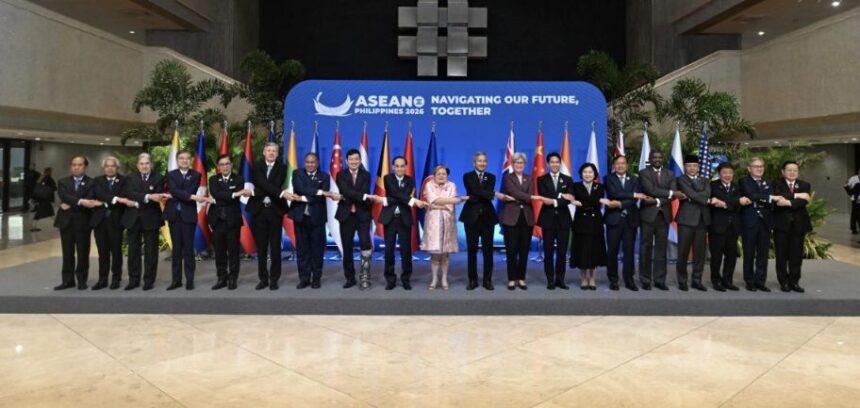
The 33rd Association of Southeast Asian Nations (ASEAN) Regional Forum in Pasay, Metro Manila, was not a venue where the United States, Russia and China came to resolve their disputes. Instead, it became a forum where each managed a different strategic challenge at the same time: Washington sought to preserve diplomatic channels with Moscow on Ukraine while reassuring Asian allies amid the Iran war, and Beijing continued pressing its maritime claims in the South China Sea despite growing regional tensions. Secretary of State Marco Rubio’s schedule – outlined in the U.S. State Department’s official travel notice – spanned the ASEAN Post-Ministerial Conference, the East Asia Summit Foreign Ministers’ Meeting and the ASEAN Regional Forum itself, underscoring how Washington approached the gathering as a single diplomatic campaign rather than a series of unrelated meetings.
The renewed U.S.-Iran war emerged as one of the forum’s dominant themes. Rubio said discussions throughout the week focused on developments in the Middle East, Russia’s war against Ukraine and security in the South China Sea, reflecting Southeast Asian concerns that instability around the Strait of Hormuz and attacks on commercial shipping could disrupt trade and energy supplies on which many regional economies depend.
The Rubio-Lavrov meeting itself was better understood as maintaining communication than launching negotiations. The talks lasted about 35 minutes, according to Reuters and the Associated Press. Afterward, the U.S. State Department said only that the two men discussed bilateral relations and “the need to end the Russia-Ukraine war,” without disclosing any substantive proposals. Neither Washington nor Moscow indicated that the meeting produced a diplomatic breakthrough. Rubio reiterated before the talks that the United States and Russia – the world’s two largest nuclear powers – must preserve working channels despite profound disagreements over Ukraine. Russia, meanwhile, repeated its longstanding position that it remains open to a “political and diplomatic resolution” while continuing military operations and maintaining its existing negotiating demands.
The South China Sea provided a reminder that regional tensions have continued to escalate even as global attention shifted toward the Middle East. The forum followed two separate confrontations between Chinese and Philippine vessels within the same week, including another water-cannon incident near Scarborough Shoal on Thursday. Chinese Foreign Minister Wang Yi warned Philippine Foreign Secretary Theresa Lazaro against relying on outside powers in the territorial dispute. Some regional analysts argue Beijing may perceive greater room to intensify maritime pressure while Washington’s diplomatic attention is divided among the Middle East, Ukraine and the Indo-Pacific.
None of the forum’s three principal diplomatic tracks produced a breakthrough. Instead, the meetings illustrated a broader transformation in international diplomacy: regional organizations originally designed for dialogue among neighboring states are increasingly becoming venues where major powers manage multiple global crises simultaneously. Rather than separating regional and global security, ASEAN now finds itself at the intersection of both.