
Ukraine
Russia’s Long-Range Strike Campaign Is Becoming a War of Industrial Attrition
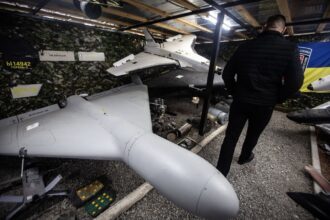
More than four years into Russia's full-scale invasion, the struggle for control of Ukraine's skies has become one of the defining contests of the war. Moscow is no longer seeking decisive effects from individual missile barrages. Instead, it is using sustained waves of drones and missiles to wear down Ukraine's air defenses, exhaust Western interceptor production and force Kyiv into a prolonged war of industrial attrition.The campaign's scale illustrates that shift. Russia launched a record 8,150 long-range drones against Ukraine in May, according to an AFP analysis of Ukrainian Air Force data. That represented a 24 percent increase from April and reflected Moscow's growing ability to sustain high-tempo attacks over consecutive months. Ukrainian authorities reported intercepting 7,476 of those drones – 91.7 percent of the total – but the headline figure conceals an increasingly important reality: Russia is no longer trying simply to penetrate Ukrainian air defenses. It is trying…
Ukraine Claims New Sea of Azov Strikes as Russia Suspends Canal Traffic
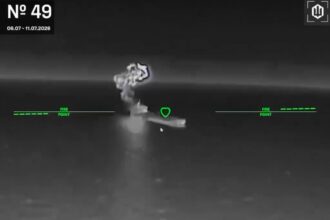
Ukraine's Unmanned Systems Forces (USF) said they struck at least 28 more Russian-linked vessels in the Sea of Azov overnight, bringing the total number targeted over the past six days to 76, according to USF commander Robert "Magyar" Brovdi. The figures have not been independently verified.Reuters reported that Russia's border service has stopped accepting new transit applications through the Azov-Don Canal following the recent attacks. Rostov region Governor Yury Slyusar said four vessels, including a tanker, were damaged near Taganrog and one sailor was killed. Reuters could not independently verify the full scale of Ukraine's reported overnight operation.The USF has not yet released a breakdown of the vessel types reportedly struck on Saturday, saying additional reconnaissance is underway.Maritime security consultancy Ambrey said video from previous attacks showed Ukrainian drones consistently targeting ships' bridges and accommodation blocks rather than their hulls—a tactic it said mirrors Russian attacks on merchant shipping and…
How Ukraine’s Drones Are Draining Russia’s Fuel Tanks
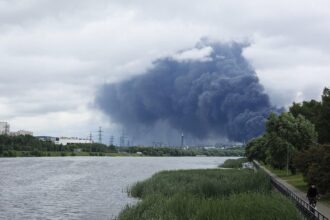
Ukraine's long-range strike campaign has pushed Russia into its most widespread fuel crisis of the war, disabling as much as 40% of the country's refining capacity and splitting Russia into rationing zones and stockpiling zones. The pressure now extends beyond refineries to the tankers supplying occupied Crimea, isolating the peninsula's Russian garrison even as Moscow answers with a deliberate campaign against Ukrainian civilian fuel stations and cities.The crisis has been building since 2025, when Ukraine expanded a campaign of drone and missile strikes against Russian oil refineries, terminals and pipelines deep inside Russian territory. Estimates of the damage diverge sharply, and the gap is not just measurement noise. Ukraine's General Staff put disabled capacity at 42.74% as of early July, while the International Energy Agency cited "more than 20%." According to UNN, citing the General Staff, the higher Ukrainian figure reflects a deliberate shift in targeting: strikes now concentrate on…
Russia Bans Diesel Exports as Ukrainian Drone Campaign Hits Fuel Supply
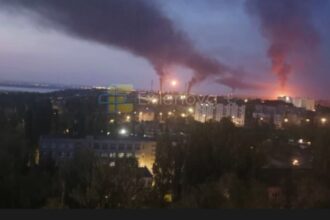
Russia has suspended diesel exports until at least the end of July after months of Ukrainian drone strikes disrupted refineries, fuel depots and fuel transport infrastructure, forcing Moscow to prioritize domestic supply over overseas sales. The suspension is not a routine market intervention. Russian refiners have historically produced roughly twice as much diesel as the domestic market consumes, exporting about half their annual output. A country built on structural fuel surplus is now importing petroleum products while restricting exports—one of the clearest signs yet that Kyiv's long-range drone campaign is fracturing Russia's internal energy logistics, not merely reducing export revenue.Deputy Prime Minister Alexander Novak announced the export suspension during a televised government meeting chaired by President Vladimir Putin, saying the measure would redirect more diesel to the domestic market. Novak said Russia would begin importing petroleum products this month while increasing output at operating refineries by allowing the use of…

Belarus Caught Between Russian Pressure and Ukrainian Deterrence
Belarusian President Alexander Lukashenko made an unusually explicit promise to his servicemen in early July: "No one is going to send you into this slaughter." The declaration came after weeks of rising tension. Ukrainian President Volodymyr Zelenskyy openly accused Russia of trying to pull Belarus deeper into the war, Kyiv threatened action against military infrastructure inside Belarus that it said was assisting Russian attacks, and Lukashenko held closed talks with Russian President Vladimir Putin before travelling to Beijing to meet Chinese President Xi Jinping. The Wall Street Journal reported in June, citing current and former Russian and European officials, that Moscow had begun a pressure campaign earlier in 2026 aimed at using Belarus as a springboard to expand the war in Ukraine or conduct unconventional operations against NATO states. The Kremlin denied the report. Behind these developments lies a three-way strategic struggle Putin is seeking to draw Belarus deeper into…

China Helped Plan Starlink Destruction, Probe Finds
A joint investigation by The Insider, Der Spiegel, and Le Monde has found that China's proclaimed neutrality in Russia's war on Ukraine conceals years of military-technical cooperation, structured around an explicit three-tier plan to disable Elon Musk's Starlink network. By fall 2023, Starlink had become Ukraine's primary battlefield communications system, with over 40,000 terminals delivered by that November, when Chinese defense engineers met secretly in Guangzhou, per The Insider. The plan escalates in tiers rather than a loose menu. Tier one is regulatory sabotage: diplomatic protests against Starlink's orbital footprint paired with joint spectrum and orbital-slot applications meant to block its expansion bureaucratically. Tier two is offensive cyber activity against civilian terminals, using fabricated credentials and vulnerability exploitation to paralyze the network. Tier three is kinetic attrition, physically destroying satellites faster than SpaceX can replace them. The transactional logic is clearest in the drone program. At a December 2024 Yekaterinburg…
