When Europe marched to war in the summer of 1914, few imagined the conflict would last more than four years, claim millions of lives, topple centuries-old empires, and reshape the world order. Yet by the time the guns fell silent on November 11, 1918, World War I had become one of the deadliest and most transformative events in modern history.
What began as a political crisis in the Balkans rapidly evolved into a global conflict involving dozens of nations across Europe, the Middle East, Africa, and the world’s oceans. Historians often describe it as the war that ended the nineteenth century and ushered in the turbulent modern era.
A Continent on Edge
The roots of World War I stretched far beyond a single assassination.
For decades, Europe’s major powers had been locked in a dangerous mix of military competition, colonial rivalries, and nationalist ambitions. A complex web of alliances divided the continent into opposing camps, while an escalating arms race fueled fears that war was becoming increasingly inevitable.
The immediate spark came on June 28, 1914, when Archduke Franz Ferdinand, heir to the Austro-Hungarian throne, was assassinated in Sarajevo by Bosnian-Serb nationalist Gavrilo Princip. What followed was a diplomatic chain reaction that quickly spiraled out of control.
Within weeks, Austria-Hungary declared war on Serbia. Germany backed its ally, Russia mobilized in support of Serbia, and France and Britain were soon drawn into the conflict. Europe’s leaders expected a short war. Instead, they unleashed a catastrophe.
The Rise of Industrialized Warfare
World War I introduced a scale of destruction the world had never witnessed before.
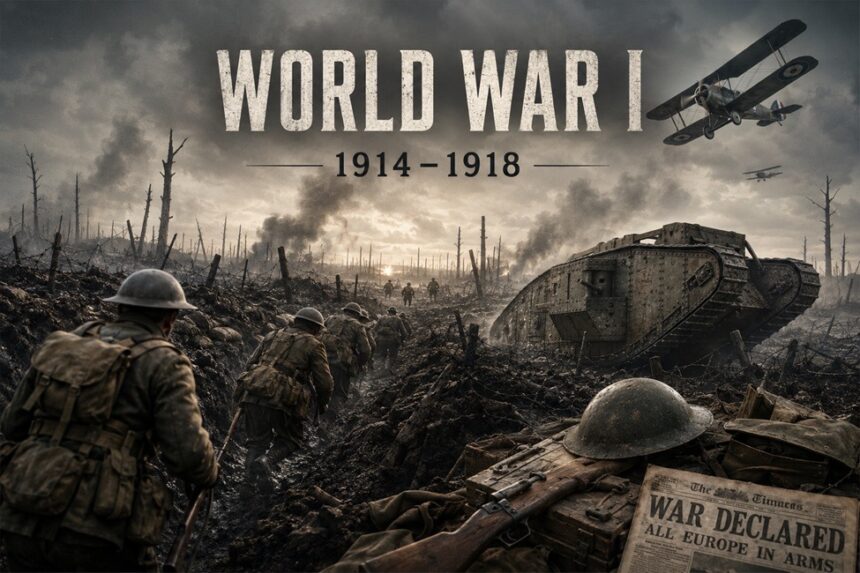
The conflict is remembered for its vast trench systems stretching across the Western Front, where soldiers endured relentless artillery bombardments, mud-filled battlefields, disease, and constant danger. Military technology advanced rapidly, bringing machine guns, poison gas, tanks, submarines, and aircraft into large-scale combat for the first time.
Battles such as Verdun and the Somme became symbols of the war’s brutality. Hundreds of thousands of soldiers were killed or wounded in campaigns that often resulted in only minimal territorial gains.
The war also extended far beyond Europe. Major campaigns were fought in the Middle East, Africa, and at sea, transforming what began as a regional crisis into a truly global conflict.
Turning Points of the War
By 1917, the conflict had reached a critical stage.
Russia, exhausted by military defeats and domestic unrest, withdrew from the war following the Russian Revolution. At nearly the same time, the United States entered the conflict on the side of the Allies after Germany intensified its unrestricted submarine warfare campaign.
American manpower and resources provided a crucial boost to the Allied war effort.
In 1918, Germany launched a massive Spring Offensive in a final attempt to break Allied lines before American forces could fully arrive. Although initially successful, the offensive ultimately failed. Allied counterattacks during the Hundred Days Campaign pushed German forces back and shattered their ability to continue fighting.
Facing military collapse and growing unrest at home, Germany agreed to an armistice that took effect on the eleventh hour of the eleventh day of the eleventh month — November 11, 1918.
The Human Tragedy
The numbers remain staggering more than a century later.
Historians estimate that between 9 and 11 million military personnel lost their lives during the war. Civilian casualties caused by violence, famine, and disease raised the overall death toll to as many as 20 million people.
More than 21 million soldiers were wounded, while countless others returned home carrying the psychological scars of combat.
The conflict also witnessed one of the twentieth century’s earliest mass atrocities. During the war, the Armenian Genocide unfolded within the Ottoman Empire, resulting in the deaths of an estimated 600,000 to 1.5 million Armenians.
Meanwhile, the global influenza pandemic of 1918 spread rapidly through military movements and wartime conditions, further increasing the human cost of the conflict.
An End That Shaped the Future
Although the fighting ended in 1918, the consequences of the war were only beginning.
The 1919 Treaty of Versailles imposed harsh penalties on Germany, including significant reparations, territorial losses, and restrictions on its military. The agreement also formally assigned responsibility for the war to Germany, a decision that would remain controversial for decades.
Perhaps even more significant was the collapse of four major empires: Germany, Austria-Hungary, Russia, and the Ottoman Empire. Their fall redrew the political map of Europe and the Middle East, creating new states and borders that continue to influence international politics today.
A Legacy That Still Echoes
Many historians view World War I not as an isolated conflict, but as the opening chapter of a much larger twentieth-century struggle.
The economic hardship, political instability, and national resentment that followed the war created fertile ground for the rise of extremist movements, including Adolf Hitler’s Nazi Party in Germany. Within just two decades, the world would be plunged into an even larger conflict: World War II.
In the Middle East, the division of former Ottoman territories by Britain and France established borders and political arrangements that continue to shape regional tensions more than a century later.
For that reason, World War I remains far more than a historical event. It was a turning point that transformed nations, altered the balance of power, and laid the foundations of the modern world. Its impact can still be seen in global politics, international borders, and many of the conflicts that continue to dominate headlines today.