Call it what it is. The agricultural collapse in Gaza, with 94% to 96% of farmland destroyed or unreachable, is not a difficult early challenge for the territory’s new governing bodies to manage. It is a structural veto on the possibility of Palestinian self-governance in the near term. The National Committee for the Administration of Gaza (NCAG), the Palestinian technocratic body led by Dr. Ali Shaath, cannot administer a territory where the physical means of feeding its population, arable land and water, sit partitioned behind an Israeli military line that keeps moving forward. That is not a metaphor. It is the literal cartographic situation as of mid-2026.
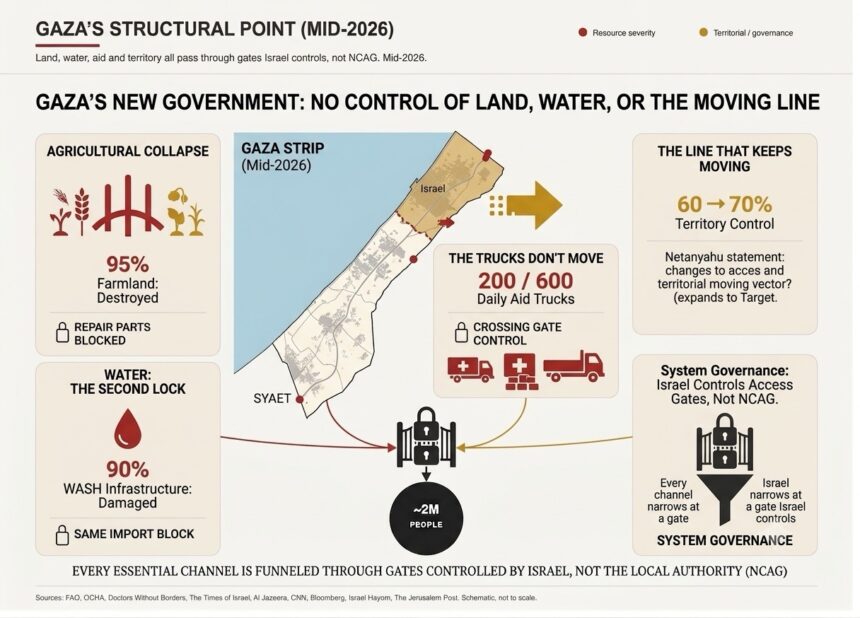
Gaza`s Systemic Chokepoint Map
The Line That Keeps Moving
The ceasefire that took effect in October 2025 established the “Yellow Line,” an Israeli withdrawal boundary covering roughly 58% of Gaza. It did not stay fixed. By late March 2026, new maps distributed to aid agencies showed an additional “Orange Line” carving out another 34 square kilometers, about 11% of the Strip, beyond the original boundary, according to The Times of Israel. Roughly 14,133 households now sit trapped in the space between the two lines, per UN figures. On May 28, Netanyahu told a settler audience that Israel already controlled 60% of Gaza and that his directive to the military was to reach 70%, a statement confirmed independently by Al Jazeera, CNN and Bloomberg.
The Orange Line’s advance has not been incidental. Israel Hayom reported that the boundary change carried the Board of Peace’s approval, meaning the international body notionally overseeing Gaza’s transition has signed off on the same territorial expansion that is consuming the enclave’s remaining farmable land. NCAG does not control this process, has no veto over it, and administers whatever remains on the western side of a line Israel and the Board of Peace can redraw without its input.
The Infrastructure of Dependency
Set against that map, the agricultural numbers stop looking like war damage and start looking like architecture. Cultivated land has fallen from roughly 9,300 hectares before the war to about 400 hectares now. Ninety-eight percent of the tree cropland was destroyed by late 2025. Only about 7% of agricultural infrastructure, wells, irrigation, and storage still function, per the FAO. Israel classifies the components needed to rebuild that infrastructure, pipes, pumps, greenhouse materials, as “dual-use” and routinely blocks their import; Doctors Without Borders reports that every one of its supply requests since January 1, 2026, has been denied.
None of this exists in isolation from stated Israeli policy. Defense Minister Israel Katz has said the “voluntary emigration plan” from Gaza will be implemented. Netanyahu’s own adviser was tasked with finding third countries willing to accept Palestinians, an effort that Somaliland and the DRC both rejected, per Haaretz. Human rights organizations and UN-mandated experts describe the combination of destroyed land, blocked repair materials, an expanding military boundary, and an explicit emigration policy as a coherent mechanism rather than a coincidence of overlapping crises. Israeli officials attribute the import restrictions to the risk of military diversion to Hamas. Both positions are on the record. What is not disputed is the outcome: land that cannot be farmed, water that cannot be repaired, and a population whose government has told them it wants them to leave.
Water: The Second Lock
Even land inside NCAG’s nominal jurisdiction cannot recover without water it does not control. Close to 90% of Gaza’s water and sanitation infrastructure is damaged or destroyed. Repair components fall under the same “dual-use” restrictions as agricultural equipment. Gazans now average 1.5 to 3 liters of water per person per day, against a UN emergency minimum of roughly 15 liters. Agriculture and water access are not two separate crises for the new administration to juggle. They are the same chokepoint: both run through import approvals that Israel, not NCAG, controls.
The Trucks Don’t Move Either
Even goods that clear Israeli approval face a second, physical bottleneck. The World Health Organization assessed in March 2026 that only about 200 trucks a day were entering Gaza, against a requirement of roughly 600 to meet basic needs. Since January 12, 2026, only 34% of trucks manifested through the UN-coordinated system have been able to offload at Gaza’s crossings, according to OCHA’s humanitarian situation reports. Kerem Shalom and Zikim remain the only two operational crossings for humanitarian and commercial goods; when Zikim closed for two weeks, all traffic was rerouted through an already congested Kerem Shalom checkpoint. This is distinct from the “dual-use” classification problem above: agricultural equipment, water-repair parts, and food aid are not just subject to approval; they are also competing for space in a crossing system that cannot move enough volume even when approval is granted.
Two Layers, One Starved Economy
The governance structure sitting above this is not neutral to the outcome either. Day-to-day administration falls to NCAG, a body with no independent revenue, no control over borders or the Orange Line, and no authority over what enters Gaza. Above it sits the Board of Peace, the US-led body chaired by Donald Trump under UN Security Council Resolution 2803. In June 2026, a leaked four-page draft resolution, reported first by The Guardian and confirmed by outlets including The Jerusalem Post, described plans to grant Board members, its Office of the High Representative, Palestinian technocrats, security personnel and foreign contractors sweeping immunity from arrest and prosecution in Gaza, alongside the right to occupy and use Gaza public property “needed for the accomplishment of the missions in Gaza” without compensation. A Board of Peace official disputed the leak, saying “there is no operative resolution or immunity framework of the kind described,” and calling suggestions of lawlessness “categorically false.” That denial should be taken seriously and reported alongside the leak, not instead of it.
If the draft reflects where the Board is actually heading, even in part, it points to a structure in which the layer with legal cover and property access sits above a layer, NCAG, managing a starved population with no comparable protections or resources of its own. That is a governance conflict worth naming plainly rather than folding into vague language about “coordination challenges.”
What This Actually Means
Put together: a military boundary that keeps annexing Gaza’s remaining farmland, an import regime that blocks the equipment needed to rebuild what’s left, a crossing system that cannot move enough trucks even when goods are approved, a stated policy goal of encouraging the population to leave, and an international oversight body reportedly drafting legal immunity and property rights for itself while the population it oversees survives on 1.5 liters of water a day. NCAG’s mandate to govern Gaza is real on paper. Its capacity to do so is constrained by facts on the ground that no technocratic committee can administer around. Until the Orange Line stops moving, the crossings can carry real volume, and the water and agricultural inputs Israel currently allows through are allowed through, Gaza’s new governance architecture is managing a humanitarian catastrophe it does not have the territorial, logistical, or legal authority to resolve, which is a different problem than a test it might eventually pass.