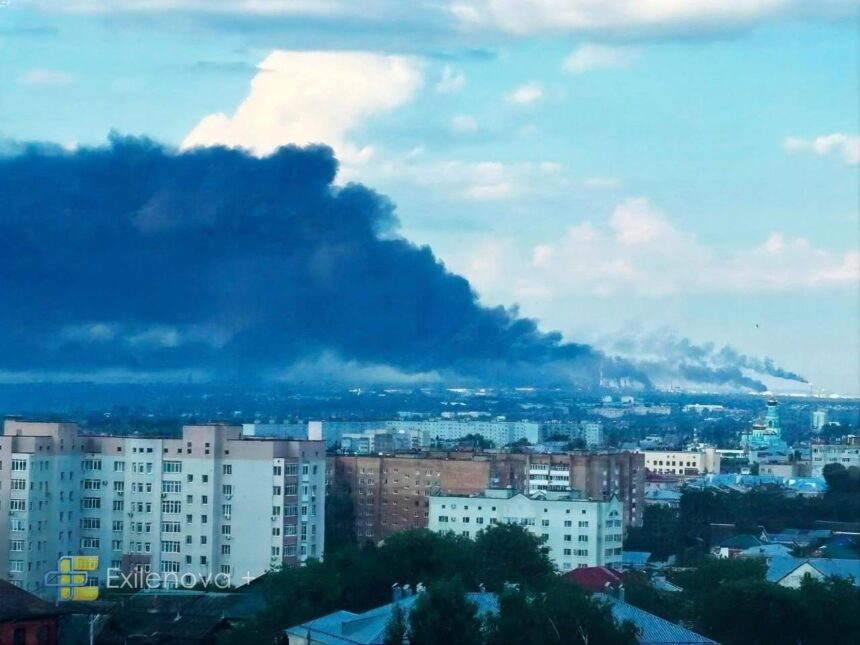
Ukraine’s General Staff said its forces struck the Syzran Oil Refinery in Russia’s Samara region overnight, causing a fire at one of the Middle Volga’s largest refining facilities. The military said explosions were recorded and the extent of the damage was still being assessed, while Samara regional authorities acknowledged a drone attack without describing the refinery’s condition. According to Telegram-based OSINT channels, including Dnipro Osint, the strike may have hit the refinery’s ELOU-AVT-5 unit, a primary crude-distillation column reported to handle roughly 30 percent of the plant’s initial processing capacity. Neither Ukrainian nor Russian authorities have confirmed that assessment.
The Rosneft-operated Syzran refinery has a processing capacity of roughly 8.5 million tonnes of crude oil per year, making it an important regional producer of gasoline, diesel and aviation fuel. Its location on the Volga River also gives it a logistical role in supplying central and southern Russia.
The significance of the strike lies less in symbolism than in refinery engineering. According to Reuters reporting and analysis by Carnegie Russia Eurasia Center energy expert Sergey Vakulenko, primary distillation units such as the one reportedly targeted at Syzran are generally among the quickest and least expensive refinery components to repair, often returning to service within weeks. The more enduring constraint created by Western sanctions falls on secondary conversion units—including catalytic crackers and hydrocrackers—and on specialized valves, catalysts and industrial control systems once supplied by Western manufacturers such as UOP and ABB. Analysts say that shortage increasingly forces Russian refiners to cannibalize equipment from other facilities, creating an industrial bottleneck that compounds the cumulative impact of repeated Ukrainian strikes.
The refinery attack did not stand alone. Ukraine’s General Staff also reported destroying a Russian military fuel train near occupied Tokmak in Zaporizhzhia region on July 11, damaging the locomotive, while Ukrainian forces reportedly struck 10 fuel tankers and four ferries supporting Russian military logistics in the Sea of Azov. Those claims have not been independently verified. Taken together, the strikes point to a campaign aimed not only at fuel production but also at the railways, ports and transfer nodes that move fuel toward Russian forces in occupied southern Ukraine. Ukrainian officials have not publicly described the operations as a coordinated fuel-denial campaign, but the target set increasingly reflects that logic.
Ukraine did not disclose which weapon system carried out the Syzran strike. Its long-range campaign has increasingly relied on domestically produced strike drones capable of reaching industrial facilities hundreds of kilometers inside Russia, allowing Kyiv to attack military and economic infrastructure well beyond the front line while reducing reliance on foreign-supplied long-range weapons.
Russia has responded by repairing damaged primary processing units as quickly as possible and redistributing refining workloads across facilities that remain operational, limiting the immediate impact on national fuel production. But the cumulative effect is becoming more important than the damage from any single strike. Rather than attempting to cripple one refinery outright, Ukraine is forcing Russia to repair multiple industrial sites simultaneously while operating under sanctions that complicate access to specialized equipment and replacement parts. The campaign seeks to impose persistent industrial friction rather than deliver a decisive one-off blow.