What began in 2022 as a workaround to Western sanctions has evolved into one of the most important pieces of strategic infrastructure in the modern global economy. Russia depends on it to finance its war in Ukraine. Iran relies on comparable networks, built over decades of sanctions, to keep exporting oil despite renewed U.S. pressure. Together, these systems increasingly form a parallel maritime order operating alongside – but increasingly outside – the traditional rules governing international shipping.
Recent events on both fronts illustrate the shift. Ukraine has expanded its campaign against vessels linked to Russia’s shadow fleet, while renewed fighting between the United States and Iran has again placed commercial shipping at the center of the confrontation around the Strait of Hormuz. Merchant shipping is no longer merely operating alongside these conflicts. It has become one of the principal ways through which economic pressure, military strategy and geopolitical competition intersect.
From Sanctions to a Parallel System
The G7 oil price cap, introduced in December 2022, was designed to limit Russian energy revenues while keeping global oil markets supplied. Instead, it created powerful incentives for an alternative maritime system.
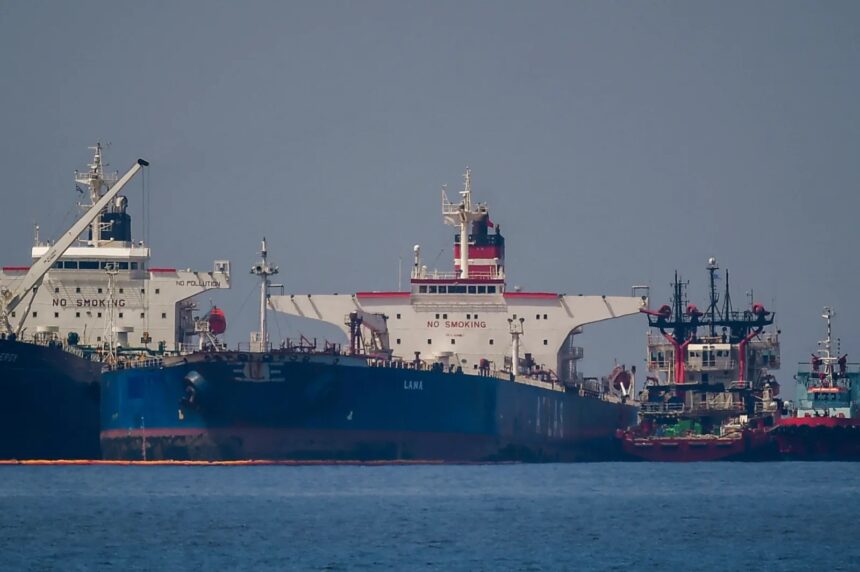
Russian oil companies spent more than $10 billion acquiring secondhand tankers after 2022, according to research by Harvard analyst Craig Kennedy. At the same time, an investigation by Follow the Money found that Western shipowners earned more than $6 billion selling roughly 230 aging tankers into what would become the shadow fleet – vessels that otherwise would likely have been scrapped.
Rather than stopping the flow of money, the sanctions environment redirected it. Revenue from continued oil exports helped finance the purchase of the very fleet designed to operate outside the restrictions imposed upon it.
Anatomy of the Shadow Fleet
Analysts generally describe the shadow fleet as vessels transporting sanctioned cargoes while minimizing regulatory oversight and financial transparency.
Typical characteristics include:
concealed ownership through shell companies;
frequent changes of flag registry;
insurance arranged outside the International Group of Protection and > Indemnity (P&I) Clubs;
manipulation or suspension of Automatic Identification System (AIS) > transmissions;
offshore ship-to-ship cargo transfers;
intermediary trading companies obscuring cargo origin and > destination.
None of these practices is inherently illegal when viewed individually. What distinguishes shadow-fleet operations is their systematic combination to complicate sanctions enforcement and obscure legal and financial accountability.
Militarizing Commercial Hulls
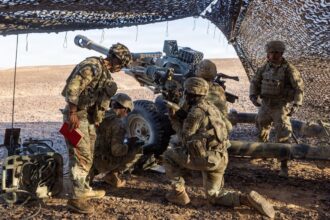
Ukraine’s Unmanned Systems Forces say they struck 172 vessels linked to Russia’s shadow fleet during a 13-day campaign launched on July 6.
Ukrainian drone commander Robert Brovdi has said Russia responded by reassigning personnel from its elite Rubicon drone unit to protect shadow-fleet tankers. That claim remains based on Ukrainian military reporting and has not been independently confirmed by Western intelligence, including whether personnel are deployed aboard vessels or operate shore-based systems protecting maritime routes.
If accurate, the reported redeployment represents a significant shift. Committing elite military assets to protect commercial shipping blurs the long-standing distinction between civilian merchant vessels and state military infrastructure.
Kyiv has increasingly argued that vessels integrated into Russia’s wartime logistics no longer fit the traditional definition of purely civilian commercial shipping. Whether international humanitarian law ultimately accepts that interpretation remains a separate – and likely contested – legal question.
Iran’s Longer Experience
Iran developed many of the techniques now associated with shadow shipping long before Russia’s full-scale invasion of Ukraine.
Changing vessel identities, conducting ship-to-ship transfers, relying on intermediary trading companies and developing alternative insurance arrangements became routine components of Iranian oil exports after years of international sanctions.
Despite renewed U.S. pressure and military confrontation around the Strait of Hormuz, Iranian exports have continued through logistics networks refined over decades. Rather than inventing a new sanctions-evasion model, Russia has adapted and expanded methods that Iran had already spent years developing.
Shared intermediaries, overlapping commercial practices and common buyers increasingly blur the line between what were once separate national shipping networks.
Weaponized Liability
Perhaps the least visible battlefield lies within maritime insurance.
Commercial shipping depends on internationally recognized Protection and Indemnity insurance accepted by ports, charterers and financial institutions worldwide. Without it, vessels often struggle to obtain financing, enter ports or secure commercial contracts.
Sanctions increasingly target that dependency rather than the cargo itself.
Russia has increasingly relied on the Russian National Reinsurance Company (RNRC) – created after earlier sanctions and significantly expanded following the 2022 invasion – to underpin insurance for vessels operating outside Western protection-and-indemnity markets.
According to Ukrainian maritime investigators, RNRC lacks the financial depth to absorb losses from a major tanker disaster involving multiple claims across jurisdictions. While the company provides a mechanism for sanctioned vessels to continue operating, questions remain about its ability to meet liabilities comparable to those covered by established international P&I clubs.
The consequence is a structural transfer of catastrophic financial risk from sanctioned exporters to coastal states, ports and commercial partners should a major maritime accident occur. Liability itself has become another instrument of geopolitical competition.
Two Maritime Economies
The cumulative effect is the emergence of two increasingly distinct maritime systems.
One depends on internationally recognized insurers, transparent ownership, established financial institutions and regulatory oversight. It continues to carry the overwhelming majority of global trade.
The other operates through opaque ownership structures, alternative insurers, sovereign backing and commercial networks specifically designed to withstand sanctions and political pressure.
The two systems remain interconnected. Ships, traders and service providers can move between them. But the divide is becoming increasingly structural rather than temporary.
For governments attempting to enforce sanctions, success increasingly depends less on intercepting individual cargoes than on disrupting the financial, legal and insurance infrastructure that enables this alternative system to function.
Outlook
The shadow fleet is unlikely to disappear even if sanctions are eventually eased.
Years of investment in alternative shipping, insurance, financing and trading relationships have created commercial incentives that extend beyond any single conflict. Buyers seeking discounted energy continue to generate demand, while sanctioned exporters have invested heavily in maintaining independent logistics networks.
Western governments are responding by expanding enforcement beyond vessel owners to insurers, ship managers, financial intermediaries and service providers – an acknowledgment that the contest is no longer about individual ships but about competing maritime systems.
The shadow fleet is therefore more than a sanctions workaround. It demonstrates how prolonged economic pressure can reshape entire industries rather than simply restrict them. What has emerged is not a temporary black market but a parallel maritime system – with its own insurers, financiers, shipowners and legal structures – that increasingly operates alongside the traditional global trading order. Whether governments can dismantle that system, or whether it becomes a permanent feature of international commerce, may prove one of the defining economic-security questions of the coming decade.