Chinese and Philippine forces were involved in three confrontations at two disputed South China Sea shoals between July 20 and 24, leaving two Philippine personnel injured and government vessels exposed to water cannons and dangerous close manoeuvres.
None of the incidents crossed into armed conflict. Their frequency and increasingly physical character, however, are testing crisis management between China and a United States treaty ally as ASEAN and Beijing attempt to complete a long-delayed maritime code of conduct.
The first confrontation occurred on July 20 near Second Thomas Shoal, where the Philippines maintains a military detachment aboard the grounded BRP Sierra Madre. The Philippine military said Chinese Coast Guard personnel struck a sailor with wooden batons. China said Philippine boats rammed its patrol craft and attacked its personnel with oars and sticks.
Video reviewed by the Associated Press showed physical contact but did not resolve the competing accounts of how the confrontation began. The incident continued a pattern of Chinese attempts to block Philippine access to the outpost.
The Philippine Coast Guard later evacuated two injured personnel. It said Chinese boats conducted blocking manoeuvres during the medical operation. One casualty had a head wound caused by blunt trauma; the other suffered a hand injury.
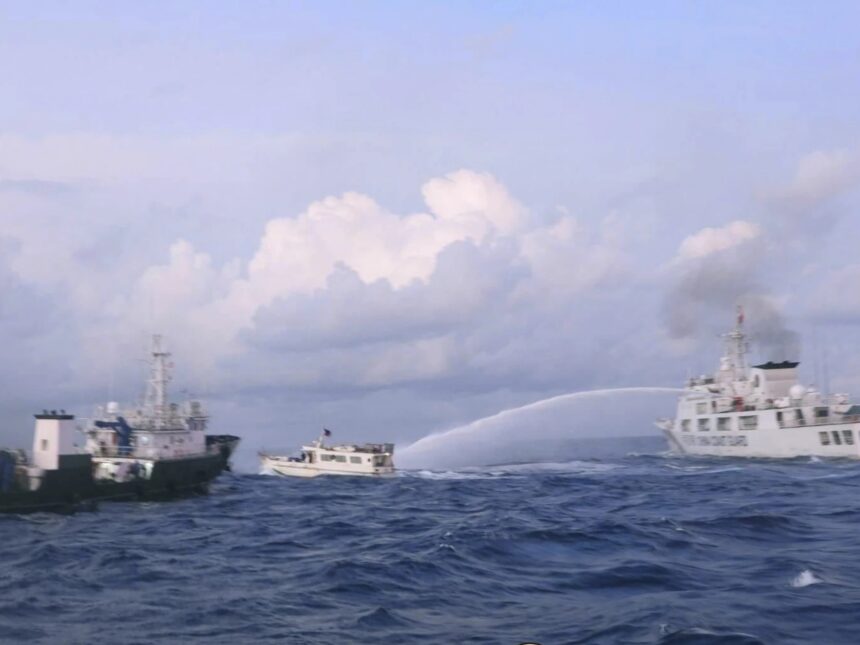
Chinese vessels then confronted Philippine Coast Guard and fisheries ships near Scarborough Shoal on July 23 and 24 while the Philippine vessels distributed fuel and food to Filipino fishermen. Manila said a Chinese ship used its water cannon for more than two minutes on July 23 without causing injuries.
On July 24, Chinese ships again used water cannons against two Philippine fisheries vessels. One Chinese vessel reportedly approached within seven metres of a Philippine ship, creating a serious collision risk. The China Coast Guard acknowledged using water cannons, warnings and blocking measures, but said the Philippine vessels had entered Chinese-claimed waters illegally and that its response was lawful.
ACLED describes such actions as grey-zone tactics: coercive measures kept below the threshold of open conflict. Coast guard and militia vessels, water cannons and close manoeuvres allow Beijing to press its claims while preserving uncertainty over what would constitute an armed attack. The same methods increase the risk that a collision or casualty could produce unintended escalation.
A 2016 arbitral tribunal rejected the legal basis for China’s expansive maritime claims and found that Beijing had violated the traditional fishing rights of Filipinos at Scarborough Shoal. It did not decide sovereignty over the feature. China rejects the ruling.
The clashes unfolded as ASEAN and Chinese diplomats met in Manila. Philippine Foreign Secretary Theresa Lazaro said negotiators are meeting monthly and aim to conclude the code of conduct this year. Its legal nature and geographic scope remain unresolved.
The alliance risk is consequential but should not be overstated. U.S.-Philippine bilateral defence guidelines state that an armed attack on Philippine forces, aircraft or public vessels, including coast guard ships, would invoke mutual-defence commitments. None of the reported incidents has been publicly classified as an armed attack.
The next indicators are whether further encounters cause serious casualties, involve ramming or boarding, draw naval forces into closer contact, or produce a code of conduct with binding restraints and a credible mechanism for addressing violations.