For much of the drone war in Ukraine, electronic warfare offered one of the cheapest answers to one of the battlefield’s cheapest threats. Jam the radio link between an FPV drone and its pilot, disrupt satellite navigation or flood the relevant frequencies, and a weapon costing hundreds or thousands of dollars could be stopped without firing an expensive interceptor.
Russia and Ukraine are increasingly designing drones around that defense.
The Cable as a Workaround – and a Constraint
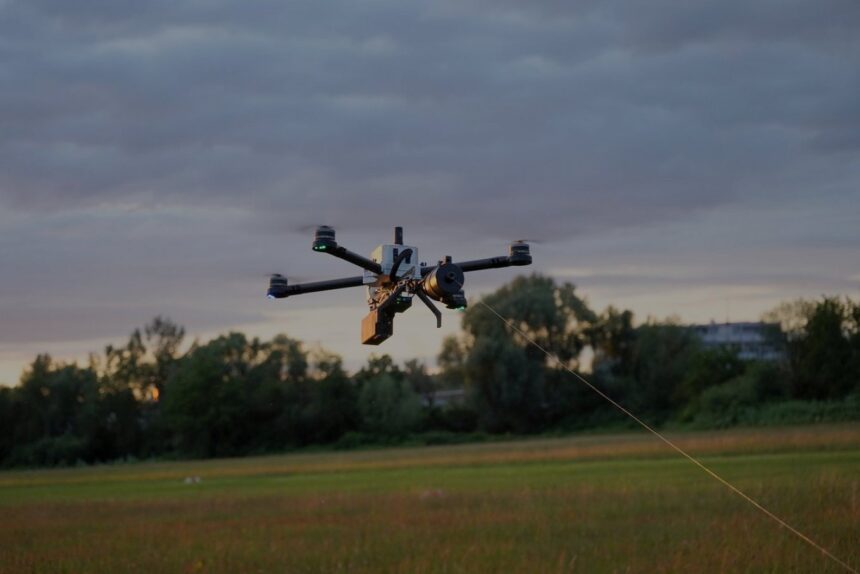
Russian forces are now using fiber-optic FPV drones to strike Ukrainian infrastructure behind the front line. Instead of receiving commands over a radio link, the drone unreels a thin cable as it flies, carrying the control signal directly between aircraft and operator. That makes the control link resistant to the conventional radio-frequency jamming used against ordinary FPVs.
That solution is not free. The cable adds weight, can snag or break mid-flight, and limits how sharply the drone can maneuver or how far it can practically travel. The same physical tether that defeats conventional control-link jamming also imposes constraints on range and agility.
Breaching the Grid
The consequences of that trade-off are becoming visible beyond frontline trenches. In Ukraine’s Sumy region, Russian fiber-optic drones have penetrated defenses around high-voltage electrical substations and attacked expensive transformers, according to Reuters, which detailed a two-stage tactic: one drone breaches protective netting before another follows through the opening and maneuvers around concrete shelters built around the substations, aiming for equipment inside.
The Center for Information Resilience verified strikes on substations 16 to 26 kilometers from the front – a breaching-and-follow-through method designed to defeat static, passive defenses rather than overpower them.
Economics can favor the attacker. Reuters reported that some of the Russian fiber-optic drones cost around $2,000, while the autotransformers they targeted can be worth millions. That asymmetry, alongside their resistance to conventional jamming, makes fiber-optic drones attractive against high-value infrastructure even when some attacks fail.
The Adaptation Cycle
Fiber optics do not make electronic warfare obsolete. They expose the limits of relying on it as the dominant counter-drone solution and illustrate a broader cycle of adaptation already visible across the war.
Radio-frequency jamming expanded as a response to mass-produced FPVs. Operators responded by changing frequencies, improving communications and adopting fiber-optic control, which removes the vulnerable radio control link at the cost of new physical constraints.
Defenders have also turned increasingly to nets, barriers, interceptor drones and other methods that do not depend on disrupting a control signal. The attacks in Sumy show how tactics can then adapt to those defenses as well: a barrier capable of stopping one drone can be deliberately breached to clear a path for another.
The result is not a neat technological progression in which each new system replaces the previous one. Radio-controlled FPVs, electronic warfare, fiber-optic drones and physical defenses coexist. Each is useful under different conditions, and each creates incentives for the other side to find another route around it.
The Push Toward Autonomy
Greater onboard autonomy offers another route through this cycle.
Ukraine is increasingly developing artificial intelligence and machine vision for drone operations, including systems designed to identify or track targets and continue operating when communications are degraded. The attraction is clear: a drone that requires constant contact with its pilot carries an electronic vulnerability, while greater onboard autonomy can reduce that dependence.
That does not mean autonomous weapons are about to replace human-controlled drones across the battlefield. Reliable target identification, navigation, computing power, cost and accountability remain serious constraints. Systems that perform well under controlled conditions can still struggle with smoke, bad weather, camouflage or rapidly changing battlefield conditions.
Nor does greater autonomy eliminate electronic warfare. Drones can depend on navigation, sensors and other systems that remain vulnerable to interference or deception. Autonomy instead changes which electronic links matter and how much a weapon depends on them during different stages of a mission.
But Ukraine has become an unusually fast laboratory for testing those limits. The pressure of constant battlefield adaptation compresses development cycles that would normally take years into months or weeks, as soldiers, engineers and manufacturers respond to enemy countermeasures.
That experience is increasingly relevant beyond Ukraine. European militaries are investing in AI-enabled and collaborative unmanned systems, while Kyiv and Washington are moving toward joint drone production using Ukrainian wartime expertise. President Volodymyr Zelenskyy said this month that the two countries were advancing plans to produce drones in the United States using Ukrainian technology.
Toward Layered Defense
The shift matters because electronic warfare has become central to how armies defend against cheap drones. Ukraine’s experience shows that a defense built primarily around one vulnerability invites an adaptation engineered specifically to remove or bypass it.
The likely outcome is not the disappearance of jamming but the layering of defenses.
Electronic warfare remains effective against many radio-controlled systems. Physical barriers can protect selected infrastructure, although the Sumy strikes show they can be breached by tactics designed around them. Interceptor drones, guns and short-range air defenses add further layers. Sensors increasingly need to detect threats that may produce little or no control-link radio signature.
Protecting a single critical site may therefore require several of these systems operating simultaneously.
That creates another imbalance. The attacking drone can remain relatively cheap while the defender must maintain electronic warfare, detection systems, physical barriers and kinetic interceptors to cover different versions of essentially the same threat.
Ukraine and Russia are locked in an adaptation contest in which each successful defense pushes the attacker to remove or bypass the feature that made it effective. Fiber-optic drones are the latest example. Greater autonomy offers another path around communications-dependent defenses, while defenders are already searching for ways to counter both.
The lesson from Ukraine is not that electronic warfare has failed. It is that on a battlefield saturated with rapidly evolving drones, no single countermeasure can be assumed to remain dominant for long.