NATO was built in 1949 to contain a Soviet threat its founders believed diplomacy alone could not hold. When the Soviet Union collapsed, the Alliance spent three decades answering a nagging question: what was it still for? The Ankara summit declaration gave an unusually direct answer.
NATO names Russia and rediscovers its mission
The declaration defines Russia as a long-term threat to Euro-Atlantic security, reaffirms Article 5 unanimously, and commits European Allies and Canada to carry more of the load. NATO pledged €70 billion in military support for Ukraine in 2026, with at least as much promised for 2027, and announced more than $50 billion in new procurement – prioritising long-range strike, air and missile defence, drones, artificial intelligence and a shared transatlantic “combat cloud.” NATO carries less raw mass than it did during the Cold War, but mass is no longer the measure. What Ankara showed is an alliance more focused, better funded and more clearly aimed at a single adversary than at any point since 1991.
Why the unity held
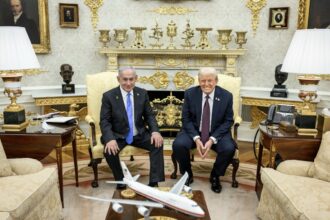
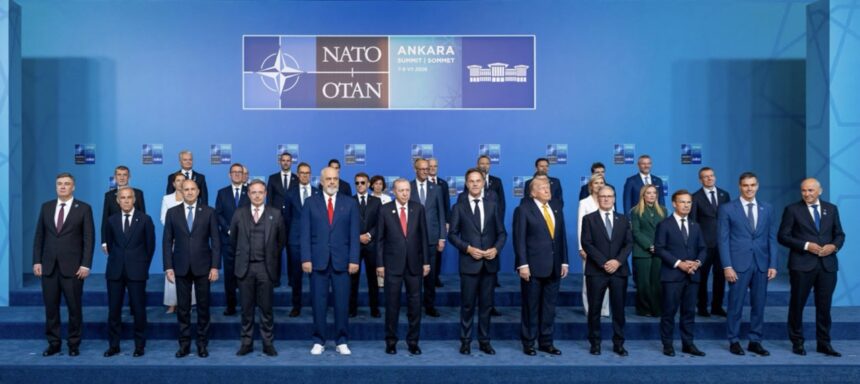
The summit could have gone badly, and it did not. U.S. President Donald Trump arrived combative. He went after Spain, reopened his feud with Denmark over Greenland, and argued over spending and Iran. But he did not walk out, and he did not hollow out the Alliance. He endorsed the declaration, reaffirmed the U.S. commitment to Article 5, met Ukrainian President Volodymyr Zelensky warmly, and spoke of “a lot of unity.”
The reason was money. European Allies and Canada are carrying the overwhelming share of the 2026 package. The €70 billion pledged for Ukraine excludes direct U.S. contributions, according to Reuters, and Europe put up the capital to build the arms industry Washington had pressed it to fund. Once Europe was paying, Trump had no reason to break ranks, and he did not.
The choice of host said something too. NATO could have staged its Russia pivot in Warsaw or Tallinn, where the hard line on Moscow is a given. Instead it met in Ankara, capital of the ally that has balanced longest and hardest between Russia and the West. Turkey backs Ukraine’s territorial integrity while it goes on trading with Moscow. Its purchase of the Russian S-400 air-defence system once cost it U.S. sanctions and a place in the F-35 fighter programme. In Ankara, Trump said Washington would lift those sanctions and look again at Turkey’s return to the F-35. The obstacles are real – U.S. law still bars Turkey from the jet as long as it keeps the S-400 – but the direction was unmistakable. For all its talk of a multi-vector foreign policy, when it comes to the hard business of weapons, industry and security, Turkey is choosing Washington, Brussels and NATO over Moscow.
Ukraine moves deeper inside NATO’s machine
At Ankara, Ukraine moved further into the Alliance’s structures. The declaration set out multiyear military commitments, deeper integration into Western procurement and training, and formal recognition that Ukraine “contributes to transatlantic security.” Trump went further in person. He cleared Ukraine to build U.S. Patriot interceptors under licence, letting Kyiv make its own air defence instead of waiting for deliveries, and he praised Zelensky in terms he rarely uses, saying the two had “developed a good relationship” and that the Ukrainian leader had “done an amazing job.”
The warmth tracked a change on the battlefield, not just at the table. A year ago Ukraine was described as holding on. In Ankara it was treated as a country that had caught up enough to make the war expensive for the larger side. Ukrainian drones now reach thousands of kilometres into Russia, threatening the airfields, refineries and supply lines behind it — including the logistics that sustain occupied Crimea. For a smaller country fighting a bigger one, cutting a single supply route is no small thing. Zelensky made the point himself when Trump asked whether he would fly to Moscow for talks: “It’s difficult. There are a lot of Ukrainian drones there,” he answered.
That is why the Alliance’s posture has shifted. NATO no longer treats Ukraine only as a country to be supplied, but as a source of capability. It is drawing on Ukrainian experience in drones, air defence and rapid adaptation — expertise no Western military has built at the same speed. Ankara began turning four years of improvisation under fire into something permanent.
NATO turns into an industrial mobilisation system
The deeper shift is institutional. NATO is moving from an alliance that made national armies interoperable toward something closer to a collective war-procurement system. Canada used Ankara to launch a Defence, Security and Resilience Bank, backed by eight other states and designed to mobilise long-term private capital and de-risk investment in production lines – a way to scale weapons manufacturing outside the slow rhythm of national budgets. Rearmament is becoming industrial policy: factories, supply chains, engineering and jobs. Badly designed spending can still waste money, but the direction is unmistakable – NATO is becoming a machine for converting threat into production, technology and capital.
The mood was combative but functional. Zelensky met Poland’s Karol Nawrocki for over an hour despite real friction. Erdoğan sent leaders home with engraved Turkish-made .357 revolvers and live ammunition, an eccentric advertisement for Turkey’s arms industry that left several governments working out how to carry the guns home legally. After years of arguing over whether Europe should rearm, NATO’s leaders left Ankara literally holding weapons.
For Beijing, the lesson was uncomfortable. The Western system remains noisy and shock-prone, yet it still converts external threat into money, arms and collective action. Ankara did not turn NATO into an anti-China alliance, but it demonstrated that the same Western network Beijing often portrays as divided and declining can still adapt, rearm and coordinate with Indo-Pacific partners.
NATO entered Ankara divided, noisy and uncertain. It left with Article 5 reaffirmed, €70 billion pledged for Ukraine, more than $50 billion in new procurement and a heavier European share of its own defence. Its strength showed not in the absence of quarrels, but in their failure to produce strategic rupture.
The Alliance built to contain the Soviet Union has rediscovered its purpose in confronting Russia. This time, it is doing so with Ukrainian battlefield experience, European industrial mobilisation, drones, deep strikes, air defence, artificial intelligence and long-term military financing. NATO survived the end of the Cold War. Ankara suggested it may now be entering another defining era.