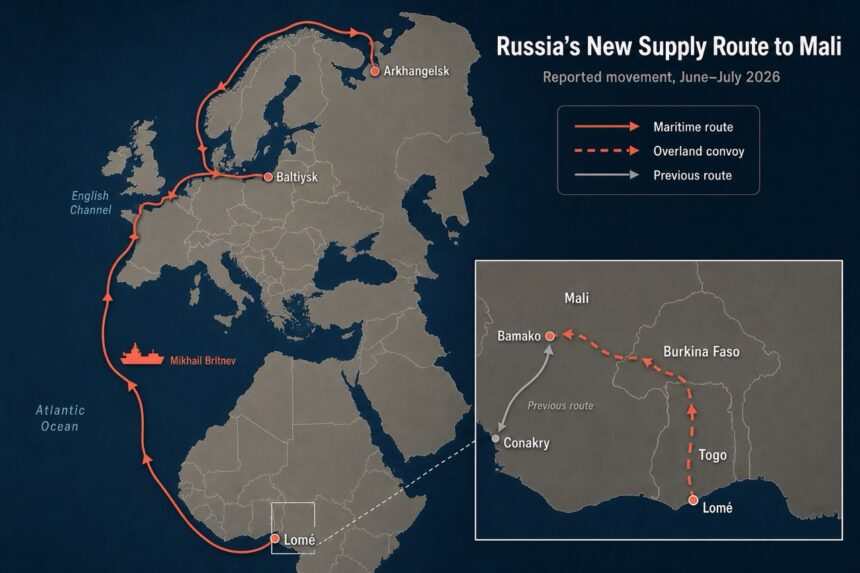
The reported journey of the sanctioned Russian cargo ship Mikhail Britnev from Arkhangelsk via Baltiysk to Lomé, followed by an overland military-equipment convoy through Togo and Burkina Faso to Bamako in July 2026. The previous Conakry–Bamako corridor is shown for comparison; routes are schematic where exact tracking was unavailable. Illustration: Conflict Alert.
A sanctioned Russian cargo vessel has delivered armored vehicles to Mali through Togo, demonstrating an alternative supply corridor for Moscow’s Africa Corps as Russian-backed forces face mounting pressure across the Sahel.
The Mikhail Britnev sailed from northern Russia, stopped at Baltiysk and reached Lomé on July 9 under escort from the Russian landing ship Aleksandr Shabalin, according to The Insider and regional reporting. Its cargo was subsequently transported roughly 1,800 kilometres through Togo and Burkina Faso toward Bamako — a longer corridor whose Burkina Faso leg is exposed to the expanding regional threat from JNIM. Reports that Guinea refused the vessel over sanctions have not been officially confirmed.
One voyage does not establish a permanent logistics route, but it shows Moscow can move heavy equipment through another West African coastal state when needed.
Separately, Bellingcat geolocated Shahed-136-type one-way attack drones used at Inafarak on July 12 and Talahandak on July 17. Their exact variant and supplier remain unconfirmed, and reports of similar drones in Mali date to May — meaning no evidence connects them to the Mikhail Britnev cargo.
Mali, Burkina Faso and Niger are meanwhile expanding the AES unified force toward 15,000 personnel, formalizing a security structure outside the ECOWAS and G5 Sahel frameworks from which the three states have withdrawn. Its legal status was approved on July 10.