The missile is again becoming an organizing weapon of conventional war. Ukraine and the Middle East have shown that states with modest air forces can impose military and economic costs at long range. Precision strike has turned into an industrial competition built around mixed salvos, production speed and the ability to replace what is fired.
Drones widened that competition rather than closing it. New companies are entering work once reserved for national design bureaus and established defence groups, while interceptor shortages now constrain even the United States.
New Producers Enter The Field
Lockheed Martin, RTX and MBDA — the established Western missile manufacturers — have long operated as private or partly private firms under state contracts, so missiles never really “went private” in the way the phrase implies. What changed is the market structure. Startups and firms using commercial components are moving into strike and air-defence work once closed to new entrants, while governments still authorize targets and control operations.
Entry is easier than mastery. A small team can iterate an airframe or its control software quickly. Scaling to reliable mass production runs into harder problems: specialized propulsion, seeker technology, inertial navigation components, and the testing and quality-control infrastructure needed to certify a weapon for combat use.
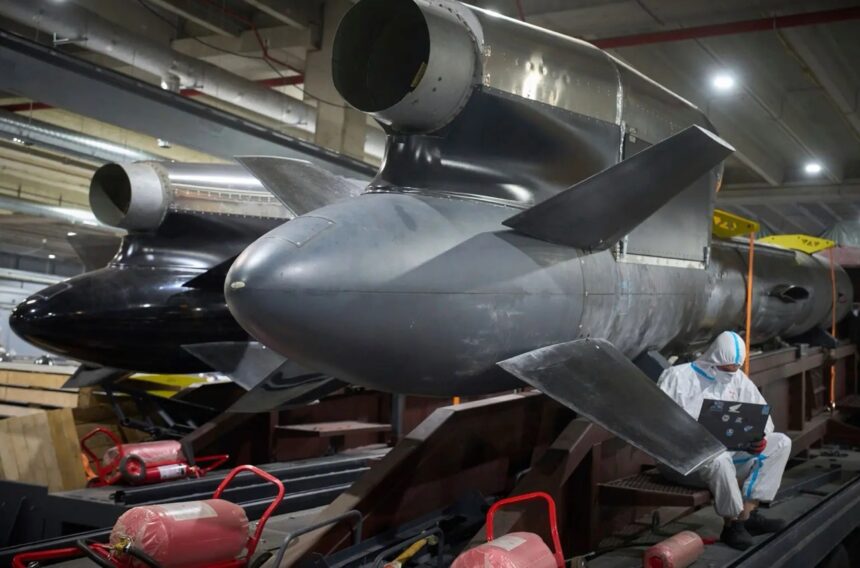
Ukraine has compressed this shift into wartime. Fire Point, a drone and missile maker founded after Russia’s 2022 invasion, produces thousands of long-range drones monthly and builds the FP-5 Flamingo cruise missile. Its FP-2 drone struck an oil refinery in Russia’s Tyumen region in June, part of a campaign that has hit at least 28 Russian refineries that month alone, according to the Institute for the Study of War, disrupting fuel output and forcing Moscow to restrict domestic sales. The same company has tested a developmental FP-7.X manoeuvring vehicle, Reuters reported, and co-owner Denys Shtilerman has said a longer-range FP-9 could be tested against a target near Moscow this year — a conditional company forecast, not a demonstrated combat capability. Fire Point remains a fraction of Lockheed Martin’s scale, supply chains and verified output.
The trend runs wider. Rheinmetall, Germany’s largest defence manufacturer, has formed a joint venture with the European startup Destinus, which says it has built production capacity exceeding 2,000 cruise missiles annually. The Pentagon has reached framework agreements with four defense-tech firms — Anduril, CoAspire, Leidos and Zone 5 — for more than 10,000 lower-cost cruise missiles. These designs generally prioritize producibility and volume over unit sophistication; the specific trade-offs in guidance precision or jamming resistance vary by program.
Drones Widen The Salvo
One-way attack drones now perform missions that once required cruise missiles: forcing air-defence activation and striking fixed infrastructure far behind the front, as Fire Point’s refinery campaign shows. Ballistic missiles keep an edge against time-sensitive, hardened or heavily defended targets, thanks to their speed and terminal energy. Each weapon type does something the other struggles to do well.
Russia illustrates the pattern most nights with drone waves alone, then periodically layers in cruise and ballistic missiles during combined attacks that exploit the gaps drones have opened. A Ukrainian General Staff officer estimated in June that Russia was producing 60–70 Iskander missiles and 40–50 Kh-101 cruise missiles per month, a figure that cannot be independently audited but tracks with observed launch rates showing sanctions have raised costs without stopping production.
North Korea has supplied complete short-range ballistic missiles to Russia. Chinese firms have not been shown shipping complete missiles, but they supply dual-use electronics and industrial inputs that keep Russian lines running, according to the Ukraine Air War Monitor, which tracks Russian strike patterns and sourcing.
Ukraine has built a private counter-drone industry to match. The Brave1 defence-technology cluster, a government-backed innovation hub, counted more than 100 interceptor-drone developers in June. SkyFall unveiled the P1-SUN “Jetkiller,” a faster interceptor built to catch jet-powered Shahed attack drones; Reuters reported it has downed jet-powered variants in combat trials the outlet could not independently verify.
Interceptors Guard The Magazine
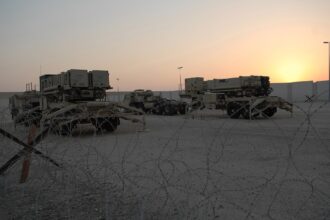
These interceptor drones cost roughly $1,000 to $10,000 each, against $4 million or more for a Patriot interceptor. Their job is to protect the air-defence magazine as a whole: Ukraine does not routinely spend Patriot interceptors on Shaheds in the first place, and cheap interceptors keep it that way, clearing drones out before scarcer, costlier systems are needed for the missiles that follow.
Fire Point is now trying to build the missile-defence layer directly, through a project called Freyja: a proposed European ballistic-missile shield built around its FP-7.X interceptor, paired with radar and command systems from partners including Germany’s Hensoldt, France’s Thales and Norway’s Kongsberg. Nine countries — Sweden, Germany, Denmark, France, Italy, the Netherlands, Norway, Spain and the U.K. — have backed the project alongside Ukraine, aiming for roughly $700,000 per intercept against several million dollars for Patriot. A successful flight test is one milestone toward that; radar, battle management, guidance and interceptor still have to work together as a certified system, and Patriot remains Ukraine’s only proven defence against Russian ballistic missiles today.
The shortage behind that caution is already strategic. CSIS estimates that fighting with Iran left the United States with fewer than 1,000 Patriot interceptors and roughly 250 THAAD interceptors. Production is expanding, but factories and qualified supplier networks take years to build.
Satellites Enable The Threat
Russia has now fired the Oreshnik — an intermediate-range ballistic missile derived from the RS-26 intercontinental design, according to the Pentagon — three times at Ukraine: at Dnipro in November 2024, at Lviv in early 2026, and at Bila Tserkva on May 24, 2026, where it destroyed three civilian garages. Each strike was examined on the ground and confirmed internationally, including by Ukrainian investigators working the debris. All three carried no nuclear warhead.
At the St. Petersburg International Economic Forum on June 4, Putin said Russia has had no need to use nuclear weapons in Ukraine and hopes it never will, according to multiple outlets. In the same remarks he said the Oreshnik strikes so far had been tests, conducted “where it was convenient to observe the results” — and that he was not ruling out the weapon’s “full-format use,” including against targets in populated areas. The logic he described is explicit: a conventional missile that can carry a nuclear warhead lets Moscow threaten nuclear-scale destruction without actually using a nuclear weapon, since its trajectory alone does not reveal what it is carrying until impact.
None of this industrial shift happened in isolation. Commercial satellite navigation and communications, above all the ubiquity of GPS and Starlink-class connectivity, gave cheap drones and cut-rate cruise missiles the precision that used to require a dedicated national guidance program. Russian strike drones have flown with embedded Starlink terminals to dodge jamming, according to Ukrainian military intelligence data reported by Euromaidan Press; Ukraine’s own long-range drones rely on the same category of commercial satellite links. The infrastructure that lets people navigate their cars and stream video from a battlefield is the same infrastructure making precision strike cheap enough for startups to build.
That is the trend worth sitting with. As missiles and strike drones get cheaper and more accurate, the barrier to launching a serious strike campaign keeps falling, and the number of states and companies capable of clearing it keeps rising. A future war fought primarily with mixed drone-and-missile salvos is not a hypothetical; it is closer to Ukraine’s daily reality now than it was three years ago. The cheaper and more available these weapons become, the harder it gets to keep any single confrontation contained.