Spain sent troops and hundreds of additional police officers to Ceuta after thousands of people crossed into the North African enclave from Morocco, overwhelming border authorities and turning a week-long surge in arrivals into a major security and humanitarian crisis.
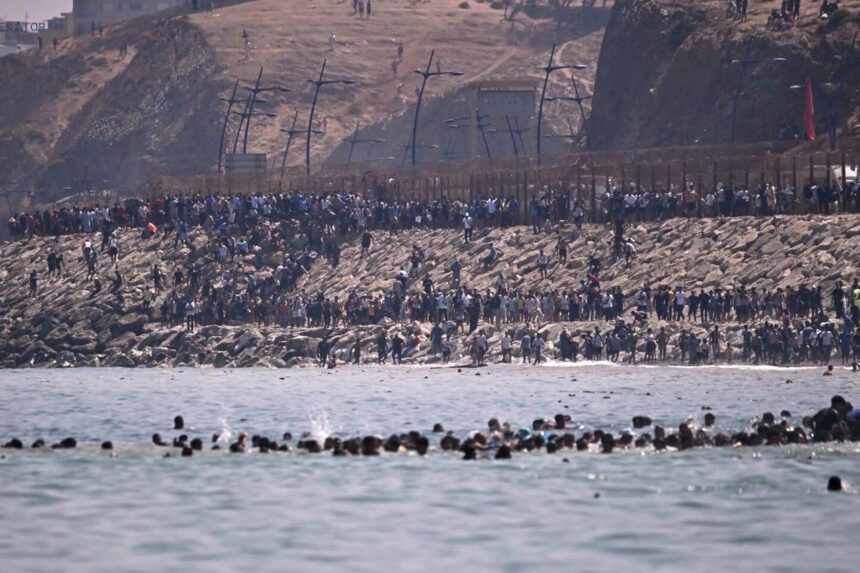
The government dispatched 60 troops and 200 additional police to reinforce security after people entered by land and sea, according to Reuters. The armed forces were deployed to support the Civil Guard in maintaining security in Ceuta. Video from the enclave showed people swimming around coastal barriers, using inner tubes and pushing through border gates.
Spanish broadcaster TVE estimated that between 2,000 and 3,000 people entered Ceuta on Thursday, although the figure was not immediately independently confirmed. The Associated Press reported Friday that at least 18 people had died attempting to reach the enclave, doubling an earlier reported toll of nine.
The mass crossing followed days of mounting pressure. More than 1,500 people had already reached Ceuta by swimming from Morocco over the previous week, overwhelming reception facilities and leaving some arrivals sleeping outside.
The geography of Ceuta makes the crisis unusually difficult to contain. A fortified land perimeter separates the enclave from Morocco, but many of the recent arrivals have attempted to bypass border infrastructure by swimming around coastal barriers. The route has repeatedly proved dangerous, particularly when large numbers enter the water at the same time.
Ceuta and Melilla farther east are Spain’s two territories on the North African coast and form the European Union’s only land borders with Africa. Migration pressure there has therefore repeatedly become both a humanitarian challenge and a politically sensitive issue between Madrid and Rabat.
The scale of the latest influx inevitably recalls May 2021, when around 8,000 people entered Ceuta over roughly two days after Moroccan border controls were relaxed during a diplomatic confrontation with Spain.
This time, the circumstances are different. Moroccan security forces have been trying to prevent crossings and reinforce the border as thousands more people gathered around the nearby town of Fnideq. Reuters reported that Moroccan forces used water cannons and pushed crowds back from crossing points. Spanish officials have also emphasized cooperation with Rabat. There is no confirmed evidence that Morocco facilitated the latest influx.
What triggered the surge remains unclear. One possible factor under scrutiny is a Spanish Supreme Court ruling issued on July 8 that limited the use of immediate border returns for people intercepted while trying to reach Ceuta and Melilla by swimming.
The court held that the special provision allowing immediate rejection at the border applies to people attempting to cross physical containment structures such as border fences, but not automatically to migrants intercepted at sea. The ruling followed the case of an Algerian man who had been returned to Morocco after being intercepted while swimming toward Ceuta.
Some officials and government critics have suggested the decision may have encouraged attempts to reach the enclave by sea. But the connection has not been established. El País reported before Thursday’s mass crossing that migration specialists questioned whether the ruling explained the increase, noting that swimming attempts regularly rise when summer conditions make the route easier.
The crisis also comes as Spain pursues a broader migration policy centered on legal status and integration. Prime Minister Pedro Sánchez’s government launched a €500 million Integration and Citizenship Plan in June that includes regularization, legal migration channels, employment measures and additional support for public services. Sánchez has argued that expanded legal migration and integration can coexist with stronger control of irregular arrivals.
For Ceuta, however, the immediate challenge is at the border. Thousands more people gathered around Fnideq overnight into Friday despite reinforced Moroccan security, with some trying to reach Ceuta through mountain routes or by sea.
The military deployment gives Spanish authorities additional capacity to restore control, but it does not resolve the conditions driving people toward the enclave or the legal and logistical consequences once they arrive. Ceuta has endured migration surges before. The speed of this one has again shown how quickly pressure on a small Spanish territory can become a security challenge for Madrid and a crisis on the European Union’s southern frontier.