The thesis works with two qualifications: the Gulf is not completely sealed because the UAE retains its Fujairah outlet, and American energy companies may benefit while the United States as a whole absorbs higher prices and military costs.
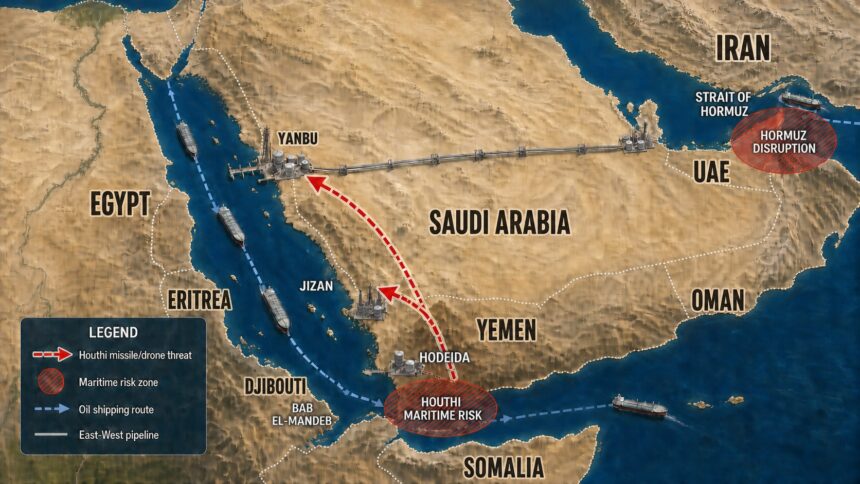
The Houthi missile and drone attack claimed against Saudi Aramco facilities in Jizan and Yanbu on July 25 did more than reopen the Saudi-Yemeni front. It placed Saudi Arabia’s principal escape route from the Strait of Hormuz under threat as Iran again restricts the Gulf’s only maritime exit.
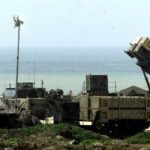
Reuters verified smoke near the Jizan refinery, although its cause and any damage remain unclear. Greek officials said a Patriot battery intercepted two missiles near Yanbu. The attack did not close Saudi exports. It showed how one regional war has joined two previously separate chokepoint crises.
The bypass becomes a target
Under normal conditions, around 20 million barrels a day of crude and petroleum products – roughly one-fifth of global consumption – pass through Hormuz. More than 20% of global LNG trade also uses the strait, primarily exports from Qatar. Iran’s effective closure after the US-Israeli air war began on February 28 forced Gulf producers to cut output and made alternative routes essential.
Saudi Arabia responded by restoring its East-West Pipeline to about 7 million barrels a day. The line carries crude from Abqaiq to Yanbu, which has exported more than 4.5 million barrels a day since April. Around 70% went to Asia, and therefore normally sailed south through Bab el-Mandeb.
The Houthis have declared a blockade, attacked Saudi-linked tankers and now targeted two hubs of the kingdom’s Red Sea energy system. They have not closed Bab el-Mandeb: Lloyd’s List counted 33 transits on July 21, within the recent range. But a blockade need not be airtight. Missile risk, insurance costs and diversions can reduce capacity before a terminal is disabled.
Iranian alignment does not prove Tehran ordered the July 25 attack. Strategically, however, the effects complement each other: Iran pressures Hormuz while the Houthis threaten the route built to escape that pressure.
Few Routes Around Hormuz
The Gulf is not literally sealed. The UAE’s Habshan-Fujairah pipeline reaches the Gulf of Oman without crossing Hormuz and does not depend on the Red Sea. Saudi cargoes at Yanbu can sail north toward Suez and Europe, while some vessels could accept extreme diversions. Strategic stocks offer temporary relief.
But the alternatives are insufficient. Earlier in 2026, the International Energy Agency estimated that Saudi and Emirati pipelines offered 3.5 million to 5.5 million barrels a day of spare bypass capacity; much of the Saudi margin has since been put to use. Iran, Iraq, Kuwait, Qatar and Bahrain depend on Hormuz for most exports. Qatar has no alternative maritime outlet for LNG.
The danger is therefore not the simultaneous hermetic closure of two straits. It is Hormuz remaining heavily constrained while Yanbu, its largest practical substitute, becomes unreliable. A system designed around one chokepoint and one bypass becomes a system with two targets.
Russia Gains More Than The US
Iran gains coercive leverage, although at the price of its own exports and the risk of further US attacks. The Houthis can raise the cost of Saudi operations in Yemen without defeating Riyadh militarily.
Russia is the clearest external beneficiary. Higher benchmark prices increase Kremlin revenue, while scarcity gives Asian refiners stronger reasons to buy Russian crude. The Hormuz disruption has already narrowed discounts on Urals oil. Moscow has deepened its strategic relationship with Iran and maintains contacts with the Houthis, but there is no public evidence that it directed these attacks. Financial benefit is not proof of operational control.
American producers also gain. US crude exports reached a record 5.6 million barrels a day in May as refiners replaced missing Gulf supplies, and Donald Trump has promoted US oil as an alternative. Yet the United States is not necessarily a net winner. Motorists face higher fuel prices, inflation spreads through freight and food, and prolonged scarcity risks recession that would eventually destroy oil demand.
What began as a US-Israeli air war has become a threat to the architecture of global energy trade. Gulf exporters are not yet locked in, but the assumption that Hormuz can be bypassed safely is breaking down. Sustained attacks on Yanbu and Bab el-Mandeb would leave the world facing not one oil chokepoint, but an interlocking geography of coercion.