Farnborough International Airshow 2026 may be remembered less for any single aircraft order than for the moment uncrewed systems stopped looking like a specialist annex to aviation. Across the exhibition halls, drones appeared as interceptors, bombers, logistics aircraft, weapons carriers and autonomous partners for crewed fighters.
This was not the disappearance of piloted flight. It was the normalization of mixed fleets in which crewed aircraft provide command, sensors and complex decision-making while uncrewed systems add range, mass and acceptable risk. The same week made clear, however, that “mixed fleet” means different things depending on whether the crewed half of the equation is working.
Commercial Aircraft Still Paid the Bills
Traditional aerospace business remained enormous. Britain’s ADS Group calculated that £62.9 billion in business was announced during the four trade days, including 353 firm aircraft orders, 904 engines and 10 helicopters. The largest transaction came from SMBC Aviation Capital, which ordered 100 Airbus A320neo-family aircraft and 100 Boeing 737 MAX jets. Philippine Airlines ordered 15 Boeing 787-10s, Riyadh Air added 28 787s, and Azorra ordered 20 Embraer passenger-to-freighter conversions. Uncrewed aviation is entering the industry’s mainstream without displacing its established commercial core.
The Economics Behind the Drone Wingman
The most consequential displays were aircraft-sized autonomous systems designed to operate inside conventional air forces, and much of the investment behind them traces to a cost argument. An F-35A costs more than $80 million, while former Air Force Secretary Frank Kendall estimated a Collaborative Combat Aircraft (CCA) – an autonomous drone designed to fly alongside crewed fighters – at approximately $25 million to $30 million. CSIS has documented that hitting that figure required the Air Force to re-engineer cost models around weight and commercial manufacturing rather than traditional fighter pricing – the premise being platforms capable of adding combat mass at substantially lower cost than crewed fighters.
BAE Systems unveiled Brontanax, a company-funded CCA roughly the size of a Hawk trainer; Anduril and Archer presented Thunder, an autonomous attack rotorcraft; and TEKEVER showed its AR6 heavy-lift family, alongside Boeing’s MQ-28 Ghost Bat, Anduril’s Fury and General Atomics’ CCA entrant. Several remain in development – Brontanax and Thunder are expected to fly in 2027 – and manufacturers’ performance claims have not necessarily been independently demonstrated. The field was also unusually diverse for an industry historically dominated by a few prime contractors, with General Atomics and MBDA exploring SPEAR missile integration on the MQ-9B and Gambit 6, and Embraer and Anduril signing a memorandum covering Barracuda cruise missiles carried by the C-390.
Lockheed Martin also unveiled MORFIUS X-Rotor, a reusable microwave system it says can disable more than 50 drones per flight at a “significantly low cost per kill.” Lockheed has not published independent test results or cost-per-kill data supporting that claim. Drones are creating both a new aviation market and the market for defeating it.
Two Speeds: Drones Sprint, Crewed Fighters Stall
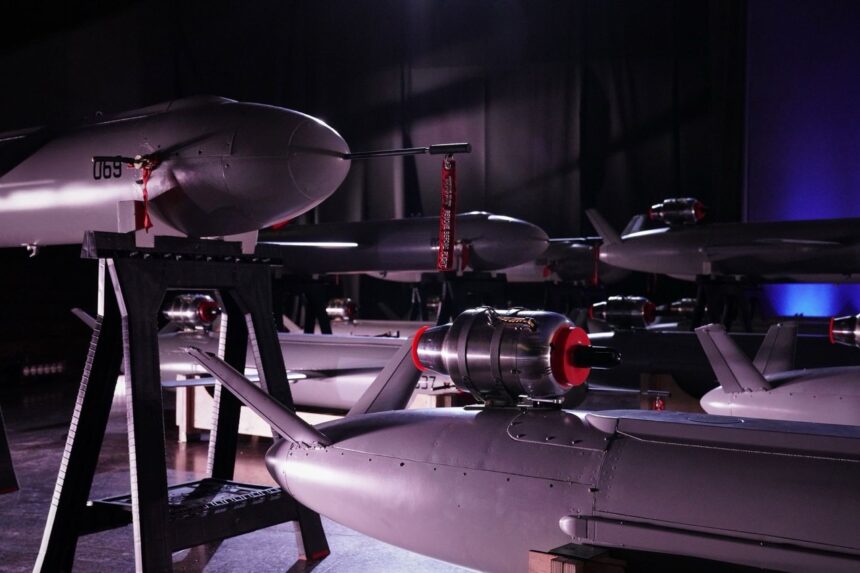
Ukraine brought a different advantage to Farnborough: products shaped by continuous contact with a changing battlefield. SkyFall presented its P1-SUN Jetkiller, a faster interceptor built in response to Russia’s jet-powered Shahed-type drones. The company told Reuters that development began about three months earlier and that Jetkiller had already intercepted more than a dozen targets — figures Reuters could not independently verify, though the timetable illustrates Ukraine’s compressed cycle: identify a threat, modify a design, test it operationally, return the results to production.
The state-owned Ukrainian Defense Industry displayed the Liutyi, Peklo and Palianytsia systems; a version of Liutyi shown carrying four missiles used display models, not evidence of an operational configuration. Airlogix signed an industrial memorandum with Czech manufacturer PBS on small turbine engines and licensed production in Ukraine. Reuters reporting, citing Norwegian Defence University College researcher Fabian Hoffmann and Ukrainian Council of Defence Industry chief operating officer Maria Popova, has identified mini-turbojet engines as a major bottleneck constraining Ukraine’s deep-strike drone output, alongside shortages of materials and broader manufacturing capacity. The public record shows no major Farnborough purchase orders for Ukrainian drones; their gains here are visibility and industrial partnerships, not confirmed sales.
Europe’s crewed-fighter sector told a slower, more fractured story. Germany formally ended cooperation on the Future Combat Air System (FCAS), the Franco-German-Spanish sixth-generation fighter project, in June, after years of disputes between Dassault and Airbus over design leadership. At Farnborough, German industry was left searching for new partners, while the surviving European program, the UK-Italy-Japan Global Combat Air Programme (GCAP), branded Tempest, showcased its Edgewing joint venture and Excalibur testbed, with Canada joining as an observer nation. GCAP is not expected to enter service before 2035. Its own hardware underlines the gap it is trying to close: the Tempest prototype will initially fly on borrowed Eurofighter engines, and the Brontanax CCA testbed will use a U.S.-designed Williams International turbofan. Germany, meanwhile, is reportedly considering doubling its F-35 order to as many as 70 jets – deepening, rather than reducing, its reliance on American aircraft while Europe’s own next-generation options remain years away.
Combat use can shorten the distance between a manufacturer and a customer because it produces operational data a demonstration flight cannot. It does not eliminate requirements for certification, secure supply chains, interoperability and long-term maintenance — and multinational industrial cooperation, as FCAS showed, does not automatically survive contact with competing national interests either.
The airshow did not announce the death of the crewed aircraft. It showed a future fleet that will be mixed, distributed and increasingly software-defined – built by an uncrewed sector moving in months rather than years, alongside a crewed-fighter sector, at least in continental Europe, still negotiating who is in charge.