More for Ukraine, more for themselves
Western leaders gathering in Paris on Monday are trying to secure more air-defence systems for Ukraine. The shortage they face, however, is not simply one of missiles or launchers. It reflects a defence-industrial model built for decades of peacetime efficiency rather than sustained high-intensity war. Russian missile attacks have exposed a structural weakness that Europe can no longer solve through emergency transfers alone.
The immediate task facing the Coalition of the Willing is to protect Ukrainian cities from an intensifying mix of ballistic missiles, cruise missiles and long-range drones. The longer-term consequence is far more significant. Ukraine’s defence is pushing European governments toward something they have debated for years but never fully built: a continent-wide approach to air and missile defence that links procurement, industrial production, operational experience and battlefield innovation into a more coherent system.
Europe does not yet possess such a system. National militaries continue to operate different interceptors, radars and command networks, while high-end ballistic-missile defence remains heavily dependent on American technology. But the direction of travel has become increasingly clear. Rather than treating Ukraine as a temporary recipient of military aid, European governments are beginning to view it as a partner in reshaping the continent’s defence architecture.
Air campaign shift
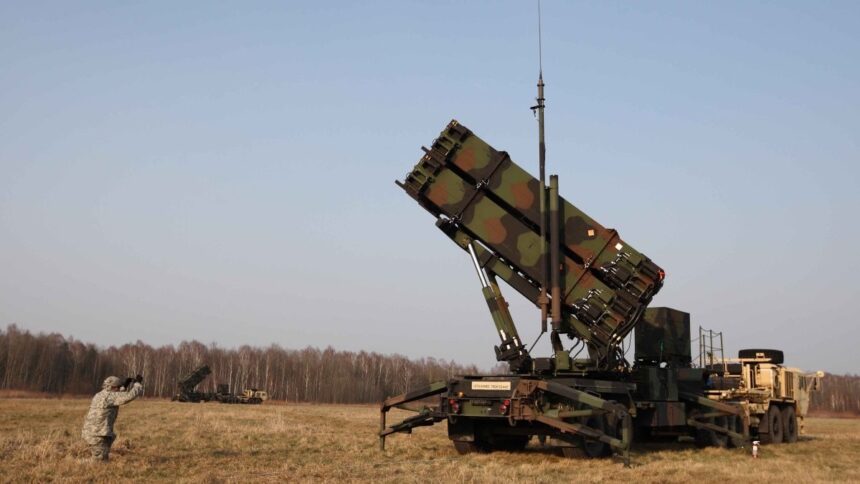
According to Reuters, the Paris discussions focus on securing additional Patriot interceptors, expanding the Franco-Italian SAMP/T programme and exploring ways to integrate Ukrainian industry into future production. The meeting builds on commitments made at NATO’s Ankara summit, where allies shifted their attention from short-term weapons deliveries toward long-term industrial capacity and production resilience.
That shift reflects the character of Russia’s air campaign. Ukraine has become increasingly effective at defeating Shahed-type drones through electronic warfare, mobile fire groups and low-cost interceptor drones. Ballistic missiles remain a different challenge altogether. Their speed compresses decision-making, leaves little warning time and demands sophisticated interceptors that Europe can neither manufacture nor replenish quickly enough.
The shortage has exposed a deeper weakness inside Europe’s defence industry. For much of the war, Western governments treated air defence as a logistics problem: identify an available Patriot battery, persuade a country to transfer part of its inventory and replace those missiles later. That approach saved lives but also revealed how little surge capacity actually existed.
As the Center for Strategic and International Studies has argued, Europe’s procurement system still lacks mechanisms capable of giving manufacturers the long-term certainty needed to expand production. Missile producers remain reluctant to invest hundreds of millions of euros in new facilities without guaranteed multi-year contracts backed by governments. The result is that factories continue operating largely at peacetime output while Ukraine consumes interceptors at wartime rates.
It is action time!
European institutions are beginning to respond. The European Union’s €150 billion SAFE facility extends financing to joint defence procurement, including projects involving Ukraine, while the European Defence Industry Programme seeks to expand production of air-defence systems, ammunition and counter-drone technologies. These initiatives stop short of creating a fully centralised procurement system, but they represent Europe’s first serious attempt to convert political commitments into sustained industrial capacity rather than repeated transfers from national stockpiles.
NATO is moving along a similar path. The Ankara summit placed defence production alongside military readiness as a central pillar of deterrence, recognising that industrial resilience has become as strategically important as the weapons themselves. Modern deterrence depends not only on possessing advanced systems but on replacing missiles, radars and launchers as quickly as they are consumed.
Ukraine occupies a unique position in this transformation because it contributes more than battlefield demand. It has become the only European country confronting the full spectrum of Russian aerial warfare every day, generating operational knowledge unavailable anywhere else on the continent.
Just as important is the speed at which Ukrainian engineers adapt. One example is the country’s expanding acoustic sensor network integrated with the Delta battlefield-awareness system. Built from inexpensive commercial components and refined through constant battlefield feedback, the network allows mobile fire teams to detect incoming drones rapidly and at minimal cost. More significant than the technology itself is the development cycle behind it. The speed of Ukraine’s battlefield innovation has attracted growing interest among allied militaries seeking cheaper and more adaptable approaches to air defence.
Collective control
Yet battlefield innovation alone will not solve Europe’s air-defence problem. The greatest obstacle may lie in command and control rather than hardware. Patriot, SAMP/T and other systems still operate through largely separate national architectures. While NATO has improved interoperability, a genuinely integrated air-defence network would require governments to share real-time sensor data, coordinate engagement decisions and, ultimately, surrender a degree of sovereign control over the use of strategic weapons. Most European capitals are not yet prepared to take that step.
This means Europe’s challenge is no longer simply producing more interceptors. It must also build the digital infrastructure, command arrangements and political trust needed for those systems to function collectively during a major crisis. Without that integration, a larger inventory of missiles will still operate as a collection of national shields rather than a coherent continental defence.
There is another risk. Long-term industrial programmes can obscure Ukraine’s immediate needs. New production lines announced today will take years to reach full capacity, while Russian missile strikes continue every week. Kyiv still requires additional launchers, interceptors and spare parts now, even as Europe attempts to redesign its defence-industrial base.
The strongest outcome from Paris would therefore combine both timelines: urgent military assistance for Ukraine alongside binding industrial commitments capable of sustaining European production well beyond the current war.