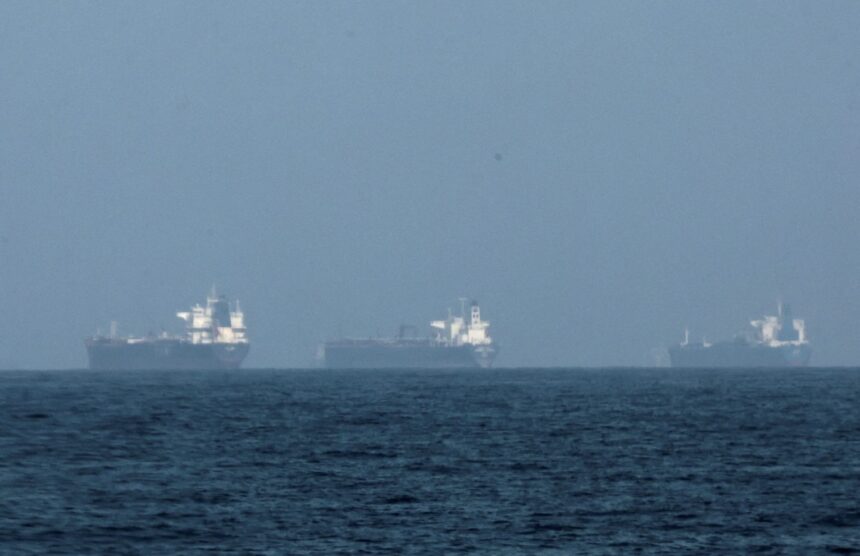
Commercial traffic through the Strait of Hormuz fell to just three commodity vessels on Tuesday, down from four the previous day, according to shipping data cited by Reuters. No very large crude carriers or liquefied natural gas (LNG) carriers were observed making the transit.
The decline is not primarily a story of cautious captains. It is a story of insurance math. War-risk premiums for Gulf transits have surged to between 3% and 10% of a vessel’s hull value, up from roughly 0.25% before the war, after the Joint War Committee of the Lloyd’s Market Association expanded its high-risk designation across the Persian Gulf. For a $100 million tanker, that turns a single transit into a $3 million-to-$10 million bet – an expense many owners and charterers are unwilling to absorb, regardless of naval escorts. Iran does not necessarily have to sink ships to cripple traffic through Hormuz. Keeping the perceived risk high enough for insurers and shipowners to reconsider Gulf transits may itself reduce commercial activity.
CENTCOM said it has facilitated roughly 900 vessel transits and 450 million barrels of crude through the strait since early May. Based on those figures, the flow averages fewer than six million barrels of oil a day and roughly 11 vessels daily – well below the estimated pre-war throughput of about 20 million barrels per day and 125 to 140 vessel transits. Convoy-style escorts also slow traffic by requiring ships to assemble before transit and maintain coordinated speeds through the waterway. The statistics CENTCOM cites as evidence that Hormuz remains open also illustrate how dramatically commercial traffic has slowed since the conflict began.
The pressure is no longer confined to Hormuz. On July 20, Houthi forces in Yemen declared a naval blockade of Saudi Arabia, threatening shipping through the Bab al-Mandeb Strait at the southern entrance to the Red Sea, the Council on Foreign Relations reported. At least seven tankers have already turned back from the Red Sea, Forbes reported. Meanwhile, Iran reportedly instructed the Houthis to prepare to close Bab al-Mandeb if U.S. strikes targeted Iran’s power grid, according to sources cited by the Foundation for Defense of Democracies. Saudi Arabia has relied on its east-west pipeline to move Gulf crude to the Red Sea port of Yanbu, but simultaneous disruption at Bab al-Mandeb would sharply reduce the value of that alternative route.
Roughly one-fifth of the world’s oil consumption normally passes through the Strait of Hormuz. With both Hormuz and Bab al-Mandeb under pressure, the disruption is no longer measured only by how many ships transit each day. It is measured by how few viable routes remain for moving Gulf energy to global markets.