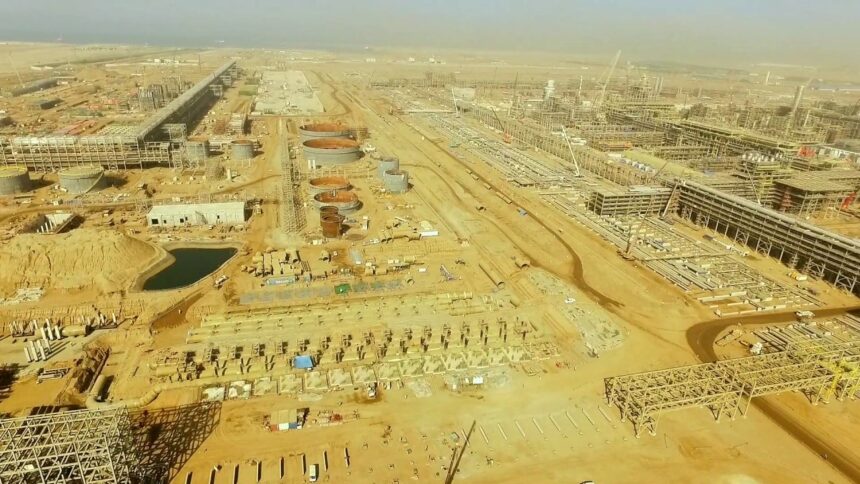
Yemen’s Houthi movement said it struck a Saudi Aramco oil facility in Jizan overnight with missiles and drones, claiming the attack sparked fires at the site. Satellite fire-detection data later showed multiple thermal hotspots within the industrial complex, although Saudi authorities and Aramco had not confirmed the extent of any damage.
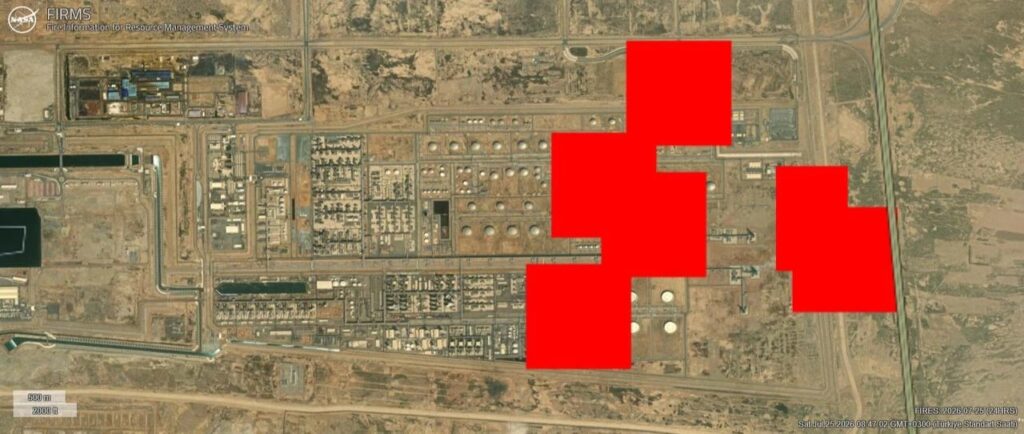
Saudi authorities had not publicly confirmed that the Aramco facility was struck at the time of publication, and Aramco had not commented. NASA’s FIRMS/VIIRS satellite monitoring system detected fire activity at the Jizan site, according to reporting by the Türkiye Today, which cited the imagery alongside social-media video showing plumes of black smoke over the complex. The satellite detections confirm that fires were present within the industrial complex. They do not establish what caused them or whether they resulted from the attack claimed by the Houthis.
Türkiye Today also reported that Saudi Civil Defense briefly issued public safety warnings for parts of Jizan province before later lifting them. Those reports have not been independently confirmed.
The reported strike came hours after the Saudi-led coalition announced what it called a “proportionate military response” against Houthi targets in Yemen’s Hodeidah governorate. Coalition spokesman Maj. Gen. Turki al-Malki said the strikes targeted “legitimate military targets that the terrorist Houthi militia uses to threaten commercial vessels in the Red Sea,” in a statement carried by the Saudi Press Agency. Al-Malki said Hodeidah Port, Ras Isa and Salif remained open to commercial shipping. A Yemeni security source told AFP the targets included a naval base in Hodeidah and a military camp on Kamaran Island, while Houthi media reported two people wounded and a telecommunications building hit.
The Houthis have framed their operations as retaliation for the coalition campaign and warned of further attacks if strikes on Yemen continue. Earlier this week, the group declared a naval blockade of Saudi Arabia and claimed missile and drone strikes on two Saudi-flagged oil tankers operating near Jizan. Saudi authorities confirmed that the Encelia was hit and caught fire, although its crew was evacuated safely and no oil spill was reported. A second claimed strike on the tanker Layla has not been independently confirmed.
Until now, Houthi operations during the current escalation had focused primarily on commercial shipping, naval targets and oil tankers rather than fixed onshore infrastructure. If confirmed, a strike on the Jizan energy complex would extend that campaign inland, demonstrating that Saudi energy facilities have joined shipping lanes as potential targets.
The geography matters. Saudi Arabia’s oil-export system has historically centered on Eastern Province facilities such as Abqaiq, but Iran’s pressure on the Strait of Hormuz has pushed Riyadh to rely more heavily on its Red Sea export corridor through Yanbu. According to Kpler shipping data cited by AFP, the Yanbu route carried 92 percent of Saudi seaborne crude exports in June and 78 percent so far in July. Jizan, located roughly 700 kilometers south of Yanbu on the Red Sea coast, forms part of that broader western energy network. Unlike Abqaiq, which processes a substantial share of Saudi crude production, Jizan primarily serves as a refining and export hub. Any confirmed disruption would therefore be more significant regionally than globally unless operations proved to be severely affected.
Riyadh’s public response has so far been notably restrained. Saudi authorities quickly lifted the precautionary warnings, while neither the government nor Aramco has disclosed the extent of any damage. Saudi Arabia has often limited public disclosure following attacks on critical energy infrastructure, including after the 2019 Abqaiq strike. Whether the current restraint reflects ongoing damage assessment, crisis management or broader efforts to avoid further escalation remains unclear.