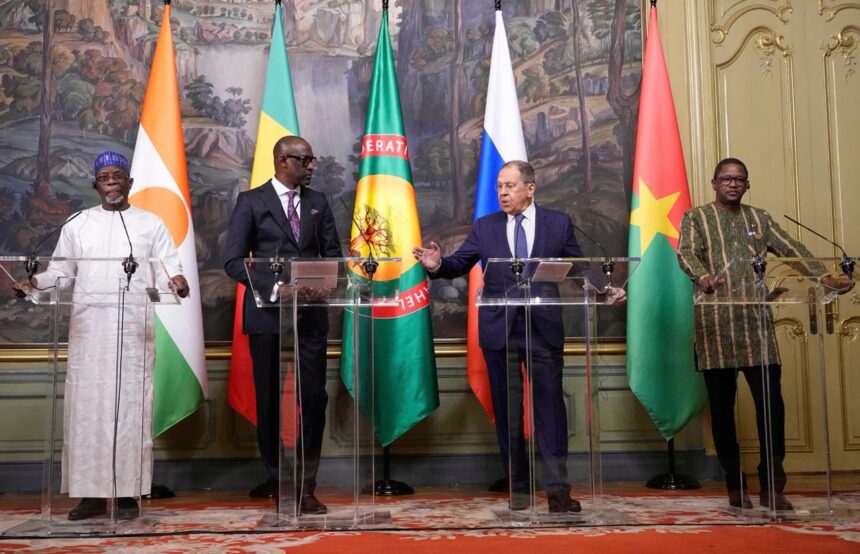
Russian Foreign Minister Sergei Lavrov arrived in Niger this week promising deeper military cooperation with Mali, Niger and Burkina Faso, the three military governments that make up the Alliance of Sahel States, or AES. The timing tells its own story. Moscow’s closest partners in the region are under pressure, and in Mali especially, Russian-backed forces are struggling to turn deeper military involvement into durable battlefield gains.
A reassurance mission, not a victory lap
The July 8 talks in Niamey were billed as another step in a growing partnership. In his opening remarks at the Russia-AES ministerial meeting, Lavrov praised closer cooperation with the three Sahel governments, while Moscow and the AES states committed themselves to strengthening military and military-technical ties.
Lavrov also accused Ukraine and France of colluding with what he called terrorist groups in the Sahel, a sweeping charge for which no credible public evidence has been produced. The accusation shifts attention from a harder fact: Russian forces are finding it difficult to reverse the deterioration facing their allies.
What looked officially like a diplomatic tour can also be read as a reassurance mission. Moscow was telling three friendly military governments that its support remained firm at precisely the moment when the security model built around those governments was coming under growing strain.
Anéfis exposes the limits of Russian firepower
The clearest test came in northern Mali. Around the strategic town of Anéfis, Malian troops and Russia’s Africa Corps came under sustained attack. Tuareg rebels said they had shot down a Russian-operated Mi-24 gunship, while a relief convoy of Russian and Malian fighters was repeatedly ambushed on the road from Gao.
Government forces eventually retook the town, but the cost was telling. One lost helicopter means little in a conventional war. Here, it points to a force stretched across huge distances, dependent on thin logistics and vulnerable to opponents who can choose where and when to strike.
It would also be wrong to treat the attackers as a single bloc. The Tuareg-led Azawad Liberation Front, or FLA, seeks self-rule, while the al-Qaeda-linked JNIM pursues a jihadist project fundamentally at odds with that goal. They are not the same movement and should not be presented as one. But their offensives increasingly place pressure on the same thin government lines at the same time. For Moscow and its allies, the strain is cumulative: different enemies, different agendas, but one overstretched defence.
The fighting does not stop at Mali’s frontiers. Niger and Burkina Faso sent support, including reported air cover at Anéfis. Algeria spent more than a year at odds with Bamako after its Defence Ministry said it had shot down an armed reconnaissance drone near the Malian border in early April 2025, saying the aircraft had violated Algerian airspace. Mali denied that account.
The result is a tangled conflict system, not the clean Russia-versus-terrorism story Moscow tells.
The sovereignty promise that isn’t holding
Russia replaced the Wagner mercenary network with the state-run Africa Corps after founder Yevgeny Prigozhin’s death in 2023. It gained greater control over the operation and inherited greater responsibility for the results.
Those results resist being called success. A year on, Russian personnel remain vital to Mali’s military government, yet insurgents continue to seize the initiative, attack bases and force Russian-backed units into costly defensive battles.
For Moscow, the payoff was never only military. The AES states offer diplomatic allies, strategic access and a lever against Western influence. For the juntas, Russia offers weapons and political backing without the human-rights and governance conditions often attached to Western partnerships.
That bargain can survive setbacks. What it cannot hide is the gap between promise and result. The pattern is coming into focus. The military governments of Mali, Niger and Burkina Faso turned sharply away from France and towards Moscow while promising sovereignty and security. Yet insurgents still set the tempo across large parts of the Sahel, Russian-backed columns are often fighting to hold ground rather than take it, and Moscow is being drawn ever deeper simply to keep its allies in the fight.
Russia is not delivering the victories it promises — in the Sahel no more than elsewhere.