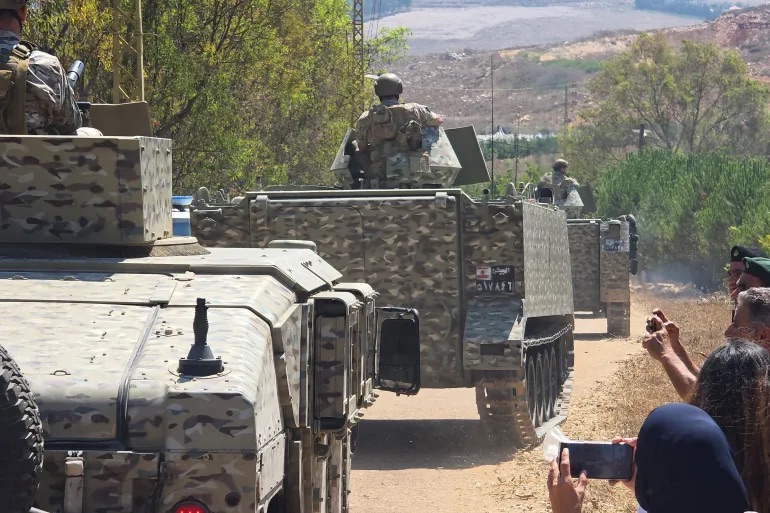
Lebanon’s most promising peace experiment in years began on Tuesday with a small, tangible act: Lebanese army units walked into Zawtar al-Gharbiyeh after Israeli forces pulled out of the southern village.
It was the first handover of ground under a US-brokered framework meant to replace both Israeli occupation and Hezbollah’s independent arsenal with the authority of the Lebanese state. As the US–Iran war spreads across Gulf bases and the Strait of Hormuz, that made Lebanon the source of something the region has almost stopped producing: a negotiated security deal actually changing who controls the ground.
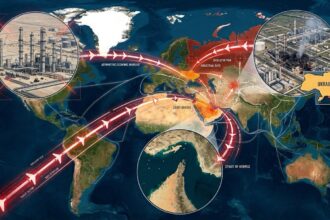
The contrast was stark. The same week, Yemen’s Iran-aligned Houthis declared a naval blockade on Saudi Arabia and warned shipping lines away from Saudi ports. Days earlier, Reuters reported that Tehran had told the Houthis to be ready to close the Bab al-Mandeb if US strikes hit Iran’s power grid. As Washington works to loosen Iran’s hold on Lebanon, Tehran’s network is showing elsewhere how quickly it can open another front.
A Handover Under Fire
The US State Department said operations had begun in three villages – Froun, Srifa and Zawtar al-Gharbiyeh – under a Trilateral Framework and a US-facilitated Military Coordination Group. Only Zawtar brought an immediate Israeli pullout; Lebanese troops were already in Froun and Srifa.
In an official statement, the Lebanese Army said its units had begun deploying in coordination with the group and told residents not to return until the area was secured. Specialists began clearing unexploded ordnance.
The village is barely livable. Its mayor told Reuters that more than half of it lay in ruins and questioned how civilians could return safely while Israeli troops remained minutes away in neighbouring Zawtar al-Sharqiyeh.
The answer came within hours. The Lebanese Army said Israeli forces opened fire in the vicinity of its units as they deployed, warning that the incident could obstruct the pilot programme. No casualties were reported.
The episode laid bare the design flaw: Israel can leave one village while holding positions close enough to menace the handover next door.
A Mechanism, Not Yet Peace
The deployment matters because the framework has moved from communiqué to execution: Israeli troops left, Lebanese forces entered, a joint body coordinated the transfer.
A pilot zone, though, is not a settlement. The framework ties each Israeli withdrawal to the Lebanese army taking full security control and stripping out non-state weapons – Hezbollah’s above all. It sets no firm date for a complete Israeli exit.
Israel’s concern is genuine: it does not want Hezbollah rebuilding military infrastructure behind a Lebanese deployment. But its sequencing is maximalist. Israeli forces still hold Lebanese ground, while withdrawal hangs on a disarmament process Beirut may not be able to deliver quickly.
That leaves Lebanon caught between conditions that pull against each other. The government must prove the army can keep Hezbollah out, yet it also needs visible Israeli withdrawals to show that diplomacy can restore sovereignty at all.
If Israel will not leave until Hezbollah disarms, and Hezbollah keeps its weapons as long as Israel occupies Lebanese territory, the framework could entrench the very deadlock it was built to break. Hezbollah has rejected the deal as a surrender; Israel treats the land it holds as leverage. More Israeli fire would weaken the army just as Washington asks it to take Hezbollah’s place.
Washington’s Strategic Wager
The United States is spending unusual political capital to prevent that. Lebanese President Joseph Aoun was due to meet US President Donald Trump later on Tuesday, becoming the first Lebanese head of state to visit the White House in nearly 20 years. The visit placed the process under direct presidential sponsorship.
Aoun was expected to present a written proposal to decommission Hezbollah’s arsenal while pressing Trump to use US leverage to secure an Israeli withdrawal.
The American bet runs deeper than the border. Washington wants a Lebanese state strong enough to decide when the country goes to war, control its own territory and eventually step out of the Israel-Iran confrontation altogether.
The pilot zones offer a formula that can be tested: Israel withdraws, the army moves in, weapons and military infrastructure are removed, and reconstruction gives communities a reason to back the state rather than Hezbollah.
Expanded, that formula would strike at Iran’s regional system. Hezbollah is Tehran’s most important military partner outside Iran, sustained by financing, logistics and weapons tied to the Islamic Revolutionary Guard Corps. The US Treasury has documented that funding, including money used to rebuild Hezbollah’s military infrastructure.
Trading Hezbollah’s military autonomy for Lebanese state control would pull a central pillar out from under Iran’s influence – and hand Washington a strategic victory while it confronts Tehran directly. It would also show that an Arab state can reclaim sovereignty from an Iran-backed armed organisation without another civil war.
None of that is assured. Hezbollah would have to accept the loss of its military power, Israel would have to trade occupation for verifiable security, and Washington would have to spend its leverage on both. The pilot zones do not prove peace is working. They prove a workable mechanism now exists – and that its first real test came within hours of the first handover.