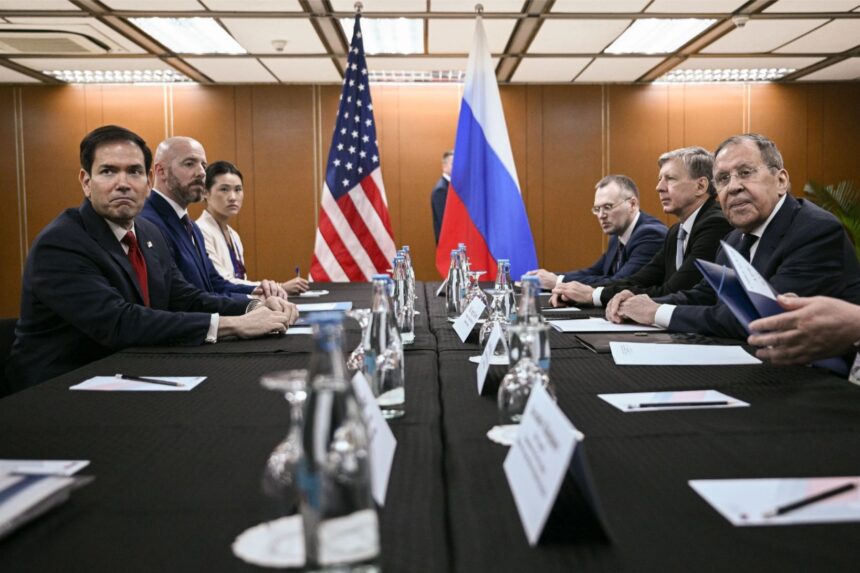
Thirty-five minutes in Manila settled nothing and clarified a great deal. When U.S. Secretary of State Marco Rubio met Russian Foreign Minister Sergey Lavrov on July 23 on the sidelines of the ASEAN Regional Forum, a leading Indo-Pacific security forum, the two produced no proposal, no timetable and no breakthrough. What the meeting delivered instead was a diagnosis: Washington and Moscow no longer share even a starting point for negotiations on Ukraine, and the formula the Kremlin has carried into every round of diplomacy since 2025 is visibly losing its purchase.
Manila’s Empty Half-Hour
International coverage converged on the same assessment: no breakthrough and little optimism, with German broadcaster ARD describing the atmosphere as “not overly optimistic”. Calling the meeting useless is accurate in operational terms. Yet it was useful diagnostically, because it exposed how far the two positions have drifted apart.
Lavrov again demanded an end to Western arms deliveries to Ukraine, accused Europe of seeking Russia’s “strategic defeat” and invoked supposed understandings reached by Donald Trump and Vladimir Putin at their August 2025 summit in Anchorage, Alaska. That summit has served Moscow as a diplomatic baseline from which every later conversation was meant to begin on Russian terms. Rubio declined the premise: Anchorage produced proposals, he has said, and no agreement – no joint document was ever published.
More significantly, Rubio said previous proposals were unacceptable to Ukraine when introduced and are probably “less acceptable” now. Peace, he concluded, would require “new suggestions and new ideas.” Moscow presented a position that would require diplomacy to validate its war aims. Washington answered that the old formula no longer works.
Kyiv Chooses Pressure
Ukraine’s military transition reinforces that message. By decrees published on July 22, President Volodymyr Zelensky appointed Major General Mykhailo Drapatyi as commander-in-chief of the Armed Forces, while Major General Ihor Skybiuk became chief of the General Staff. The reshuffle followed days of domestic protests and disputes over military reform. Drapatyi said he had been instructed to continue and intensify offensive operations, plan new actions in Russia’s rear and accelerate the military’s technological development.
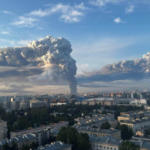
His mandate signals continuity and possible intensification of an existing campaign. Ukrainian drones and missiles have struck refineries, military factories, airfields and logistical infrastructure across Russia, producing fuel shortages and disrupting supply routes, according to Associated Press reporting. Zelensky has claimed the strikes forced Moscow to redistribute air-defense systems, a claim AP could not independently verify. Rubio himself acknowledged that Russia now faces deep strikes on its territory to an extent it was not experiencing late last year.
These operations cannot decide the war by themselves. They can, however, change the assumptions behind diplomacy. Russia’s military depth, industrial capacity and civilian economy are no longer insulated from the consequences of Putin’s decision to continue fighting.
The West Rebuilds Leverage
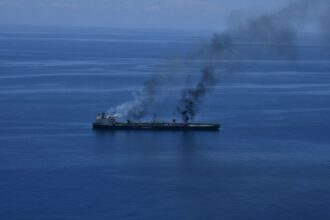
Europe supplied the economic component on the same day. All 27 EU governments approved the 21st sanctions package, targeting Russia’s banking system, energy income, military industry, sanctions-evasion networks and shadow fleet – the tanker network Moscow uses to move oil around Western restrictions. The package also paused the automatic adjustment of the oil-price cap until July 15, 2027, preventing a rise that would have benefited Moscow.
This was unity secured through compromise. Greece obtained a one-year exemption, with automatic renewal, allowing continued transport of Russian liquefied natural gas under contracts signed before the full-scale invasion of February 2022. Proposed visa restrictions on Russian combatants were reduced to a legal framework requiring a further decision before taking effect. The package demonstrates political cohesion more convincingly than maximal economic resolve.
A parallel instrument is moving through Washington. The Lindsey O. Graham Sanctioning Russia Act of 2026, named for the senator who championed it until his sudden death on July 11, has secured more than 60 Senate co-sponsors – enough, in principle, to overcome a filibuster. It would sanction senior Russian officials, financial institutions and the shadow fleet while directing tariffs of up to 100 percent against the five largest buyers of Russian oil and gas. The administration has blessed the revised text, and Axios reported that Trump demanded the inclusion of Iran-related provisions and said there was a “good chance” the bill would advance, with senators preparing for a possible vote as early as next week. The legislation is therefore potential leverage awaiting application – yet its bipartisan breadth contradicts Moscow’s expectation that time would gradually detach Washington from Kyiv.
A Harder Peace, Not a Nearer One
None of this proves that Trump has become unconditionally pro-Ukrainian. His policy remains transactional and reversible, American attention has repeatedly shifted toward Iran, and White House envoys Steve Witkoff and Jared Kushner have not visited Kyiv. Their July 22 call with Zelensky kept the channel open without producing a new negotiating round.
The observable change is narrower and more important. Washington no longer appears prepared to treat Moscow’s interpretation of Anchorage as the foundation for peace. Trump has praised Ukraine’s battlefield performance, permitted continued weapons transfers financed by NATO partners, accepted movement on congressional sanctions, and announced that the United States would grant Ukraine a license to manufacture Patriot interceptors, although implementation details remain unresolved. Rubio’s “new ideas” remark acknowledges that diplomacy must adjust to a changed military and political balance.
Western unity should not be exaggerated, since Europe diluted its sanctions and the American bill remains unsigned. Peace may even be further away: Zelensky has warned that Russia could choose new mobilization and escalation before winter. But any future settlement is now less likely to follow Moscow’s preferred sequence of Western disarmament of Ukraine followed by territorial capitulation. The Manila meeting failed because Lavrov brought back the old demands. Its real significance is that Rubio declined their underlying premise. Moscow’s peace formula has not produced peace – and the diplomatic ground on which it was built is quietly washing out from under it.