Taiwan has warned that Beijing’s expanding coast guard operations are no longer isolated patrols but part of a sustained effort to establish a “new status quo” around the island’s surrounding waters without resorting to open military conflict.
Ocean Affairs Council Minister Kuan Bi-ling said China’s recent activities represent a deliberate grey-zone campaign designed to normalize the regular presence of Chinese government vessels in areas where Taiwan exercises jurisdiction. Speaking in comments reported by Reuters on Wednesday, Kuan said repeated operations seek to reshape perceptions of maritime authority through persistence rather than force.
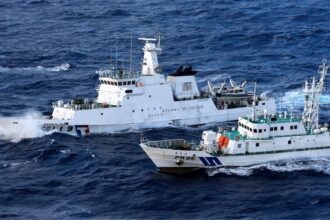
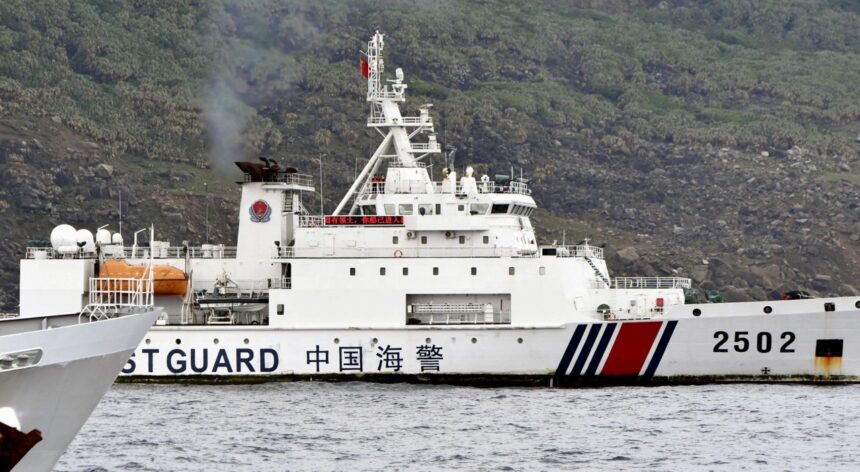
The warning follows a series of China Coast Guard (CCG) operations that have steadily expanded beyond the Taiwan Strait. On 4 July, a Chinese task group operated within roughly 54 nautical miles of Taiwan’s eastern coast near Hualien before being shadowed by Taiwan Coast Guard vessels. Taipei lodged a formal protest, while Beijing described the mission as routine law-enforcement activity.
The patrol ended without confrontation. Its location, however, was strategically significant. Taiwan’s eastern coastline has traditionally been regarded as the island’s military rear area, hosting key air bases, logistics facilities and maritime approaches considered less vulnerable than the heavily contested western coast in the event of a cross-strait conflict.
Why a Non-Crisis Is the Strategy
No single coast guard patrol crosses the threshold likely to trigger a military response from Taiwan’s partners. That restraint is central to Beijing’s approach rather than a sign of limited ambition. By keeping individual operations below the level of armed confrontation, China shifts the burden of response onto diplomatic protests, coast guard shadowing and political messaging instead of military deterrence.
Governments that assess each patrol in isolation risk overlooking their cumulative effect. Repeated operations can gradually normalize a different operational reality in waters Taiwan currently administers, making Chinese government presence appear increasingly routine.
Researchers at the Global Taiwan Institute have described a similar pattern around Kinmen and the Pratas Islands, where periods of intermittent Chinese activity evolved into more regular coast guard patrols that are now treated as part of the regional security environment rather than exceptional incidents.
A Campaign Below the Threshold of War
These operations rarely involve direct force. Instead, repeated patrols, radio challenges, vessel inspections and overlapping jurisdictional claims seek to reinforce Beijing’s assertion that it exercises authority over waters claimed by Taiwan.
Taiwan’s Coast Guard Administration has told lawmakers that Chinese coast guard vessels have demanded destination and voyage information from commercial ships operating in disputed areas, despite not boarding or physically intercepting them. Taipei has instructed Taiwanese-flagged vessels not to comply with any unauthorized inspection or boarding demands, while Coast Guard Deputy Director-General Hsieh Ching-chin said Taiwanese patrol vessels would intervene if necessary.
The broader objective appears to be less about disrupting individual voyages than reinforcing China’s jurisdictional narrative through persistent state presence. Each operation, viewed independently, may seem minor. Collectively, they can gradually influence perceptions of what constitutes normal maritime activity.
Commercial Implications
Even without direct interference, sustained grey-zone operations can carry commercial consequences. Maritime insurers routinely reassess war-risk exposure as regional security conditions evolve, while shipping companies often build additional safety margins into voyage planning around contested waters.
Although there is no evidence that commercial shipping is currently rerouting away from Taiwan’s eastern approaches on a significant scale, a sustained increase in Chinese government operations could gradually affect commercial risk calculations if patrols become more frequent or intrusive. Maritime analysts note that uncertainty alone can increase insurance costs and complicate operational planning for shipping companies.
Taiwan’s Counter-Posture
Taipei has sought to adapt as well as protest.
In May, Taiwan’s Coast Guard Administration commissioned the Donggang, the twelfth and final vessel of its Anping-class patrol ship program, completing a fleet designed to serve both law-enforcement and wartime support roles. According to Reuters and Coast Guard Administration specifications, the Anping-class is derived from the navy’s Tuo Chiang-class fast-attack corvette and can be fitted with anti-ship missiles during a national emergency.
Speaking at the commissioning ceremony, Kuan said Taiwan’s coast guard “no longer performs solely traditional law enforcement duties,” reflecting the increasingly blurred line between civilian maritime agencies and national defence in the Taiwan Strait.
Why It Matters
China has increasingly relied on coast guard vessels rather than naval warships to press its territorial claims across the Indo-Pacific. Similar tactics have been employed around the Senkaku Islands in the East China Sea and against Philippine vessels in the South China Sea. Taiwan argues that Beijing is now applying the same incremental approach to its eastern maritime approaches, an area historically regarded as strategically secure.
The current operations remain well below the threshold of armed conflict. Yet that is precisely why they warrant attention. Beijing does not need every patrol to produce a diplomatic crisis or military confrontation. It only needs enough routine operations to make future patrols appear increasingly unremarkable.
For Taiwan, the strategic contest is therefore not only about protecting maritime space, but preventing incremental coercion from becoming accepted practice among governments, commercial shipping and the wider international community.