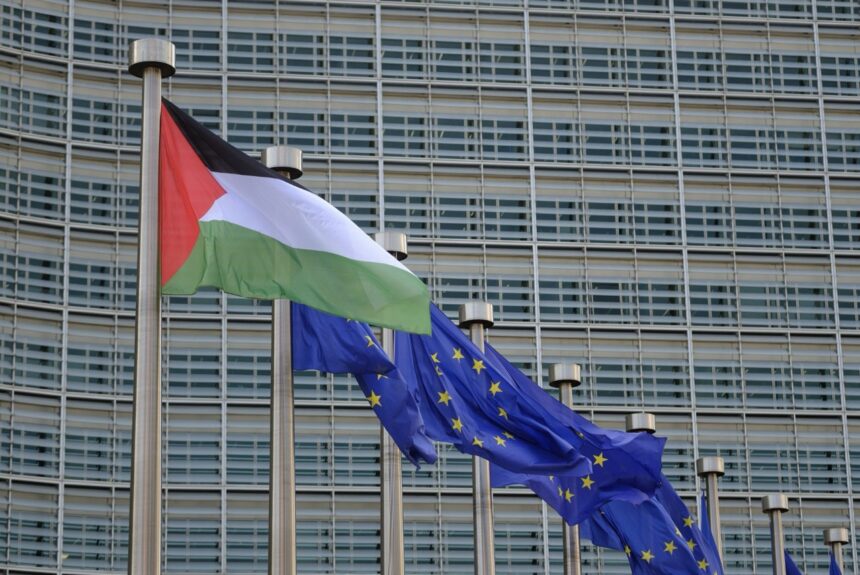
The European Union and 15 international partners launched the Team Gaza Initiative on July 13, committing an initial €883.6 million (about $1 billion) for early recovery projects, European Commission President Ursula von der Leyen announced at the second Palestine Donor Group meeting in Brussels.
The sum covers roughly 1.4% of the $71.4 billion in recovery and reconstruction needs identified in the April 2026 Rapid Damage and Needs Assessment (RDNA), jointly prepared by the European Union, the United Nations and the World Bank. The scale of that funding gap explains why the initiative focuses on restoring essential services – including debris removal, water and sanitation repairs, and basic healthcare – rather than financing large-scale reconstruction.
Large-scale rebuilding remains heavily constrained by Israeli import controls. Israel classifies cement, steel and heavy construction machinery as “dual-use” goods requiring case-by-case approval, according to the Israeli rights organization Gisha, giving Israeli authorities effective control over the pace and scope of reconstruction.
Institutional governance presents a second challenge. The National Committee for the Administration of Gaza (NCAG), established to administer the enclave under Chief Commissioner Ali Shaath, remains headquartered in Egypt because continuing insecurity has prevented its deployment inside Gaza despite the October ceasefire framework. To avoid channeling funds through Hamas, the European Union is using its long-established PEGASE financial mechanism to support Palestinian institutions. Donors also pledged an additional €41.7 million for the Palestinian Authority through PEGASE during the Brussels meeting.
Australia and Canada have indicated they intend to join the initiative, potentially expanding the funding pool. Without eased import restrictions and an operational civilian administration inside Gaza, however, the initiative is likely to remain an emergency stabilization mechanism rather than the foundation for the large-scale reconstruction the territory still requires.