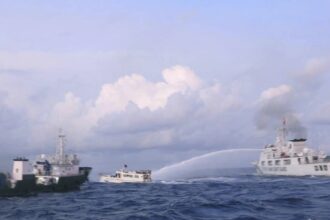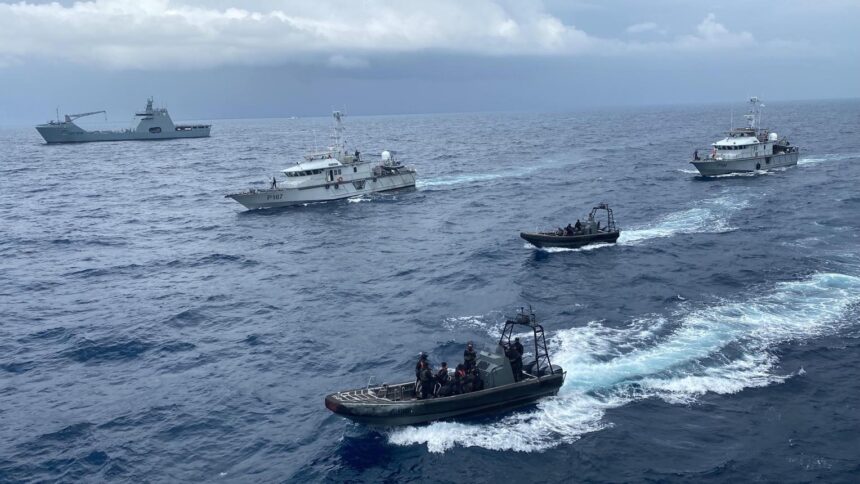
On June 1, six navies answered to a single command for the first time. In Lagos, Nigeria inaugurated the Combined Maritime Task Force (CMTF), a joint force to confront piracy, armed robbery, kidnapping, oil theft, illegal fishing and trafficking across waters from Senegal to Angola. Eleven governments had endorsed the concept. Only six – Côte d’Ivoire, The Gambia, Ghana, Liberia, Nigeria and Sierra Leone – arrived with ships. The rest, Angola among them, stayed ashore.
Formally, the task force is an answer to piracy. In practice, it is Nigeria’s response to a deeper redrawing of West Africa’s security map. That imbalance matters. Nigeria supplied most of the initial ships, aircraft and command capacity. The force carries a regional mandate but begins as a Nigerian-led project, dependent on persuading more coastal governments to share costs, intelligence and risk.
Piracy is the immediate reason. The Gulf of Guinea recorded 21 attacks or attempted attacks in 2025, up from 18 the year before. Incidents remain below their peak, but the region still accounted for 23 kidnapped crew members and most maritime kidnappings worldwide. The decline reflects stronger patrols and coordination, not the disappearance of the networks behind the attacks.
Piracy alone does not explain why Abuja is converting years of fragmented cooperation into a standing force. Part of the answer lies inland, where the Sahel’s political order has collapsed and Russia has become the principal external military partner of Mali, Niger and Burkina Faso.
The Sahel Is Reaching the Coast
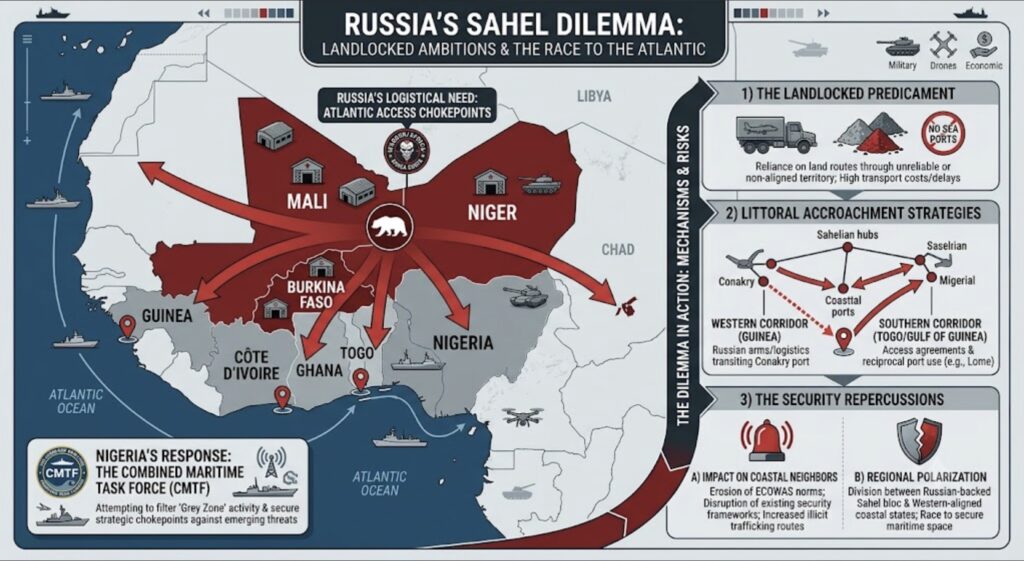
For decades, West African states cooperated through the Economic Community of West African States (ECOWAS), a 15-member bloc aligned with the West. That order has fractured. Mali, Niger and Burkina Faso quit ECOWAS and formed the Alliance of Sahel States (AES), expelling French, European and American forces and turning to Moscow.
The break runs deeper than rivalry. ECOWAS leans on Western backing; the AES depends on Russia – the same confrontation that already sets Russia against the West in Ukraine. The prospect is that West Africa becomes a second theatre of that contest, two camps bound to collide along the line dividing them.
Russian formations – first the Wagner group, now the Defence Ministry-controlled Africa Corps – fight alongside national armies and shield governments that depend on Russian weapons, personnel and political backing. In July, Russia and the three AES states agreed to expand military cooperation as insurgent attacks continued.
But Moscow’s Sahel project has a missing piece: a coast. Its partners are landlocked, and Russia itself has spent years hunting a warm-water naval base on Africa’s flanks – pressing Sudan for a Red Sea port, courting eastern Libya, holding on at Tartus in Syria. Each effort answers the same need: somewhere to land troops, arms and cargo. Until it secures one, Russia has reason to push toward the Atlantic shore held by ECOWAS states.
Russian arms for Mali have already moved through Guinea’s Atlantic port of Conakry, while a military agreement between Russia and Togo reportedly allows reciprocal access to military ports. The arrangement offers Moscow a potential maritime outlet for its landlocked partners and a foothold on the Gulf of Guinea.
This does not establish that the CMTF was built to contain Russia. Neither Abuja nor the African Union names Moscow as a target; the African Union mandate addresses piracy and maritime crime. Still, the implication is hard to ignore: coastal states are organising their waters while Russian-backed regimes hold the hinterland and Moscow hunts for routes to the Atlantic.
The Pipeline Russia Has No Reason to Welcome
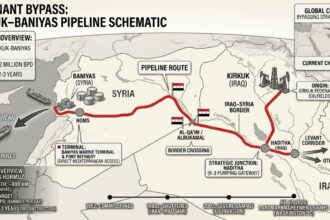
The same geography governs one of Africa’s largest infrastructure ambitions. The proposed Trans-Saharan Gas Pipeline would carry Nigerian gas north through Niger to Algeria and onward to European markets. The 4,128-kilometre project is designed to move up to 30 billion cubic metres annually, and Algeria launched construction of its section in June.
The route crosses territory shaped by insurgency, military rule and Russian influence. Moscow has not declared an intention to block it, and no public evidence shows Africa Corps deployed to prevent Nigerian gas from reaching Europe. But Russia’s Energy Security Doctrine treats competition and threats to its export position as national-security concerns. A functioning pipeline would give Europe another source of gas and reduce the strategic weight of Russian supply.
Blocking or reshaping such a project requires no explosives or formal veto. By embedding itself as a regime protector in Niamey – the essential transit state – Russia gains influence over the regulatory decisions, security conditions and political relationships on which the pipeline depends. It could use that leverage to delay the project or raise its costs – an inference from geography and energy competition, not evidence of a disclosed Kremlin plan.
Protecting the Gulf’s Economic Bloodstream
For Nigeria, this is not an abstract strategy but economic survival. Offshore fields, export terminals, pipelines and shipping lanes are the arteries of its oil and gas trade – and they are under constant assault. Militants, jihadist groups, oil thieves and smuggling syndicates target the infrastructure that keeps the state solvent, and some officials allege foreign-backed proxies do the same. Every attack raises costs and weakens investor confidence. Securing the shoreline is no longer optional.
The force could also help coastal governments confront newer forms of illicit trade. Russia’s shadow fleet and other sanctions-evasion networks rely on opaque ownership, flags of convenience, falsified documentation and ship-to-ship transfers. Public evidence does not yet mark the Gulf of Guinea as a major shadow-fleet hub, but busy energy routes, uneven enforcement and numerous ports could make it attractive to them.
Nigeria is therefore building more than an anti-piracy patrol. It is trying to raise a security framework around the Atlantic edge of a region increasingly split between coastal governments tied to ECOWAS and inland regimes aligned with Russia. The force remains small, and Angola’s absence from its six founding contributors shows how difficult real burden-sharing will be. Its creation nonetheless reflects a broader recognition: the contest over West Africa is shifting from deserts and capitals toward ports, pipelines and shipping lanes.
The lesson reaches beyond Africa. The world saw it again at Hormuz, where a single contested strait can choke the flow of energy and hold economies hostage. In an age when trade, fuel and survival travel by sea, command of the water is command of the future.
Whoever secures the Gulf of Guinea will not merely police pirates. They will decide how West Africa fuels itself and connects to the world – and whether the order Russia is building across the Sahel can reach the Atlantic.