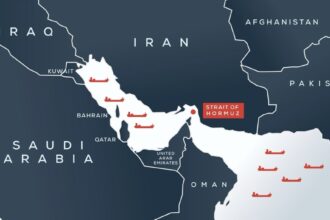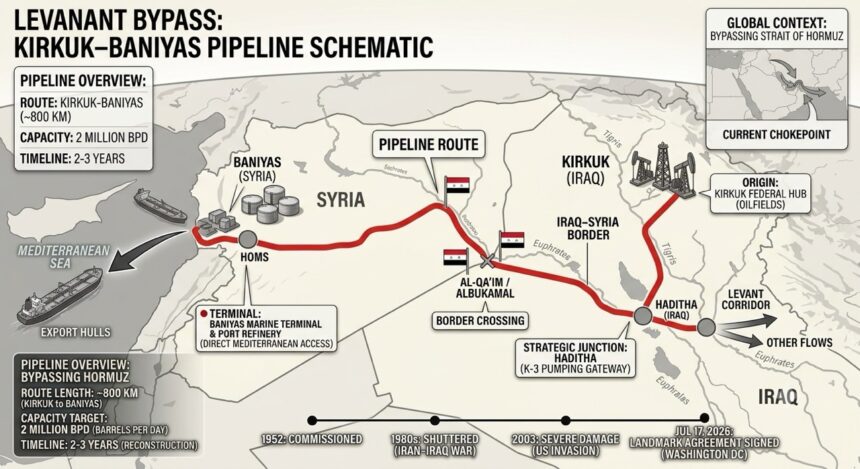
Iraq and Syria signed a memorandum of understanding in Washington on Friday to rehabilitate the long-idled Kirkuk–Baniyas crude oil pipeline, advancing plans to reopen a Mediterranean export route as the war around the Strait of Hormuz exposes Baghdad’s dependence on Gulf shipping lanes.
The memorandum was among roughly 50 agreements worth about $60 billion announced during Iraqi Prime Minister Ali al-Zaidi’s visit to Washington. It was signed by Bassem Abdul Karim, general manager of Iraq’s state-owned Basra Oil Company, and Youssef Qablawi, chief executive of Syria’s Petroleum Company, during a U.S.-Iraq business summit attended by senior American and Iraqi officials.
The U.S. State Department said a U.S.-led international consortium is expected to carry out the project’s technical and financial work. According to Al-Monitor, citing people familiar with the negotiations, the consortium is centred on Chevron, U.S. investment firm TI Capital and Qatar’s UCC Holding. The memorandum establishes a framework for feasibility studies and implementation rather than authorising immediate construction.
The pipeline entered service in 1952, linking Iraq’s Kirkuk oilfields with the Syrian Mediterranean port of Baniyas. It was shut during the Iran-Iraq War in the early 1980s, suffered further damage after the 2003 U.S.-led invasion of Iraq and has remained largely idle ever since.
The agreement comes as Iraq looks for alternatives to Gulf export routes. Iraqi crude production fell from about 4.2 million barrels per day in February to roughly 1.9 million in June, according to OPEC data cited by CNBC, as the conflict around the Strait of Hormuz disrupted tanker traffic. Oil exports account for about 90% of Iraq’s state revenue.
The project has also become politically feasible following the collapse of Bashar al-Assad’s government and Washington’s subsequent easing of sanctions on Syria, opening the door for greater Western participation in the country’s energy sector.
Security remains the project’s greatest uncertainty. ISIS cells continue to operate along parts of the roughly 800-kilometre corridor through Iraq’s Anbar province and eastern Syria, while decades of neglect have left pumping stations, power systems and sections of the pipeline requiring extensive reconstruction. Even so, the agreement signals that regional governments are redesigning Middle Eastern energy infrastructure around the possibility that the Strait of Hormuz may no longer be a reliable export corridor.