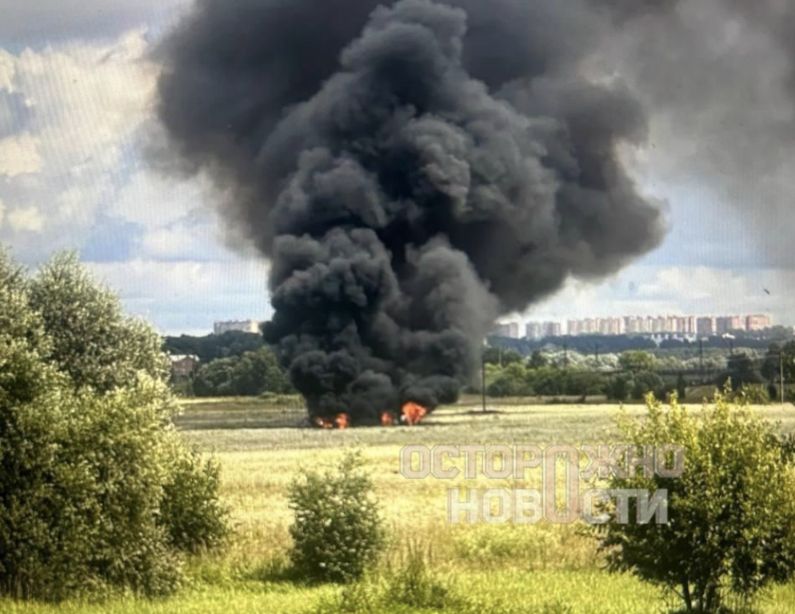
A Russian military aircraft crashed near Zvenigorod, west of Moscow, on Thursday during what local reports described as a training flight. The independent Russian outlet Astra said the jet was likely a Sukhoi Su-57, Russia’s only operational fifth-generation fighter, a report later cited by UNITED24 Media. Russia’s Ministry of Defense had not confirmed the aircraft type, the crew’s condition or the cause of the crash at the time of publication, according to Defence Blog.
Video circulating on Russian Telegram channels showed wreckage engulfed in flames as emergency crews responded to the scene. Astra reported that the pilot likely ejected before impact, though Russian officials had made no public statement on the crew’s condition, according to reporting compiled by UNITED24 Media.
If the aircraft is confirmed to have been a Su-57, the incident would affect one of Russia’s smallest and most strategically important combat aircraft fleets. The Su-57 program has missed nearly every major production target since serial deliveries began in 2020, and open-source estimates of the operational fleet range from roughly 20 to just over 40 aircraft, with many assessments placing the figure closer to 30. The wide variation reflects the limited public information available on a program largely shielded from independent scrutiny. Unlike Russia’s much larger fleets of Su-34 and Su-35 fighters, the loss of even a single production Su-57 would represent a meaningful reduction in the country’s only operational fifth-generation combat aircraft capability.
The program’s slow maturation is also reflected in its propulsion system. Most Su-57s have flown with the interim AL-41F1 engine, derived from the Su-35, while the intended second-stage powerplant – known as Izdeliye 30 or AL-51F1 – has only recently begun entering production aircraft. Russia has maintained that future deliveries will incorporate the new engine as standard. Meanwhile, a Royal United Services Institute (RUSI) assessment of the Sukhoi production complex found the aircraft’s manufacturing chain remains vulnerable to Western sanctions affecting advanced electronics, precision machine tools and specialized materials, despite Moscow’s claims that domestic substitution has offset those constraints.
The reported crash also follows another significant Russian military aviation accident. On June 15, a Tu-22M3 strategic bomber crashed near Svirsk in Russia’s Irkutsk region while returning from a training flight, with the Defense Ministry attributing the loss to engine failure. All four crew members ejected, according to Reuters reporting carried by Investing.com. Taken together, the reported Su-57 crash and the June Tu-22M3 accident add to a series of aviation incidents that have prompted questions about maintenance, production capacity and wartime operating tempo within the Russian Aerospace Forces. Whether Thursday’s crash reflects broader systemic problems will depend on the findings of any official investigation.
The cause of Thursday’s crash remains unknown, and Russian authorities have not announced a formal investigation. Claims circulating on social media that the aircraft was brought down by hostile action or friendly fire are unsupported by publicly available evidence and remain unverified.