Nothing about France’s presence in Africa was ever going to vanish. Some twenty African states use French as an official language, fourteen share a currency pegged to the euro, and the commercial and family networks running between Paris and the continent outlast every government now in office. What collapsed in the Sahel was one specific expression of that presence – the garrison. Within three years France lost its bases in Mali, Burkina Faso and Niger, handed back installations in Chad, Senegal and Côte d’Ivoire, and watched Russia become the security partner of choice for the three military governments of the so called Alliance of Sahel States (AES), the mutual-defence bloc those juntas formed in 2023. Paris lost the soldiers and kept the leverage. What the leverage now consists of is the more interesting question.
Retreat Without Disappearance
France granted independence to its African colonies around 1960 but kept the influence in the region: bases, defence pacts, a currency zone, and political and commercial networks dense enough to earn a name of their own, Françafrique. Operation Barkhane was that system’s last large expression. Launched in 2014 with up to 5,500 troops across five Sahel states, it was meant to contain the jihadist insurgencies French forces had first been sent to fight in Mali in 2013, and it never did. Attacks spread, civilian casualties mounted, and French soldiers became the visible face of a war their hosts were losing. Anti-French protest surrounded the coups in Bamako, Ouagadougou and Niamey, each new government expelled the troops, and Moscow moved in through the doors left open. What replaced Barkhane is deliberately small. France completed its withdrawal from Senegal in July 2025, ending its permanent military presence in West Africa. Djibouti remains its principal permanent base, while smaller contingents advise local forces in Côte d’Ivoire and share a training facility in Gabon. The national strategic review calls the replacement model “cooperation and access,” meaning training, equipment and capability support delivered when a partner government asks for it. Barkhane made Paris the owner of every failure. The new posture keeps the soldiers few, the flag low and the ownership local.
Benin showed how that works under pressure. The coastal state sits directly south of Niger and Burkina Faso, has absorbed jihadist spillover into its northern districts since 2021, and remains one of the few West African governments openly aligned with Paris and the Economic Community of West African States (ECOWAS). On December 7, 2025, soldiers led by Lieutenant Colonel Pascal Tigri announced on state television that President Patrice Talon had been overthrown. The attempt collapsed within hours. Nigerian air power and the ECOWAS standby force moved alongside loyalist units, and France contributed what an aide to President Emmanuel Macron described as surveillance, observation and logistical support at Cotonou’s request. Le Monde reported that roughly 15 French special-forces personnel deployed from Côte d’Ivoire. Brief, invited and quiet, the operation proved that closing bases has not removed France’s ability to move intelligence and specialists through cooperative states.
Rabat Plays Its Own Game
Morocco needs its own explanation. Rabat rejoined the African Union in 2017 after 33 years away over Western Sahara, returning with a strategy built on commerce rather than troops – banks, telecommunications, fertiliser exports, religious training for Sahelian imams, construction firms and ports. Every strand serves one organising interest, which is recognition of Moroccan sovereignty over the territory.
The July sequence is striking. France and Morocco signed 14 cooperation instruments in Rabat on July 16 at their fifteenth high-level meeting, covering defence, energy, transport, migration and education. Five days later, Morocco and Benin concluded another 14 agreements in Cotonou at the seventh session of their joint commission, spanning security, justice, extradition, higher education and investment. Read quickly, the pattern suggests French choreography. Read carefully, it shows two governments with converging interests and separate agendas. France recognised Morocco’s Western Sahara claim in 2024 and is preparing an unusually ambitious bilateral treaty with Rabat, and French officials describe Morocco as an economic and logistical bridge into Africa. Morocco’s Atlantic Initiative, meanwhile, offers landlocked Sahel states a route to the ocean through Moroccan corridors – a route the three AES foreign ministers endorsed in Rabat in April 2025 – serving Morocco’s commercial reach and its territorial claim regardless of what France wants. The Franco-Algerian rupture over that same recognition, the worst crisis between those two governments in decades, marks the limit of French influence over North African alignments.
Russia’s Incomplete Replacement
Russia arrived through a private door. From 2017 the Wagner Group – state-backed mercenaries with their own commercial stakes in the countries they entered, run by the late Yevgeny Prigozhin – offered African governments a package no Western state would match: regime protection, no human-rights conditions, no parliamentary scrutiny, and payment partly in mining concessions. Deniability was the design. Wagner deployed to the Central African Republic in 2018 and to Mali in December 2021, months after the coup and weeks before the French withdrawal. Following Prigozhin’s failed mutiny and death in 2023, Moscow folded the network into the Defence Ministry-controlled Africa Corps, converting a deniable business into a state instrument.
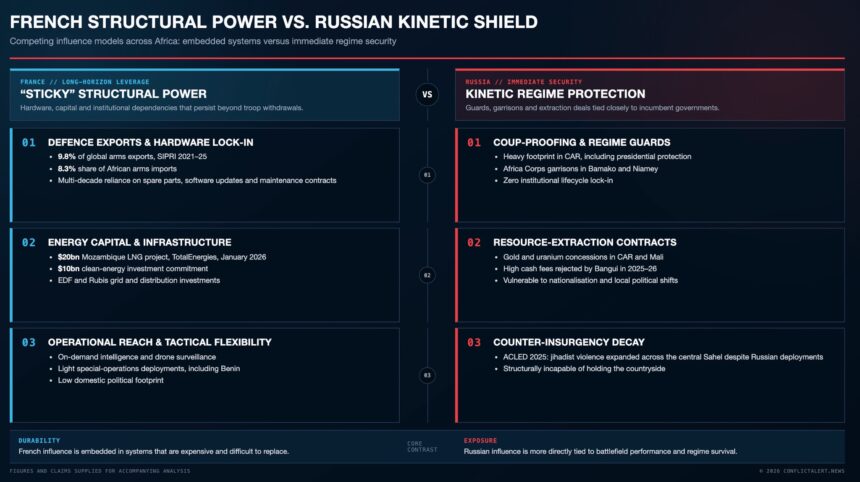
The Central African Republic remains the deepest penetration, with Wagner personnel protecting President Faustin-Archange Touadéra, holding mineral access and embedding themselves in parts of the state. Even there the arrangement has limits, and Bangui resisted Moscow’s demand to swap Wagner for Africa Corps and begin paying substantial cash fees, according to the Associated Press. The wider failure is territorial. ACLED reported that jihadist influence expanded across Mali, Burkina Faso and Niger during 2025 while state authority eroded across large rural areas. Russian forces protect governments, provide air support and escort convoys, which amounts to regime security rather than territorial security. Juntas survive. Districts do not.
The reputational cost is on the record. A UN human rights investigation found more than 500 people killed, most summarily executed, by Malian troops and foreign military personnel during a five-day operation at Moura in March 2022, with 58 women and girls subjected to rape or other sexual violence. OHCHR did not identify the foreign personnel. UN-appointed independent experts, Human Rights Watch and Amnesty International attributed their presence to Wagner, and Mali rejected the findings. Governments that expelled French troops citing sovereignty and civilian harm now host partners facing the same accusations — and partners who cannot supply what their economies need most. Mali, Burkina Faso and Niger are landlocked. Ports, corridors, transit agreements and infrastructure capital come from coastal ECOWAS states, from Morocco and from European and Gulf financing. Russia has none of them to offer.
Power Through Contracts
Weapons and energy make the surviving influence measurable. SIPRI calculates that France was the world’s second-largest exporter of major arms in 2021–25 with 9.8 percent of the global total, supplying 8.3 percent of African major-arms imports, behind the United States, China and Russia. The figure understates what it represents. Systems such as Rafale combat aircraft and CAESAR artillery generate obligations that outlive the sale – ammunition, spare parts, maintenance, software updates, pilot training, mid-life upgrades – binding military institutions to a supplier for decades and surviving ruptures that would end a basing agreement overnight.
Energy runs deeper still. TotalEnergies announced the full restart of the $20 billion Mozambique LNG development on January 29, 2026, and remains involved in major projects in Angola, Nigeria, Uganda and Tanzania. At the May 11–12 Africa Forward summit in Nairobi it announced plans to invest $10 billion in Africa by 2030, while French and African firms presented more than $11 billion in renewable-energy commitments involving TotalEnergies, EDF and Rubis. These are companies rather than the state, though projects of that size require financing, diplomatic protection and decades of cooperation with host governments, so the two reinforce one another. Niger’s nationalisation of Orano’s Somaïr uranium operation marks the outer limit, because contractual power can be revoked by decree.
France has lost military primacy in the central Sahel and retains structural power across the continent through weapons ecosystems, energy capital, development finance and technical expertise. Its influence holds where governments choose long-term French partnerships and collapses where they nationalise, replace or expel. The flags came down across the central Sahel, while French contracts endured elsewhere on the continent. Soldiers can be removed by decree in an afternoon. A maintenance contract on a fighter fleet takes thirty years to expire.