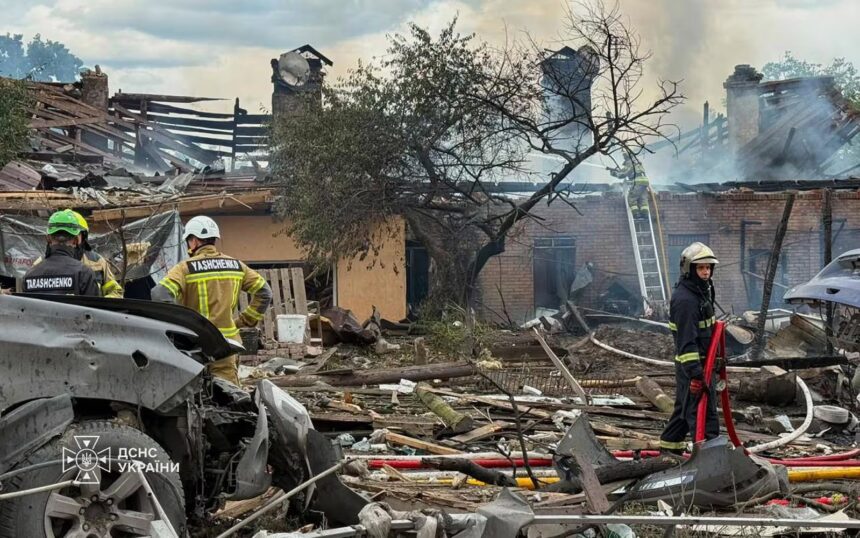
A Russian ballistic missile struck a defense-industry gathering in Ukraine’s Bucha district on Friday, killing 10 people and injuring nearly 100 in one of the deadliest attacks this year on the country’s rapidly expanding defense sector. The strike has also revived debate over how Ukraine can protect a decentralized wartime defense industry whose public events increasingly present attractive targets for Russian long-range weapons.
The missile hit a private training ground where a defense exhibition was underway, according to attendees, industry representatives and Ukrainian officials. The Irish Times reported that executives from Ukrainian defense companies were among those present. An event advertised online by Armada, an association of unmanned-systems manufacturers, promoted a “Defense Demo Day & Defense Expo” near Kyiv on the day of the attack. The Ukrainian Council of Arms Manufacturers later confirmed that industry representatives had been at the site and urged attendees not to publish photographs, videos or other details that could reveal the location.
That request reflects the central question now facing investigators. Publicly available registration pages, promotional flyers and social-media posts can reveal the location and timing of defense-related events, potentially reducing operational security. Ukrainian investigators have not said whether any such information played a role in Friday’s strike, and there is no public evidence that Russia identified the gathering through those materials.
Ukraine’s State Emergency Service said search-and-rescue operations in the Bucha district had concluded by Friday evening after firefighters extinguished blazes in three private homes and eight vehicles. Authorities declared a day of mourning in the Kyiv region. Ukraine’s General Staff said the facility struck was privately operated and not under the control of the country’s Defense Forces. Air Force spokesperson Yurii Ihnat separately described the location as a sports complex rather than a training ground, but officials agree that defense-industry representatives were present when the missile struck.
President Volodymyr Zelenskyy condemned the attack as another act of Russian terror while also questioning why the event had been held under wartime conditions. Speaking after the strike, he said the gathering “definitely should not have been there” and called for a full review of how it had been organized.
Prosecutor General Ruslan Kravchenko opened two separate criminal investigations: one into Russia’s missile strike as a suspected war crime and another examining whether organizers or officials failed to comply with wartime security requirements.
The two investigations address different questions and should not be interpreted as distributing responsibility equally. Russia launched the missile and bears responsibility for the attack itself. The domestic negligence inquiry is an internal accountability process examining whether Ukrainian organizers took adequate precautions in a country where missile strikes remain a daily threat.
The attack echoes an earlier Russian strike that prompted similar questions. In August 2023, a Russian missile hit the Taras Shevchenko Drama Theatre in Chernihiv during a drone-technology exhibition, killing seven people. The attack led Ukrainian authorities to tighten security guidance for defense-related events. Friday’s strike suggests those lessons were not fully translated into practice.
The challenge is structural rather than procedural alone. Ukraine’s defense-technology sector has grown through distributed networks of private manufacturers, engineers, volunteers and military units working together at remarkable speed. That decentralized model has become one of the country’s greatest military advantages, allowing rapid innovation in drones, electronic warfare and battlefield technologies. At the same time, exhibitions, demonstrations and networking events remain essential for connecting developers with military customers, investors and one another – creating temporary concentrations of expertise that can become attractive targets.
Long-range Russian strikes have been the principal driver of rising civilian casualties in Ukraine this year. The UN Human Rights Monitoring Mission documented 1,396 civilians killed and 7,978 injured during the first half of 2026, a 37 percent increase compared with the same period last year. Ballistic missiles, drones and guided aerial bombs accounted for much of that increase.
Friday’s attack demonstrates that Russia continues to target areas well beyond the front line in an effort to disrupt Ukraine’s ability to sustain its war effort. As the country’s defense industry becomes increasingly dispersed across hundreds of private companies and volunteer initiatives, protecting the people behind that innovation – not just factories and production lines – may become one of Ukraine’s most difficult security challenges.