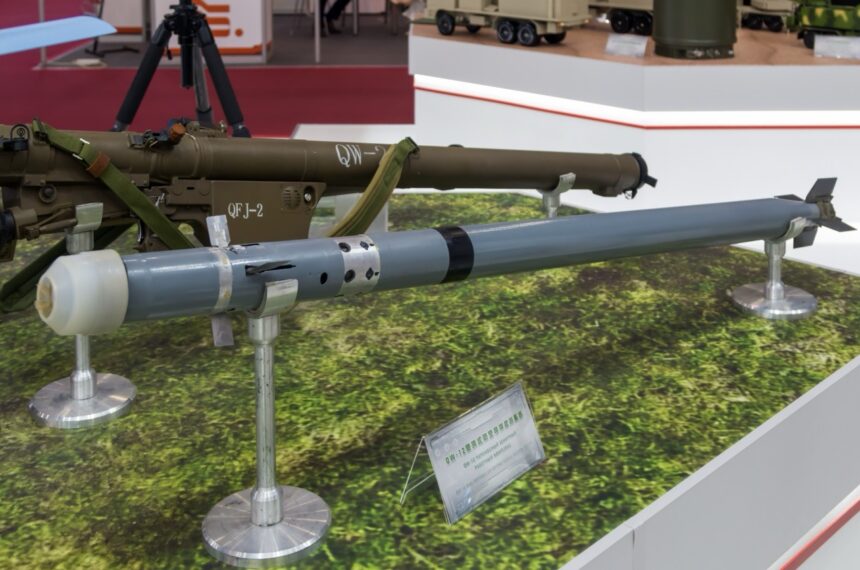
Iran may be weeks away from receiving hundreds of Chinese-made shoulder-fired air-defense systems, giving Tehran a weapon unlikely to reverse U.S. dominance in the air but potentially capable of making some of the most dangerous American missions even harder. There is already a combat case suggesting the risk is not theoretical.
The Deal and the Hardware
Iran has agreed to purchase between 300 and 400 man-portable air-defense systems, or MANPADS, including Chinese QW-12 and FN-16 missiles, according to Reuters. Three sources familiar with the deal said the $60-70 million contract has been signed and that an initial shipment could arrive within weeks. China called the report “completely groundless,” while Pakistan denied any role in transiting the weapons. Reuters cautioned that quantities and delivery schedules could still change.
The two missiles are not identical. The FN-16 is reported to use a dual infrared and ultraviolet seeker intended to improve resistance to defensive countermeasures such as flares. The QW-12 is another infrared-guided system and has demonstrated the ability to engage targets using flares in Chinese testing. Open-source specifications place their engagement envelopes at only several kilometers in range and roughly four kilometers in altitude.
That limited reach is precisely why neither weapon can rebuild Iran’s national air-defense network. But it also explains where they could matter.
A Threat Already Seen in Combat
Calling the missiles a gamechanger would go too far. They cannot replace the long-range radars and surface-to-air batteries needed to contest airspace nationally, and fixed-wing aircraft can generally reduce exposure by staying above the MANPADS engagement envelope, using standoff weapons and employing countermeasures.
Helicopters, combat search-and-rescue forces and some drones cannot always do that.
In May, three sources told NBC News that Iran had probably used a Chinese-made shoulder-launched missile against the U.S. F-15E lost over southwestern Iran on April 3 – the first known crewed U.S. aircraft shot down inside hostile Iranian territory during the war. NBC reported that it remained unclear whether the missile was recently transferred or came from older Chinese stocks already in Iran. The Chinese Embassy denied supplying weapons. The Critical Threats Project and Institute for the Study of War later summarized the U.S. assessment. Public reporting has not established exactly which missile was used.
The aftermath shows why a MANPADS hit can matter far beyond the loss of one aircraft.
Both F-15E crew members ejected. The pilot was recovered on April 3, but the weapons systems officer remained stranded in mountainous terrain until April 5. His recovery became a major combat search-and-rescue operation involving dozens of aircraft, while U.S. helicopters participating in the wider rescue effort came under Iranian fire.
One successful engagement can therefore create another military problem. Downed personnel must be located and recovered. Helicopters and supporting aircraft may have to enter hostile airspace. Surveillance and protection assets can be redirected toward the rescue. Forces attempting the recovery may themselves become targets.
Why Mobility Matters
Iran’s fixed air defenses have repeatedly been struck because large radars, launchers and command sites can be found and destroyed. MANPADS invert that problem: small teams can disperse, relocate and operate without a target-illuminating radar advertising their position.
Reuters reported that military experts see precisely this mobility as their advantage. Teams can be moved rapidly around military installations, energy infrastructure and other sensitive sites, making them less vulnerable than fixed air-defense batteries.
RAND research on low-altitude air defense has found that scattered MANPADS can push aircraft toward higher-altitude operations and pose a particular danger to helicopters. They are most effective as one layer within a broader air-defense system rather than as a substitute for medium- or long-range defenses.
Three hundred or 400 systems spread across a country the size of Iran would not create a sealed air-defense umbrella. Concentrated around missile sites, air bases, nuclear facilities or other priority targets, however, they could create localized areas where operating close to the ground becomes considerably more dangerous.
The effect would be measured less in control of the sky than in how American missions are planned.
China’s Calculus
There is also a larger strategic question for Washington.
If the Reuters report is confirmed, Chinese-made weapons would be helping Iran rebuild a capability that American and Israeli forces have spent months degrading, without China becoming a direct participant in the war.
China has publicly emphasized diplomacy and denies the reported MANPADS deal. On July 16, Foreign Minister Wang Yi and his Pakistani counterpart called on Washington and Tehran to halt hostilities and resume negotiations, according to China’s Foreign Ministry.
The report has nevertheless reached the highest level of U.S.-China relations. President Donald Trump said Chinese involvement would be “surprising,” telling reporters that President Xi Jinping had previously assured him China would not participate on Iran’s behalf, according to Reuters. Trump said he had not spoken with Xi since the latest reports emerged.
That makes confirmation of any transfer significant beyond the missiles themselves. It would raise questions in Washington about whether Beijing is moving from diplomatic and economic support for Tehran toward directly helping Iran rebuild military capabilities degraded by U.S. and Israeli strikes.
Even a relatively small $60-70 million procurement could impose costs far beyond its purchase price if U.S. commanders have to commit more protection, surveillance and rescue assets to missions conducted within MANPADS range.
Chinese MANPADS would not make Iran’s skies inaccessible, and they would not erase U.S. advantages in stealth, surveillance, electronic warfare or long-range strike.
But Iran does not need to defeat American airpower outright to influence how it operates. If several hundred concealed missile teams make helicopters, rescue forces, drones and other low-altitude missions dangerous enough, commanders have to adjust routes, altitude, protection and acceptable risk.
For Iran, making U.S. air superiority more expensive may be enough.