
Iran
Russia Uses Caspian Route to Resupply Iran
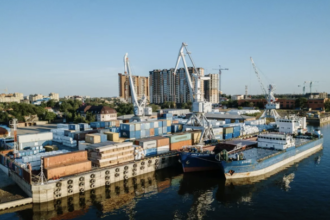
Russia is shipping drone components, ammunition and TNT to Iran through the Caspian Sea, helping Tehran rebuild stockpiles depleted by U.S. and Israeli strikes, according to a European government document obtained by NBC News and verified by a Western official. More than two dozen Russian vessels have delivered the material to Iran's Amirabad port, reversing Iran's earlier role as Russia's main drone supplier. The Caspian's 2018 legal convention bars non-littoral military forces, leaving Western navies no basis to intercept the shipments. The support extends beyond hardware: US officials told the New York Times on August 11 that Russia has also shared "advanced drone tactics" with Iran, including a swarm-and-relay method Iran used to down a US F-15E in April, adapted from Russia's war in Ukraine. Ukraine said it struck vessels carrying military cargo between Iran and Russia in the Caspian Sea on July 25; Iran said one attack hit an…
U.S. Carrier Shift Opens Pacific Gap
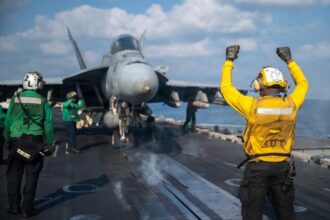
The United States is sending the USS George Washington toward the Middle East to relieve the USS Abraham Lincoln, opening a temporary carrier gap in the western Pacific as China tests American attention elsewhere. The Wall Street Journal first reported the rotation, and the Associated Press confirmed that George Washington was in the Strait of Malacca, on course toward the Indian Ocean after visiting Da Nang, Vietnam. The Lincoln has spent more than 240 consecutive days at sea and more than 260 days deployed, an unusually long stretch for a modern carrier, according to AP, after being redirected to the Middle East in January to support the Iran war. The deployment has drawn congressional scrutiny. Sen. Richard Blumenthal wrote to Defense Secretary Pete Hegseth citing reports of "shortages of basic supplies, water contamination, plumbing issues, deteriorating mental health, deck safety concerns and disruptions of the mail system," Reuters reported. Hegseth…
Trump Threatens Oman as Iran Deadline Expires
The clock that was supposed to end the U.S.-Iran war ran out on August 17, and Washington marked the moment not with a deal but with a threat against one of its oldest Gulf partners. President Donald Trump warned Oman that the United States would "bomb the shit out of them" if Muscat interfered with reopening the Strait of Hormuz, and later told reporters, "No, I don't think they behaved very well, but we'd handle them very easily," according to Reuters. The remark landed as the 60-day window set in June expired without an agreement and tracked commodity traffic through the strait nearly halted. The Deadline Passes Iran and the United States never agreed on what the 60-day clock actually measured. Reuters has reported that the June memorandum declared a full, lasting halt to military operations, an arrangement that unraveled within weeks as fighting resumed around the strait. Tehran has…
Oil Still Flows Around Blocked Hormuz Strait
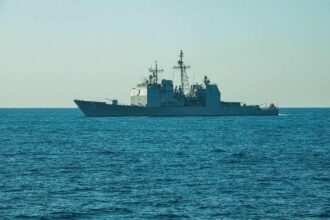
Gulf states have stopped treating dark shipping as an emergency improvisation and started running it as standard business. What began as a workaround has hardened into a parallel export architecture — one that keeps oil moving through a war zone Iran insists is closed, at a price the region's state oil companies have simply built into their operating costs. State Companies Make the Shadow Playbook Official The tactics themselves aren't new — disabling transponders and transferring cargo ship-to-ship have been Iranian and Russian sanctions-evasion staples for years. What's changed is who's using them. Rigzone reported that Adnoc is now offering to shuttle Iraqi crude through Hormuz on its own "dark-transit playbook," using vessels it partly owns through logistics arm Navig8 rather than leased tankers exposed to outside owners' risk tolerance. Egypt Oil & Gas reported that Adnoc's own logistics unit has directly executed AIS-dark exports of Upper Zakum and Das…
Iran Prepares for Renewed War With US
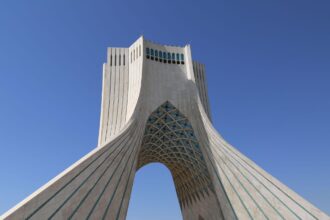
Iran's leadership remains deeply distrustful of President Donald Trump's intentions and is treating the current lull in fighting less as a path to peace than as a window to prepare for its resumption, according to reporting and officials' own public statements over recent months. Tehran is steering the country toward what officials describe as a "survival economy," the Wall Street Journal reported, citing people close to Iran's leadership and negotiating team. The paper reported that Tehran is rationing scarce goods, restricting access to foreign currency, cutting investment and shifting more of the burden onto households, while preserving strategic imports and the core machinery of the state. Analysts describe this as a calculated trade-off rather than simple economic misfortune. Hadi Khalazadeh, a researcher at the Quincy Institute and former senior Iranian Social Security Organization official, told the Journal that the approach shifts Iran "from a resilient economy that can absorb shocks…
US Ramps Up Economic and Naval Pressure on Iran
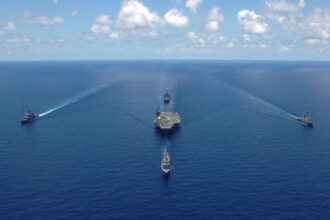
The United States is expanding pressure on Iran through a combined economic and military strategy as hopes for an immediate reduction in tensions fade. Treasury Secretary Scott Bessent said Washington would soon announce economic measures against Tehran that he said "have never been seen in the history of economic isolation on a country," in an interview on Newsmax's "Rob Schmitt Tonight" on August 13, according to Reuters. The comments followed President Donald Trump's renewed push in recent days for economic pressure over military escalation, telling Axios over the weekend he was "low-keying it" with Iran. Defense Secretary Pete Hegseth separately said the naval blockade of Iranian ports could continue indefinitely through ship rotations, telling reporters in Panama following the PANAMAX exercises, according to Reuters. Iran has signaled it is prepared to match that timeline: a senior Islamic Revolutionary Guard Corps adviser said on August 12 that Tehran is ready to…
