Gulf states have stopped treating dark shipping as an emergency improvisation and started running it as standard business. What began as a workaround has hardened into a parallel export architecture — one that keeps oil moving through a war zone Iran insists is closed, at a price the region’s state oil companies have simply built into their operating costs.
State Companies Make the Shadow Playbook Official
The tactics themselves aren’t new — disabling transponders and transferring cargo ship-to-ship have been Iranian and Russian sanctions-evasion staples for years. What’s changed is who’s using them. Rigzone reported that Adnoc is now offering to shuttle Iraqi crude through Hormuz on its own “dark-transit playbook,” using vessels it partly owns through logistics arm Navig8 rather than leased tankers exposed to outside owners’ risk tolerance.
Egypt Oil & Gas reported that Adnoc’s own logistics unit has directly executed AIS-dark exports of Upper Zakum and Das crude, selling one broken-up cargo to a Northeast Asian refiner at a $20-a-barrel premium over its official price – evidence the practice is now profitable enough to run as deliberate strategy rather than a stopgap. Energy News Beat reported that Iraq’s state marketer, SOMO, is now selling crude to Adnoc specifically so it can move via that playbook, discounting cargoes by $25–$30 a barrel to attract buyers willing to accept the risk.
Saudi Arabia’s shift is the clearest signal of institutionalization: a producer that avoided shuttle transfers for months is now loading tankers at Ras Tanura and anchoring supertankers off Oman through its state carrier, Bahri — not as a one-off, but as declared, ongoing policy as Houthi attacks close off its Red Sea alternative.
The Price of Staying Insured
None of this is cheap. War risk premiums for Hormuz transits, which ran around 0.25% of a vessel’s hull value before the war, have surged to between 3% and 10%, according to The National – turning a roughly $250,000 policy on a $100 million tanker into one costing $3–10 million per transit.
The shipping industry’s initial response to that repricing was to withdraw: tanker traffic through Hormuz collapsed by more than 80% in the days after the February 28 strikes that opened the war, as owners priced themselves out of the route entirely, according to the Irregular Warfare Initiative.
Gulf state producers took a different path: absorb the cost rather than wait it out. Adnoc’s move to route exports through vessels tied to its own logistics arm, rather than relying on independent shipowners who can simply refuse the risk, signals a company positioning itself to keep moving cargo on its own terms even as premiums stay elevated – though it’s not established that this structure amounts to full self-insurance rather than heavily discounted or negotiated coverage.
A Fraction of What Once Flowed
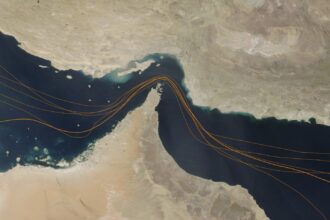
Estimates of current volumes diverge sharply depending on who’s counting, and that gap matters. Bloomberg’s sourcing put shuttle-trade volumes above 4 million barrels a day. Splash247 reported that Bloomberg has separately described flows “considerably above” that figure, while U.S. Energy Secretary Chris Wright put total Hormuz transits closer to 9 million barrels a day – roughly half the pre-war level. Either estimate contradicts Tehran’s claim that the strait is fully closed.
But both figures still fall far short of the roughly 20 million barrels a day – a fifth of global supply – that transited before the war. That gap is the story in miniature: enough oil is getting through to keep prices from spiking uncontrollably, but not nearly enough to call the strait open.
Global refining markets are consequently operating with little slack. A single lost tanker, a shift in Iranian targeting patterns, or a disruption to the ship-to-ship transfer points off Oman could tighten supply again quickly – the current flow is a managed risk, not a resolved one.
Diplomacy Frozen, Improvisation Made Permanent
The dark-fleet system persists because a negotiated reopening remains politically unreachable. President Trump said on August 14 that he intends to declare the strait U.S. territory once Iran suffers what he described as a decisive defeat. Iranian Deputy Foreign Minister Kazem Gharibabadi rejected the claim the next day, arguing that the strategic waterway cannot be brought under anyone’s control by rhetoric, military threat, or unilateral declaration.
Neither position leaves room for the kind of negotiated safe-passage arrangement that has ended previous Gulf shipping crises. Iranian attacks on tankers have continued through the standoff — 19 to 23 strikes on Adnoc vessels alone, by differing counts, with at least one crew member killed.
That stalemate is why the shuttle system now functions as infrastructure rather than a stopgap. With no diplomatic off-ramp visible and attacks ongoing, Gulf state oil companies have concluded that absorbing the cost and the danger is more reliable than waiting for the strait to reopen on anyone’s terms. The tankers going dark off Oman are, in effect, the closest thing the Gulf has to a functioning peace: not a resolution, but a system built to outlast one.