
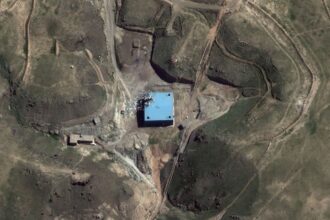
U.S. Reportedly Brokers Syria Nuclear Site Deal
The United States has reportedly brokered separate understandings with Syria and Israel aimed at removing nuclear material from a clandestine site known as "Site 99," Axios reported August 10, citing U.S. and Israeli officials. The International Atomic Energy Agency (IAEA) and Syria's government separately signed an agreement three weeks earlier to carry it out. Site 99 is linked to the Assad government's clandestine Al-Kibar nuclear program, centered on a reactor Israel destroyed in a 2007 airstrike. U.S. officials told Axios the site held yellowcake and other residue from the Al-Kibar program. The material cannot be used directly in a nuclear weapon, but a U.S. official cited by Axios said it could be used in a radiological dispersal device, or "dirty bomb." Israeli officials told Axios they detected activity around the site in recent weeks that raised concern Syria's government might be trying to regain access, possibly with Turkish help. Those…
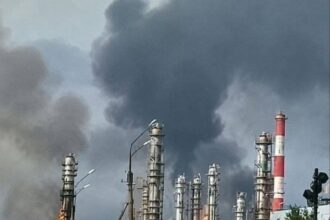
Deep-Strike Campaign Squeezes Russia’s Oil Refineries
Russia's refining sector is being taken apart one processing unit at a time. On the night of August 9–10, Ukrainian drones reached into two of Russia's most important fuel-producing regions within hours of each other, striking the Saratov oil refinery and, roughly 1,200 kilometers further east, the Taneco refinery in Tatarstan, the fourth consecutive night of confirmed Ukrainian strikes on Russian oil infrastructure. "A just peace is closer with every target struck on the territory of the Russian Federation that is involved in its criminal war against Ukraine," Ukraine's General Staff said of the Saratov operation. A strike deep in Russia's interior Tatarstan head Rustam Minnikhanov described a "massive" drone attack on industrial and civilian facilities in Nizhnekamsk, a city roughly 1,200 km east of the Ukrainian border, according to CBS News. Taneco is no minor target: the plant has an annual processing capacity exceeding 16 million tons of oil…
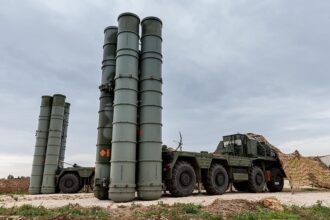
Syria Takes Control of Russian Military Bases
Syria and Russia signed a memorandum of understanding on August 9 restructuring Moscow's military presence on Syria's Mediterranean coast, according to Syria's Foreign Ministry, carried by state news agency SANA. The deal follows 18 months of negotiation. Damascus takes administrative control of the civilian-use sections of Russia's air base and naval facility. The remaining military infrastructure is redesignated as "joint training and qualification centers" — language that functions as a legal mechanism, stripping Russia's extraterritorial military status without a hard eviction. The transition has a three-month deadline. Russia has not commented, and how much operational access its personnel retains is unspecified. The two sites have anchored Russia's Middle East presence since 2015, doubling as Moscow's logistics bridge to Africa Corps operations in Libya, the Central African Republic, Mali and Sudan. Assad's December 2024 ouster triggered a drawdown, but resupply flights resumed through 2025. Interim President Ahmad al-Sharaa has visited Putin…

Russia Speeds Up Its Own Version of Starlink
Russia doesn't need to finish building its own Starlink to start using it. That's the uncomfortable detail buried in an August 10 interview with Ukraine's Defense Intelligence (GUR) Deputy Chief Vadym Skibitsky, published by RBC-Ukraine. Moscow's Rassvet satellite constellation is going up faster than its own planners expected, and even in its current, half-built state, it's already flying over Ukraine with enough reach to matter. A structural workaround, not just a space race Rassvet exists because of one exploited dependency. Russian forces used Starlink informally earlier in the war, until Ukraine and SpaceX cut that access off. That loss taught Moscow, mid-conflict, exactly how much leverage comes from depending on someone else's satellites and someone else's geofencing decisions. Built by Bureau 1440 under Roscosmos oversight, the project shifted from a commercial broadband pitch into a deliberate mechanism for engineering around that vulnerability. That mechanism operates on two fronts at once.…
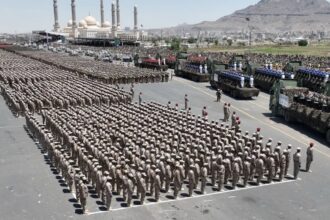
Yemen Situation Report: A Frozen War Heats Up Again
Yemen is again moving toward a more dangerous phase of its decade-long war. The UN-brokered truce in 2022 sharply reduced large-scale hostilities but never produced a political settlement, leaving the country's core military and political divisions intact. During the years of relative calm, Ansar Allah, the formal name of the Houthi movement, consolidated its administration across northern Yemen while maintaining and expanding missile, drone and maritime-strike capabilities that are now being employed again as regional tensions rise. Reuters reported in July that forces on both sides were mobilizing and reinforcing several front lines as the Saudi-Houthi truce broke down. The latest escalation unfolded in two waves of missile and drone attacks on the government-held Red Sea port city of Mocha, known locally as al-Makha, within less than 24 hours. An earlier barrage killed at least 11 people, including eight military personnel and three civilians, according to an AFP toll reported…
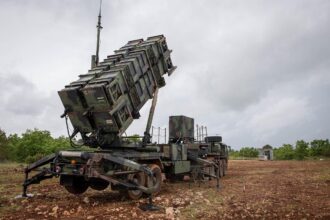
US Firms Resist Ukraine Patriot License
American manufacturers' resistance to licensing Ukraine to build Patriot interceptors is less about intellectual property than about competition, The Atlantic reported on August 8, citing a Republican official who supports granting Kyiv the license. Manufacturers fear Ukraine could improve the missile design and then mass-produce it faster and more cheaply than US factories currently can, according to the report. Raytheon and Lockheed Martin will officially attribute their reluctance to "intellectual property theft and technology transfer" concerns, according to the congressional source cited in The Atlantic. The tension follows a swerve in US policy. President Trump pledged at the NATO summit in Ankara on July 8 to license Ukrainian production, and Raytheon and Lockheed Martin both opened co-production talks with Kyiv within the following three weeks. By late July, however, Trump told the Financial Times that he was "not sure" he would follow through, saying "we're looking at it" and that…
