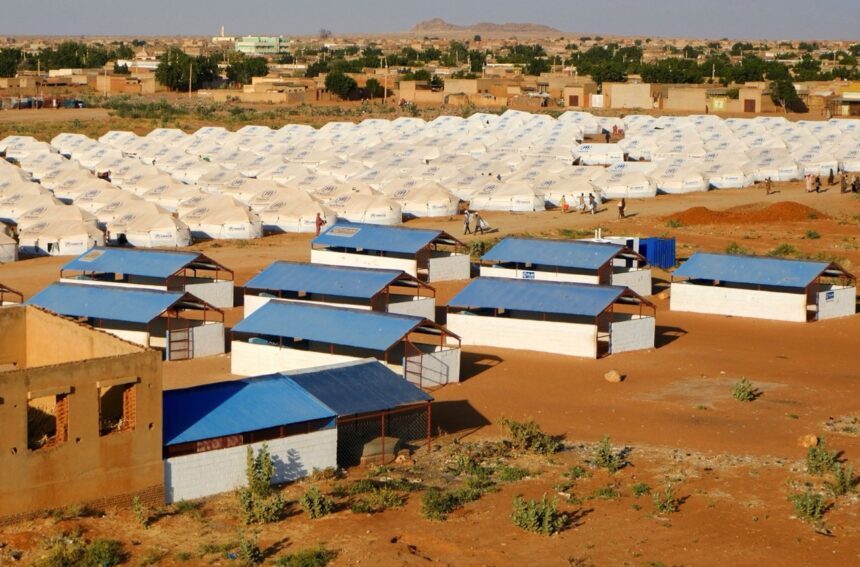
El Obeid, the capital of Sudan’s North Kordofan state, is home to approximately half a million people, including more than 100,000 displaced by the civil war. It links Darfur, held by the Rapid Support Forces (RSF), to army-controlled central and eastern Sudan, and has faced intensifying RSF pressure in recent weeks. Control of El Obeid would give either side a major advantage over the corridor linking RSF-held Darfur with army-controlled central and eastern Sudan.
The escalation comes amid a concentrated diplomatic week: the G7 called for a halt to attacks on the city and a wider arms embargo, the European Union banned Sudanese gold and Washington circulated a ceasefire framework. Each instrument is real, but none yet reaches the decentralized war economy that sustains both belligerents. A genuinely national political dialogue remains a distant goal.
The war’s vocabulary obscures part of the problem. The Sudanese Armed Forces (SAF) are the army-led de facto state authority, not an uncontested legitimate government: no civilian mandate stands behind it, and in recovered Khartoum returnees report wrecked infrastructure, failing power and unpaid workers – evidence that territorial control has not yet translated into governance.
That distinction matters because SAF claims the privileges of state authority without possessing a representative mandate. Its control of ministries, courts and diplomatic representation increases its responsibility for civilian protection, effective administration and a negotiated return to civilian rule.
The Corridor City
El Obeid is not merely caught in the fighting. Pressure on the city may serve either as preparation for a strategic assault or as a bargaining chip, while the RSF has not yet demonstrated an offensive on the scale required to seize it. The UN reports that the RSF now controls every route around the city except to the east.
The city’s value explains the pressure around it. Beyond its corridor position, El Obeid hosts SAF’s Fifth Infantry Division, an airbase, an oil pipeline and a major gum arabic market. “Controlling it is about power, land and money,” analyst Kholood Khair told AFP.
Inside the city, authority, and therefore responsibility, belongs to SAF. In February 2025, the army broke an earlier RSF siege of El Obeid. It now controls the city and bears primary responsibility for protecting civilians and maintaining essential services inside it.
The War Economy Outruns the Toolkit
Economic pressure is expanding, but against a moving target. On July 13, the EU prohibited the purchase, import or transfer of Sudanese gold and restricted mercury and cyanide exports used in mining, targeting a revenue source for networks linked to both SAF and the RSF. Yet Sudanese gold moves through smugglers, relabelling and transit states – Chad, Egypt, Eritrea, South Sudan – before reaching international hubs, leaving a purchase ban only the first layer of an enforcement system that does not yet exist.
A Reuters investigation published July 15 shows the other half of the problem: Boeing aircraft operated by companies controlled by a veteran US government and UN contractor flew routes connecting Chad, Libya, Somalia and RSF-linked logistics hubs in Darfur. Reuters found no evidence that the contractor knowingly supported atrocities or violated sanctions. The enforcement problem is therefore not necessarily an absence of legal exposure, but the difficulty of proving knowledge, identifying who financed the flights and establishing what individual aircraft carried. Sanctions experts told Reuters that knowingly transporting personnel, cargo or logistical support for the RSF could violate existing measures.
Justice as a Front Line
On July 12, the Anti-Terrorism and Crimes Against the State Court in Port Sudan sentenced RSF commander Mohamed Hamdan Dagalo (Hemedti), his brothers Abdelrahim and Al-Qoni, and 13 other figures to death in absentia on charges including war crimes, crimes against humanity and genocide.
But the verdict also cuts across the diplomacy. The court, operating under army authority, ordered confiscation of RSF assets, instructed the authorities to seek Interpol Red Notices and ruled that the crimes could not be subject to political pardon. The Ayin network reports that the ruling may further stymie RSF participation, that the plan has exposed divisions inside the army, and that Massad Boulos, the US president’s senior adviser for Arab and African affairs, privately urged Sudanese officials to lock in commitments before domestic pressure hardened positions.
Accountability and negotiation must run on connected but separate tracks. A capital judgment against the opposing leadership, delivered while a truce is under discussion and explicitly excluding political pardon, risks collapsing the two tracks into one and turning the courtroom into part of the battlefield. An authority whose mandate is itself contested cannot turn state institutions into instruments of escalation while claiming to speak for the national interest.
The 90-Day Test
The framework the US administration is carrying calls for an immediate 90-day humanitarian truce, a UN-supported mechanism for limited RSF withdrawals prioritizing North Darfur and North Kordofan, disarmament and reintegration into a unified national army, and a civilian-led transition excluding Islamists and atrocity perpetrators. SAF accepted much of it but made its broader acceptance conditional on the full withdrawal of the RSF from every city it has occupied since May 11, 2023. The Sudan Tribune reported that the RSF accepted an unconditional truce while rejecting the withdrawals.
Three tendencies now define the moment. First, Western pressure has converged: the week’s measures came from governments that frequently diverge on other international crises – a notable convergence of diplomatic and economic pressure this week. Second, SAF moved against that current: the Port Sudan verdict, foreclosing pardon while a truce sits on the table, is a concrete step away from settlement by the side that claims to embody the state. Third, El Obeid has become the point where every track converges – the UN’s warnings, both armies’ calculations, and the first technical clause of the truce negotiations themselves.
Ninety days is the length of the truce on paper. In El Obeid, time runs on a different clock – hours of electricity, the price of water, whether the road east stays open. The diplomatic calendar is written in weeks and communiqués. The El Obeid calendar is written morning by morning, and it is on that clock, not the other, that the ninety days will be won or lost.