Russian drones struck a shopping center in the Ukrainian city of Kryvyi Rih twice on Friday, killing at least 16 people and wounding 130, including 22 children, in what Ukrainian authorities described as a “double-tap” attack intended to hit emergency crews responding to the first strike. The second drone hit 20 to 30 minutes after the initial attack, according to Ukrainian officials cited by Reuters, after police, firefighters and medical personnel had begun arriving at the scene. The reported sequence has prompted Ukrainian prosecutors to investigate the attack as a possible war crime.
The first strike hit the shopping center during the afternoon, starting a fire and leaving civilians trapped or wounded inside and around the building. Emergency services were already conducting rescue operations when the second drone approached the same location. Oleksandr Vilkul, head of the Kryvyi Rih Defense Council, said the repeat strike was carried out using a jet-powered Shahed drone variant flying at extremely low altitude and warned at the time that further strikes were possible. Regional governor Oleksandr Hanzha said 22 children were among the 121 wounded and 29 people were in serious condition, including five children.
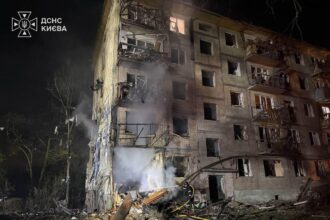
Ukraine’s State Emergency Service said its personnel were among those exposed to the second strike. Images and video from the scene showed extensive damage to the commercial complex, shattered storefronts and emergency crews working through debris as smoke rose from the building. Kryvyi Rih, President Volodymyr Zelenskyy’s hometown in central Ukraine, has repeatedly been targeted by Russian missiles and drones during the war. Ukraine’s Prosecutor General’s Office opened a criminal investigation into the strike as a possible war crime under Article 438 of the country’s Criminal Code.
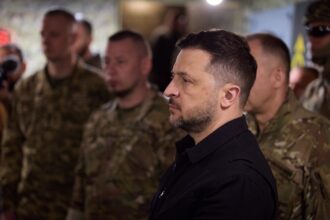
Ukrainian authorities characterized the sequence as a deliberate double-tap attack: a tactic in which an initial strike is followed by another attack on the same location after rescuers, security personnel or civilians have arrived. The timing of Friday’s second strike is consistent with such a sequence, but the available reporting does not independently establish that Russian forces deliberately timed the second drone to target emergency workers. President Volodymyr Zelenskyy accused Russia of deliberately trying to kill rescuers, but establishing the attackers’ intent would require further investigation.
That distinction matters legally. A second strike against a legitimate military objective is not automatically unlawful simply because emergency personnel have arrived. But deliberately directing an attack against civilians or civilian objects is prohibited under international humanitarian law, and medical personnel and civilian rescue workers performing humanitarian duties are separately protected from attack under the Geneva Conventions and customary international humanitarian law. That protected status is precisely why the timing of repeat strikes on locations where rescuers have gathered draws such close legal scrutiny, even where deliberate intent to target them has not been independently established.
The strike therefore raises questions that go beyond the immediate casualty toll. Investigators would need to establish what Russian forces were targeting, whether a legitimate military objective was present, what information was available to those directing the second attack and whether rescuers or civilians were deliberately targeted. The reported 20-to-30-minute interval between the two impacts is relevant evidence, but by itself does not establish intent.
Russia has repeatedly been accused of using successive strikes during its war against Ukraine, a pattern Ukrainian officials and rights monitors describe as a recurring feature of Russian attacks on populated areas rather than an isolated tactic. Human rights organizations and Ukrainian authorities have documented attacks in which additional munitions struck locations after emergency personnel arrived, creating particular danger for firefighters, paramedics and police responding to the initial explosion. Such incidents have made the period immediately following Russian missile and drone strikes increasingly hazardous for the people tasked with rescuing survivors.
Friday’s attack also underscores the continuing vulnerability of Ukrainian cities far from the immediate front line as Russia expands its use of long-range drones and missiles against targets across the country. For emergency services, the danger increasingly extends beyond surviving the first impact: responders must conduct rescue operations while assessing whether additional weapons may already be approaching. That calculus has become part of the routine risk facing Ukrainian first responders more than four years into Russia’s full-scale invasion.
The Kryvyi Rih strike will require further investigation before Ukrainian allegations of deliberate double-tap targeting can be established. What is already clear, however, is that the second attack occurred after the emergency response to the first had begun, turning a civilian disaster site into a renewed strike zone and exposing both survivors and those trying to rescue them to another wave of violence. The Prosecutor General’s Office investigation will seek to establish whether Friday’s sequence constituted a war crime, but the civilian toll stands regardless of its eventual findings.