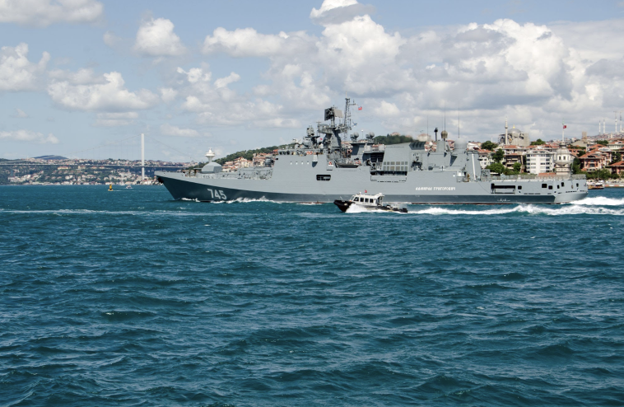
For the first time since Russia re-established a permanent Mediterranean naval task force in 2013, Moscow appears to have no major surface combatants deployed in the sea. Open-source naval monitoring identified the absence by July 1, after the frigate *Admiral Kasatonov* and replenishment tanker *Akademik Pashin* left the region following calls at Tartus, Alexandria and Oran in June. The Telegraph reported Friday that Western officials see the disappearance as evidence of a Russian surface fleet under severe strain, with one describing its condition as being in “a shambles.”
- Tartus No Longer Works the Way It Used To
- Turkey Turned Geography Against Moscow
- Ukraine’s Black Sea Campaign Has Effects Far Beyond the Black Sea
- The Shadow Fleet Is Becoming a Naval Mission
- A Navy That Can Still Fight, but Cannot Be Everywhere
- The Mediterranean Absence May Be Temporary. The Constraint Is Not.
The disappearance does not mean Russia has lost the ability to send warships back into the Mediterranean. It does, however, mark a striking reversal for a navy that used the region for more than a decade to support Russia’s intervention in Syria, monitor NATO, launch cruise missiles and demonstrate that Moscow could sustain military power far beyond its own coastline. The more important question is why Russia is no longer maintaining the continuous presence that once served as a symbol of its restored great-power ambitions, rather than whether it can return at all.
The answer involves more than one failed deployment or one missing ship. Russia’s Mediterranean contraction reflects several pressures arriving at the same time: the erosion of its military position in Syria, Turkey’s restriction of the Turkish Straits, Ukrainian attacks on the Black Sea Fleet, chronic maintenance and shipbuilding problems, and a growing requirement to use scarce surface combatants to protect the sanctioned commercial shipping network that helps finance the war in Ukraine. Each of those pressures alone might be temporary, but their coincidence is what has left the Mediterranean without a major Russian surface combatant for the first time in more than a decade.
Tartus No Longer Works the Way It Used To
For years, Russia’s Mediterranean posture depended on Syria. The naval facility at Tartus and Hmeimim air base allowed Moscow to sustain ships and aircraft in the eastern Mediterranean while supporting Bashar al-Assad’s government and projecting influence into the Middle East and North Africa. Tartus was especially valuable because it gave Russian vessels a logistics point much closer to their operating area than home ports in northern Russia or the Baltic.
Assad’s fall in December 2024, when Ahmad al-Sharaa’s forces swept into Damascus and forced Assad to flee to Moscow, changed that arrangement. Russia did not immediately lose access to Syria, but its position became dependent on negotiations with al-Sharaa’s new government, which had no reason to grant Moscow the exceptionally favorable terms it enjoyed under Assad. Those talks lasted roughly 18 months before producing a formal restructuring: under a memorandum signed on August 9, Syria will retake full civil administration of Hmeimim Airport and the fourth commercial berth at the port of Tartus, while the remaining military facilities convert into joint Syrian-Russian training centers.
Russia therefore retains a foothold, but not the same one. A facility operating under joint control is different from the secure logistics hub Moscow could treat as the backbone of an expeditionary force. Every reduction in assured access makes a permanent squadron more difficult and more expensive to sustain.
That matters because Russia’s Mediterranean task force was always dependent on logistics. A ship can cross Gibraltar and operate temporarily without Tartus. Maintaining a standing force month after month requires fuel, maintenance, crew support, ammunition handling and dependable port access.
Turkey Turned Geography Against Moscow
The second constraint is geographic. After Russia launched its full-scale invasion of Ukraine in February 2022, Turkey invoked the Montreux Convention and restricted passage through the Bosporus and Dardanelles for warships belonging to belligerent states. The measure disrupted Russia’s ability to freely rotate and reinforce naval forces between the Black Sea and Mediterranean and sharply reduced the utility of the Black Sea Fleet as the natural feeder for the Mediterranean squadron.
The legal distinction matters. Article 19 of the Montreux Convention allows belligerent warships that have become separated from their bases to return to those bases, meaning Russian Black Sea Fleet vessels are not categorically prohibited from returning home through the Straits. Turkey’s restrictions instead constrain Moscow’s ability to use the Bosporus and Dardanelles for routine wartime rotations and redeployments, removing much of the flexibility Russia enjoyed before 2022.
Before the full-scale invasion, the operational route was comparatively straightforward: ships based at Sevastopol could move through the Turkish Straits into the Mediterranean and later rotate back. Russia now has to rely much more heavily on vessels from the Northern and Baltic fleets for Mediterranean deployments, sending them through the North Sea, English Channel, Atlantic and Gibraltar before they even reach the theater. That is a much more demanding deployment cycle, consuming fuel, maintenance time and crew endurance while increasing the competing demands on Russia’s limited pool of modern ocean-going surface combatants.
Ukraine’s Black Sea Campaign Has Effects Far Beyond the Black Sea
Ukraine has also contributed directly to the problem. Since 2022, Ukrainian missiles and naval drones have destroyed or damaged numerous Russian vessels and forced much of the Black Sea Fleet away from Sevastopol. The campaign is usually discussed in terms of Ukraine restoring freedom of maneuver in the western Black Sea and pushing Russian ships farther from its coast, but the consequences extend beyond that theater.
The Black Sea Fleet historically supplied ships and personnel for Russia’s Mediterranean presence. When those vessels are lost, damaged, forced into more defensive postures or constrained by Turkey’s restrictions, Russia has to draw more heavily on its Northern and Baltic fleets for distant operations. That creates a wider force-allocation problem, since every frigate assigned to compensate for Black Sea losses is unavailable for another theater, and every deployment around Africa, northern Europe or the Mediterranean consumes readiness that cannot be duplicated elsewhere.
Ukraine has therefore produced a second-order effect rarely visible on maps of the Black Sea battlefield. By degrading one Russian fleet, Kyiv has increased the pressure on the others and made Moscow’s wider naval commitments more difficult to sustain. A campaign fought with cruise missiles and naval drones around Crimea has consequently contributed to Russia’s declining ability to maintain a permanent naval presence thousands of kilometers away.
The Shadow Fleet Is Becoming a Naval Mission
The newest pressure comes from Russia’s sanctioned oil trade. Western countries have intensified efforts to identify, sanction and in some cases board vessels linked to Russia’s so-called shadow fleet, the network of aging tankers and opaque ownership structures used to keep Russian oil moving despite sanctions. Moscow has responded by increasingly assigning naval vessels to escort commercially important shipping.
A NATO military official said in July that Russian shadow-fleet escort missions were consuming valuable days at sea and reducing the navy’s ability to generate forces for other missions. Russian ships have reportedly escorted merchant vessels through the English Channel, the Baltic and North seas and around Africa, forcing some warships into operations outside their usual areas. Tanker protection alone does not explain the disappearance of the Mediterranean squadron, since Russia’s decline there began earlier and is rooted in Syria, Montreux, wartime losses and structural weaknesses in the fleet, but the escort requirement adds another mission to a navy already struggling to cover its existing commitments.
The imbalance is obvious. Russia’s shadow fleet consists of hundreds of commercial vessels, while the number of modern Russian surface warships capable of sustained long-range operations is relatively small. Moscow cannot place a frigate beside every sanctioned tanker, but even selective protection consumes ships, crews and days at sea that could otherwise be allocated elsewhere.
That is one of the more unexpected consequences of sanctions enforcement. Western governments do not have to seize every ship to create pressure. If Russia feels compelled to divert naval assets merely to reduce the risk of interdiction, the commercial fleet begins competing directly with military deployments for scarce resources. That competition for available hulls is now another factor shaping Russia’s ability to sustain distant naval commitments.
A Navy That Can Still Fight, but Cannot Be Everywhere
None of this means the Russian Navy is collapsing as a whole. Russia still fields a formidable submarine force, retains long-range missile capability and can surge surface ships into specific theaters when the Kremlin considers the mission important enough. Its Northern Fleet remains central to nuclear deterrence, and Moscow continues to operate naval forces in the Baltic, Arctic, Pacific and waters around Europe and Africa.
The weakness is increasingly visible in simultaneous force generation. Russia wants a navy capable of defending its ballistic-missile submarines in the Arctic, contesting NATO in the North Atlantic and Baltic, supporting operations around Africa, sustaining access to the Mediterranean, protecting sanctioned commercial vessels and replacing ships lost or damaged in the war against Ukraine. Its surface fleet increasingly appears too small and too maintenance-intensive to perform all of those missions continuously at the same time.
That explains why the empty Mediterranean matters. NATO has not suddenly gained conventional superiority there because Russian ships departed, since Western navies already possessed far greater collective capacity. What has changed is Russia’s ability to maintain the political theater of permanent presence.
For Moscow, having a warship continuously visible in the Mediterranean was itself part of the message. It signaled that Russia could maintain military weight beside NATO and influence events from Syria to North Africa, going well beyond the profile of a continental power or a regional navy confined to nearby seas. Today, that message is harder to sustain.
The Mediterranean Absence May Be Temporary. The Constraint Is Not.
Russia will probably return major warships to the Mediterranean. The region remains strategically important, Moscow retains relationships with Syria and Algeria, and it has explored greater access to facilities elsewhere, including Libya and potentially Sudan. A future Russian deployment would therefore not invalidate the significance of the current absence.
The deeper problem is that every return will still confront the same arithmetic. Turkey’s restrictions remain, Syria’s bases are less secure than under Assad, Ukraine has damaged the fleet that once supplied much of the Mediterranean force, and tanker escorts are consuming additional surface-warship availability. Rebuilding that capacity would require more than moving ships around a map. It would mean overcoming Russia’s longstanding limits in shipbuilding, maintenance and deployment cycles.
Russia’s permanent Mediterranean squadron was created in 2013 as evidence that Moscow had returned to sustained blue-water operations. Thirteen years later, its inability to keep a major surface combatant there continuously illustrates how much the strategic environment has changed. Ukraine’s war has damaged ships in the Black Sea, Assad’s fall weakened Russia’s logistical foothold in Syria, Turkey restricted the easiest route between the Black Sea and Mediterranean, and Western pressure on sanctioned shipping has created another mission for Russia’s already stretched surface fleet.
Taken together, those pressures expose a vulnerability behind Russia’s image as a global naval power. Moscow still possesses warships capable of projecting force, yet it increasingly has to choose where those ships matter most and which missions can be left uncovered. The disappearance of its Mediterranean fleet shows the limits of Russia’s naval resources: Moscow still has warships, but fewer that it can spare for permanent deployments far from home.