Russia’s Pacific Fleet conducted coordinated anti-ship missile launches near the disputed southern Kuril Islands on Thursday, combining a cruiser, a nuclear-powered submarine and a shore-based Bastion missile system in an exercise that came a week after President Vladimir Putin’s unprecedented visit to one of the islands claimed by Japan. The Pacific Fleet said the weapons struck simulated enemy ships more than 300 kilometers away, though that claim has not been independently verified. The exercise added another military dimension to an already sharp diplomatic confrontation between Moscow and Tokyo over the disputed island chain.
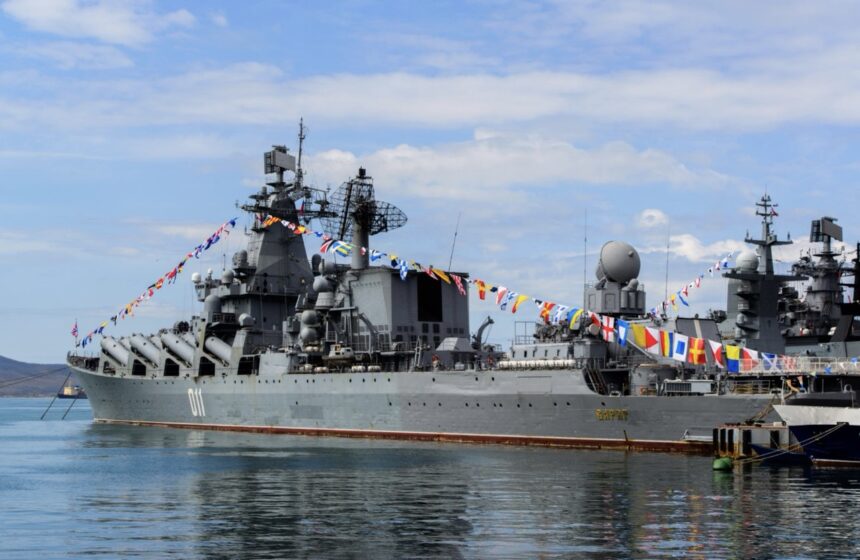
The drill involved three different anti-ship weapons. The Pacific Fleet flagship Varyag fired two Vulkan missiles, the nuclear-powered guided-missile submarine Omsk launched a salvo of Granit cruise missiles, and a Bastion coastal-defense battery fired an Oniks missile from one of the Kuril Islands. Russian naval aviation supplied targeting data, while the firing area was closed to civilian shipping and aircraft. The Pacific Fleet said all of the targets were hit, a claim that has not been independently verified.
The launches were part of a much larger Pacific Fleet training cycle rather than an exercise announced in direct response to Japan. Drills beginning on August 4 involved about 13,000 personnel, 60 surface ships, submarines and support vessels, and 30 aircraft and unmanned systems across the Sea of Japan, Sea of Okhotsk and northwestern Pacific, according to USNI News. Putin observed part of those exercises aboard Varyag on August 12 before traveling the following day to Iturup, known in Japan as Etorofu.
That visit transformed an already scheduled military exercise into a more politically charged demonstration. Putin became the first sitting Russian president to visit one of the four southern islands claimed by Japan. Tokyo protested, while Moscow subsequently summoned Japanese Ambassador Akira Muto and insisted that Russian sovereignty over the islands was not open to dispute. The Soviet Union seized the islands at the end of World War II, and Russia has administered them since. Japan calls them its Northern Territories and maintains that they are Japanese territory, and the unresolved dispute has prevented Moscow and Tokyo from signing a formal postwar peace treaty.
Japan had already protested the broader Russian exercises after Moscow notified Tokyo of live-fire activity around Kunashir and Iturup earlier this month, saying it could not accept moves that strengthen Russia’s military presence around the disputed islands. Japanese Prime Minister Sanae Takaichi separately called Putin’s visit to Iturup “absolutely unacceptable”, underscoring how the territorial dispute and the military buildup have become intertwined in Tokyo’s public response. The latest missile launches have reinforced those concerns as relations between the two countries remain badly strained by the territorial dispute and Japan’s sanctions over Russia’s full-scale invasion of Ukraine.
The military significance extends beyond the sovereignty dispute. The Kuril chain controls maritime approaches between the Pacific Ocean and the Sea of Okhotsk, a strategically important operating area for Russia’s Pacific Fleet. Thursday’s drill demonstrated Russia’s capacity to coordinate long-range anti-ship strikes from shore, surface and submarine platforms in a single engagement, with naval aviation providing targeting data. Such layered defenses can make it more difficult for an adversary to operate close to the Kuril chain and the approaches to the Sea of Okhotsk. Omsk is a nuclear-powered guided-missile submarine (SSGN) designed for anti-ship warfare. Its participation does not indicate that Thursday’s exercise involved nuclear weapons.
For Moscow, the exercise reinforces its ability to exercise military control over territory Japan continues to claim while strengthening defenses around Russia’s Far Eastern maritime approaches. For Tokyo, the combination of Putin’s visit and an increasingly visible Russian military presence makes an already frozen territorial dispute harder to insulate from the wider deterioration in Russia-Japan relations. The immediate risk of armed confrontation remains low, but further deployments, missile exercises or high-level Russian visits to the islands are likely to produce renewed Japanese protests and deepen a dispute that neither side currently shows signs of compromising over.