The Sahel’s security crisis is no longer defined by separate insurgencies in Mali, Burkina Faso and Niger. Militant groups now operate across a single interconnected theater, exploiting weak state control, a fractured regional bloc and a Russian security partnership too limited to fill the vacuum left by departing international forces. Violence is also reaching the seats of state authority themselves – from the blockade around Bamako to repeated attacks on Niamey’s international airport – while steadily pushing south toward the Gulf of Guinea.
A Confederation Without a Front Line
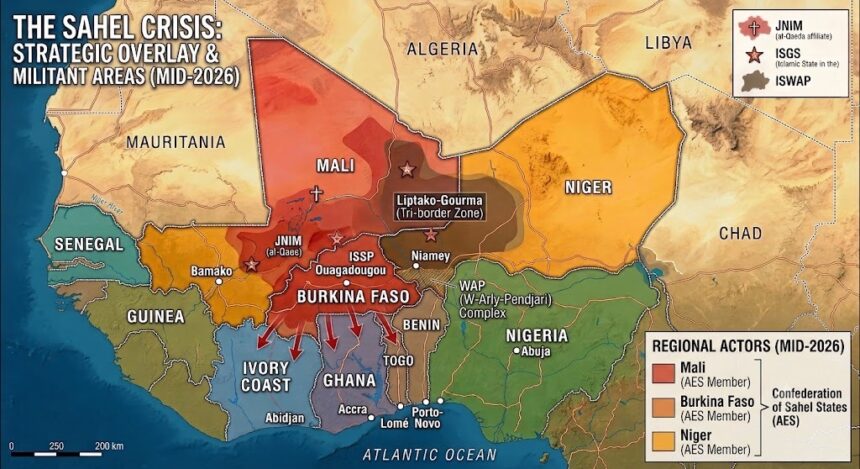
Mali, Burkina Faso and Niger have moved well beyond their 2023 mutual-defense pact, the Charter of Liptako-Gourma. In July 2024, they transformed it into the Confederation of Sahel States (AES) while retaining the French-derived acronym, and completed their withdrawal from ECOWAS in January 2025. The bloc has prioritized military sovereignty and deeper security ties with Russia over Western partnerships. Armed groups routinely operate across porous borders, making country-by-country assessments increasingly inadequate. The Sahel today functions as a single operational theater rather than three separate insurgencies.
A New and Alarming Convergence
Jama’at Nasr al-Islam wal-Muslimin (JNIM), al-Qaeda’s regional affiliate, remains the dominant militant force across much of Mali and Burkina Faso. The Islamic State Sahel Province (ISSP) maintains a smaller but highly capable presence in the Liptako-Gourma border region.
The most significant development of 2026, however, has been tactical rather than territorial. On April 25, JNIM and the Azawad Liberation Front (FLA) – a coalition of predominantly Tuareg separatist groups that previously fought alongside French and UN-backed forces against jihadists – coordinated attacks that killed Mali’s defense minister and enabled the seizure of Kidal, the symbolic center of the Tuareg independence movement. Analysts describe the partnership as pragmatic rather than ideological: the FLA offers territorial legitimacy and local networks in northern Mali, while JNIM provides manpower and combat capability. Their long-term political objectives remain fundamentally incompatible, making the alliance one of battlefield convenience rather than strategic unity.
Capitals Under Direct Pressure
The conflict is no longer confined to remote rural regions. JNIM has effectively closed many of the main roads into Bamako since last year, repeatedly attacking and burning food and fuel convoys headed for the capital, increasing economic pressure on the Malian government.
In Niger, militants struck Diori Hamani International Airport in Niamey on June 18 – the second attack on the facility this year – killing 11 soldiers and two civilians. Researchers at the Armed Conflict Location & Event Data Project (ACLED) say such attacks reflect an evolution in militant strategy, shifting from rural insurgency toward direct pressure on national centers of political authority.
The Russian Security Paradox
Russia’s Africa Corps, which absorbed Wagner’s remaining military footprint in Mali, is estimated to field roughly 2,000 personnel. That compares with the approximately 20,000 UN peacekeepers, French troops and regional forces that operated in the central Sahel before the series of military coups reshaped the region’s security architecture.
The comparison illustrates the scale of the security vacuum. Africa Corps has strengthened the military capabilities of allied governments through training, advisory support and operational assistance, but it lacks the manpower to replicate the territorial coverage once provided by multiple international missions operating simultaneously. During the April offensive, Africa Corps withdrew from Kidal, Aguelhok and Tessalit as militant forces advanced, leaving large areas beyond effective government control.
Humanitarian Crisis Deepens
The worsening security environment continues to fuel one of Africa’s largest humanitarian emergencies. Millions of people across Mali, Burkina Faso and Niger require humanitarian assistance, while conflict, food insecurity and climate pressures have displaced millions more. Aid organizations continue to face severe access constraints because of insecurity, damaged infrastructure and administrative restrictions, leaving many communities beyond the reach of regular humanitarian support.
Pressure Builds on Coastal West Africa
Perhaps the conflict’s most important strategic trend is its gradual expansion toward the Gulf of Guinea. JNIM has intensified operations near the borders of Benin, Togo and Côte d’Ivoire, prompting coastal governments to reinforce frontier security and expand military deployments. Although no sustained insurgent strongholds have yet emerged in these countries, repeated cross-border attacks indicate that militant groups are actively seeking to establish new operating areas beyond the traditional Sahelian battlefield.
Outlook
The Sahel increasingly functions as a single regional conflict system rather than a collection of national crises. Militant organizations exploit porous borders, military governments coordinate through the AES, and external actors continue to reshape the region’s security landscape without fundamentally reversing the insurgents’ momentum.
The most immediate risk is not the sudden collapse of any one government but the continued erosion of state authority across border regions, allowing militant groups to expand incrementally while pushing instability farther into coastal West Africa. Without stronger regional cooperation, more effective governance and sustained humanitarian access, one of the world’s most persistent conflicts is likely to become broader rather than more contained.