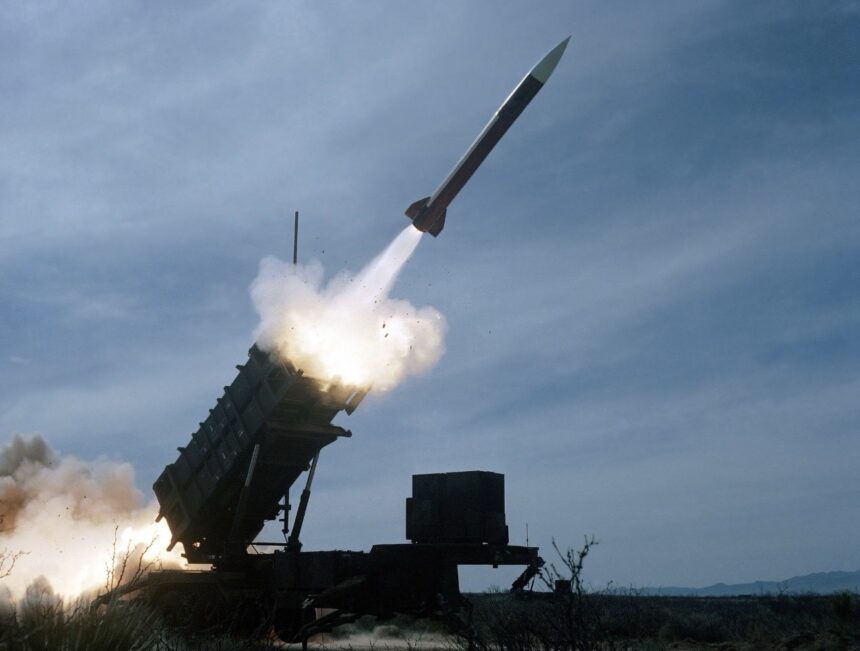
U.S. President Donald Trump said Washington will grant Ukraine a license related to Patriot air-defence production after meeting President Volodymyr Zelenskyy on the sidelines of the NATO summit in Ankara, describing the move as a way to strengthen Ukraine’s ability to defend itself against Russia’s sustained missile campaign.
“We’re going to give a license to you to make Patriots,” Trump said, adding that Ukraine would “figure out the complexity quickly.” He argued the arrangement would allow Kyiv to build its own capability rather than depend solely on additional U.S. deliveries, telling Zelenskyy that Washington could “tell you to make them yourselves.”
If implemented, the proposal would represent a shift from emergency weapons transfers toward longer-term defence-industrial cooperation. Rather than relying exclusively on shipments from existing U.S. inventories, licensed production could eventually expand the industrial base supporting Ukraine’s air-defence network. The practical scope of the proposal, however – including whether it would cover interceptor missiles, components, assembly or broader Patriot system production – has not yet been publicly clarified.
No Contractor, No Contract Yet
Trump acknowledged he had not coordinated the announcement with industry before making it. No manufacturer-level licensing agreement involving Lockheed Martin or RTX (formerly Raytheon Technologies), the principal companies responsible for Patriot production, has been publicly announced, nor have Washington or Kyiv released details covering technology transfer, intellectual property, production standards or implementation timelines.
The announcement therefore functions primarily as a political commitment rather than an operational programme.
Although Ukraine has consistently argued that expanding Patriot production is essential to counter Russia’s growing missile campaign, translating Wednesday’s announcement into operational manufacturing would require formal agreements with industry, certified production facilities, technology-transfer arrangements and regulatory approvals that have yet to be negotiated or disclosed.
Ukraine has repeatedly warned that Russian missile production continues to outpace the rate at which Western partners can replenish advanced interceptor stocks, although precise production figures vary between official and independent assessments.
Part of a Wider NATO Push
The bilateral meeting came amid renewed Russian long-range strikes against Ukrainian cities and broader discussions at the NATO summit on strengthening Ukraine’s air-defence architecture.
A day earlier, Zelenskyy met NATO Secretary General Mark Rutte to discuss expanding allied support through the Priority Ukraine Requirements List (PURL), the mechanism under which European allies and Canada finance purchases of U.S.-made military equipment for Ukraine. The two leaders also discussed Ukraine’s proposal for an Anti-Ballistic Coalition, aimed at increasing allied cooperation against Russia’s growing use of ballistic missiles.
Zelenskyy reiterated that expanding Patriot capability remains Ukraine’s most urgent military requirement as Russian forces continue combining ballistic missiles, cruise missiles and long-range drones in increasingly complex strike packages designed to stretch Ukrainian air defences.
The discussions also build on commitments made by G7 leaders in Évian in June to explore ways of expanding Ukraine’s domestic defence-industrial capacity through licensed production and closer cooperation with Western manufacturers.
A Different Form of Military Assistance
Licensing production represents a fundamentally different form of military support than transferring weapons directly from existing inventories. Rather than drawing additional interceptors from already limited U.S. stockpiles, the objective is to expand long-term production capacity available to Ukraine and its partners.
Whether that strategy succeeds will depend not on Wednesday’s announcement alone but on the industrial agreements that follow. Technology transfer, manufacturing certification, workforce training and supply-chain integration would all be required before Ukraine could produce Patriot equipment domestically.
For now, Trump’s announcement marks an important political signal of continued U.S. support for Ukraine’s air defence rather than an immediate expansion of its battlefield capabilities. A licensing announcement and a functioning production line are separated by months – potentially years – of negotiations, industrial preparation and regulatory approval. Whether the proposal ultimately changes the balance of missile production will depend on agreements that have yet to be negotiated and made public.