NATO leaders met this week in Ankara to review a defence spending commitment now four years in the making. French President Emmanuel Macron argued that Europe had fundamentally strengthened its defence effort. The summit suggested that point is no longer in serious dispute. The harder question is whether unprecedented spending commitments can be converted into lasting military capability built inside Europe rather than purchased abroad.
The mechanism driving that spending is already in place. At the 2025 NATO summit in The Hague, the alliance’s 32 members agreed to invest 5 percent of GDP annually on defence and security by 2035 – 3.5 percent on core military requirements and 1.5 percent on related infrastructure, cyber defence and national resilience. Spain secured an exemption, keeping its commitment close to 2.1 percent of GDP. The agreement effectively replaced the 2 percent benchmark adopted at the 2014 Wales summit, more than doubling NATO’s baseline expectation within little more than a decade.
Reaching the 3.5 percent core target alone would push NATO’s collective defence spending toward roughly $2.4 trillion by 2035, representing a major real-terms increase over current levels. Ankara did not revisit that figure. Instead, it highlighted a different problem: alliance members remain uneven in their ability to transform larger budgets into military capability.
That challenge is becoming less about how much Europe spends than about how it allocates scarce industrial, financial and political resources. Procurement choices, defence-industrial capacity, research funding and fiscal priorities are increasingly competing for the same pool of public investment. The debate has therefore shifted from spending targets to strategic allocation.
The imbalance is most visible in procurement. Between February 2022 and mid-2023, roughly three-quarters of publicly announced European Union defence orders went to suppliers outside the bloc, according to research by the French strategic institute IRIS that was later cited in Mario Draghi’s 2024 European competitiveness report. The estimate has since been challenged by the International Institute for Strategic Studies, which concluded that European firms accounted for closer to half the value of contracts over the same period because the earlier methodology excluded domestic procurement. The precise share remains debated. The broader conclusion does not. European governments continue directing a substantial portion of their rearmament budgets to non-European – predominantly American – manufacturers, strengthening external production capacity even as they seek greater strategic autonomy.
Brussels has begun trying to reverse that trend. The European Union’s Readiness 2030 initiative aims for 55 percent of member states’ defence procurement to come from European or Ukrainian manufacturers by 2030, while joint procurement is expected to reach 40 percent by 2027. Germany’s procurement plans through 2026 similarly allocate only about 8 percent of planned acquisitions to American suppliers, signalling a deliberate effort to rebuild domestic and European industrial capacity. The objective is straightforward: ensure higher defence spending expands Europe’s own manufacturing base rather than primarily financing foreign producers. Whether that objective can overcome decades of reliance on readily available American equipment remains uncertain.
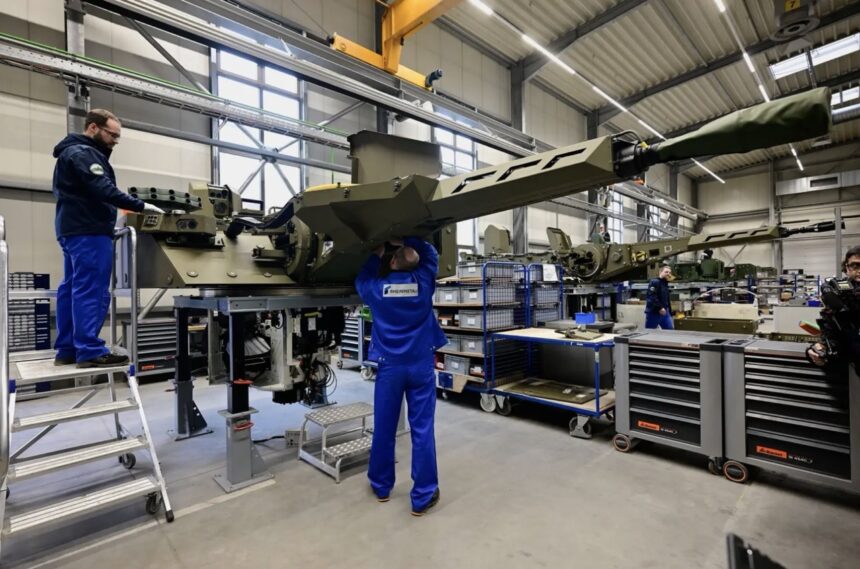
Money, however, is only part of the equation. Defence production operates on industrial timelines that governments cannot accelerate simply by approving larger budgets. Ammunition plants, missile assembly lines, skilled engineering workforces, explosives production, machine tools and specialised supply chains require years to expand. Europe’s allocation challenge is therefore also a sequencing challenge. Financial commitments can be announced overnight; industrial capacity cannot.
That constraint is increasingly pushing defence policy into areas traditionally regarded as civilian investment. Programmes under the European Defence Fund, including its “spin-in” initiatives, are designed to adapt civilian research for military applications. European Commission policy proposals have also explored allowing cohesion funds – originally intended to reduce regional economic disparities – to support defence-related investment. The Commission’s 2026 White Paper on dual-use research proposes opening the successor to Horizon Europe, the bloc’s flagship civilian research programme, to defence applications for the first time. Supporters argue the measures strengthen Europe’s technological sovereignty. Critics in the European Parliament warn they risk gradually redirecting civilian research budgets toward military priorities.
The same tension extends to national finances. Governments pursuing higher defence spending must also sustain healthcare systems, pensions, education and ageing populations. Poland already spends close to 4.8 percent of GDP on defence, while Germany has permanently stationed an armoured brigade in Lithuania – its first standing combat brigade abroad since 1945. Several southern European governments, meanwhile, are expected to struggle to reach NATO’s 3.5 percent core target. Defence spending has therefore become not only a security question but also a test of long-term fiscal sustainability and domestic political consensus.
Beneath NATO’s display of unity lies another strategic divergence. The alliance’s planning documents continue to identify Russia as its principal long-term military threat. Elements of the current U.S. administration’s strategic thinking, by contrast, increasingly describe Russia as a challenge that can be managed while framing China as the primary long-term competitor. That distinction matters. If Washington progressively shifts strategic attention toward the Indo-Pacific, European governments may face greater pressure to finance – and produce – the capabilities that previous generations of American security guarantees helped provide.
The Hague agreement established a spending target. Ankara demonstrated that spending alone cannot determine strategic outcomes. The more difficult questions concern where the money is invested, who manufactures the equipment, how quickly industrial capacity can expand and which civilian priorities governments are prepared to sacrifice along the way. Europe’s rearmament will ultimately be measured less by the percentage of GDP devoted to defence than by whether those investments produce a more resilient and technologically independent defence-industrial base – or simply a more expensive version of the dependencies they were intended to reduce.