Belarusian President Alexander Lukashenko made an unusually explicit promise to his servicemen in early July: “No one is going to send you into this slaughter.”
The declaration came after weeks of rising tension. Ukrainian President Volodymyr Zelenskyy openly accused Russia of trying to pull Belarus deeper into the war, Kyiv threatened action against military infrastructure inside Belarus that it said was assisting Russian attacks, and Lukashenko held closed talks with Russian President Vladimir Putin before travelling to Beijing to meet Chinese President Xi Jinping.
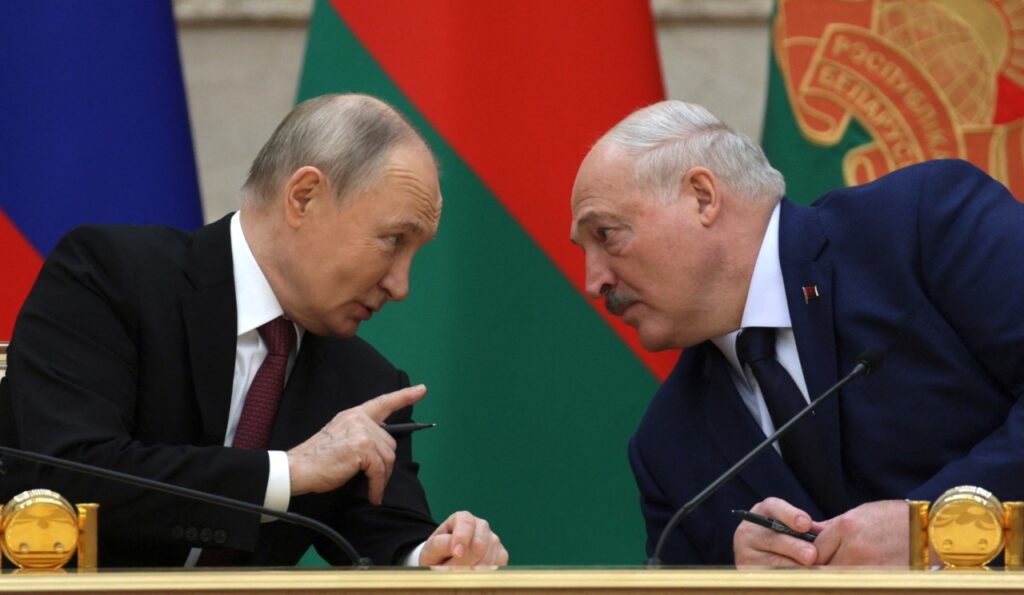
the Union State. Source: Gavriil Grigorov / via REUTERS
The Wall Street Journal reported in June, citing current and former Russian and European officials, that Moscow had begun a pressure campaign earlier in 2026 aimed at using Belarus as a springboard to expand the war in Ukraine or conduct unconventional operations against NATO states.
The Kremlin denied the report.
Behind these developments lies a three-way strategic struggle
Putin is seeking to draw Belarus deeper into Russia’s war.
Lukashenko, despite his dependence on Moscow and extensive support for the Russian war effort, is trying to avoid crossing the final threshold into direct military participation.
Ukraine, knowing exactly what happened when Belarusian territory was used for the assault on Kyiv in 2022, is increasingly prepared to deter, expose and disrupt any renewed attempt to turn its northern neighbour into a more active platform for Russian aggression.
Belarus is already part of Russia’s war effort.
It has provided territory, infrastructure, training facilities and industrial support to Moscow in 2022. What it has not done yet – is to send its regular army into Ukraine.
That distinction is becoming increasingly difficult for Lukashenko to preserve.
For Ukraine, the danger is not theoretical.
When Russia launched its full-scale invasion on February 24, 2022, Russian forces attacked Ukraine from Belarusian territory and advanced south towards Kyiv.
Belarusian territory and infrastructure also supported Russian military operations. The northern assault ultimately failed, and Russian forces withdrew from the Kyiv region.
But the experience fundamentally shaped Ukraine’s perception of the Belarusian threat.
A June assessment by the European Union Institute for Security Studies found that Belarus hosts combat-support systems, provides training to Russian forces and supplies equipment and ammunition to the Russian war effort.
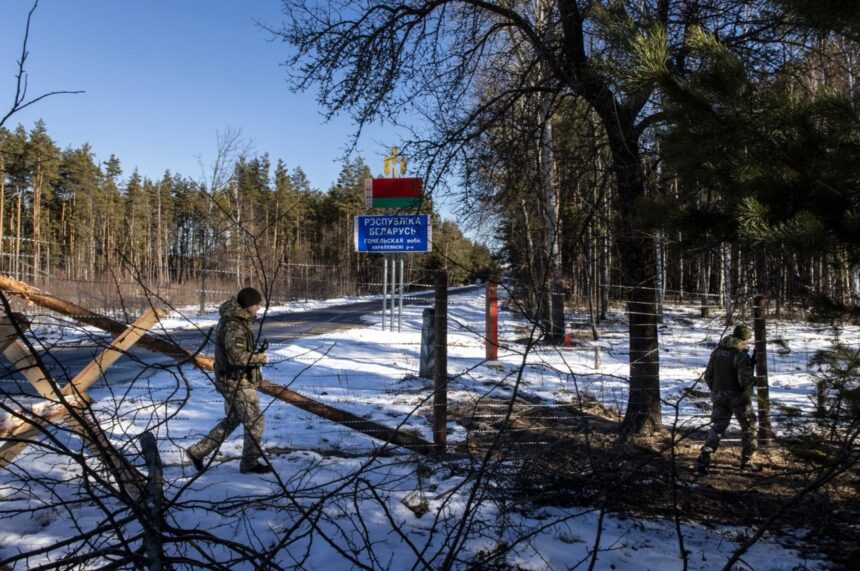
Ukraine must also keep forces deployed along its roughly 1,000-kilometre northern border to guard against a renewed threat.
Even preparations for a new front can serve Moscow’s interests by forcing Kyiv to keep troops and air-defence assets away from active battlefields in the east and south.
That is why Zelenskyy’s warnings have become increasingly sharp.
In an open letter to Putin on June 4, Ukrainian President said directly: “You want to draw Belarus even deeper into this war, and we are now forced to prepare for that as well.”
Two weeks later, the Ukrainian president went further. In an official address on June 20, Zelenskyy said Ukraine had identified four signal relay stations in the Gomel and Brest regions that were working for Russia and helping enable drone attacks against Ukrainian territory.
He warned that Belarus had time to remove the equipment.
By June 22, the stations appeared to have stopped operating.
Pro-war Russian bloggers complained about their disappearance, and Zelenskyy later said the facilities were no longer functioning, although Minsk never publicly acknowledged shutting them down and there was no independent confirmation of the Ukrainian account.
The mechanics mattered more than the dispute. Kyiv had issued a public deadline concerning assets on the sovereign territory of a Russian ally that hosts Russian nuclear weapons — and the assets went dark.
The episode established a new Ukrainian approach: infrastructure on Belarusian territory that directly enables Russian attacks can be publicly identified, given a deadline and implicitly threatened with destruction.
Ukraine is no longer prepared simply to monitor Belarusian complicity. It is signalling consequences.
The Union State Gives Putin a Ready-Made Framework
The danger is greater because Russia and Belarus are not merely conventional military allies.
On paper, they form the Union State of Russia and Belarus, a formal integration structure established by treaty in 1999. The two countries remain separate sovereign states under international law, but the Union State provides an existing institutional framework for economic, political and increasingly deep military integration.
Russia and Belarus operate a joint regional grouping of forces. Russian tactical nuclear weapons are deployed on Belarusian territory.
In December 2024, Putin and Lukashenko signed a new treaty on security guarantees within the Union State, reinforcing a common security architecture that already gives Moscow considerable military access and leverage.
The treaty was subsequently ratified, and during a March 2025 joint news conference, Putin said the two countries were establishing a unified defence space, with a joint regional grouping of forces, advanced Russian defence systems and tactical nuclear weapons already present in Belarus.
The European Union Institute for Security Studies assessed in June that this deepening military integration is steadily eroding Belarusian sovereignty and increasingly turning Russia and Belarus into a single military space.
For Putin, therefore, bringing Belarus further into the war does not require creating a new alliance from scratch.
Much of the architecture already exists. The question is how far Moscow intends to use it.
The Wall Street Journal’s reporting suggested that Russian pressure had intensified in 2026. Kyiv has also repeatedly said it believes Putin wants Lukashenko to become more deeply involved.
For Lukashenko, the danger is equally clear. He has already allowed Belarus to become a military platform for Russia.
Sending Belarusian troops into Ukraine would cross a far more dangerous threshold, exposing his own armed forces to combat, increasing the risk of Ukrainian retaliation and further reducing what remains of Belarusian sovereignty.
His political problem is that his room for resistance is much smaller than it once was.
Russia’s Fuel Crisis Gives Lukashenko New Leverage
Yet Lukashenko is not entirely without instruments.
Ukrainian drone attacks have severely damaged Russian oil-refining capacity and contributed to fuel shortages across the country.
Moscow has increasingly turned to Belarus to help cover the gap.
In his June 20 address, Zelenskyy said gasoline supplies from Belarus to Russia had increased thirteenfold between January and May compared with the same period a year earlier, while diesel supplies had tripled.
Separate industry data subsequently reported by Reuters showed that Belarusian gasoline and diesel deliveries to Russia continued to rise sharply.
The volumes still cover only part of Russia’s fuel deficit.
They do not overturn the fundamental balance of power between Moscow and Minsk.
But they give Lukashenko a new, if limited, source of leverage at precisely the moment Moscow is seeking more from Belarus.
The Novopolotsk and Mozyr refineries have become increasingly important to the Russian domestic market.
That does not make Belarus indispensable, but it complicates the assumption that Russia can pressure Minsk without cost.
The relationship is still profoundly unequal. Lukashenko remains dependent on Russian political, economic and military support.
But dependence now runs in more than one direction.
And Lukashenko has spent decades trying to turn precisely such dependencies into room for manoeuvre.
Lukashenko Looks to Washington and Beijing
Lukashenko has ruled Belarus since 1994 partly through an extraordinary ability to balance stronger powers.
For years, he extracted economic support from Moscow while periodically improving relations with the West whenever Russian pressure became uncomfortable.
He resisted some Russian demands for deeper integration, quarrelled with the Kremlin over energy and trade and cultivated relationships outside Moscow.
That strategy became much harder after the disputed 2020 presidential election and the mass protests that followed.
Facing international isolation and a domestic challenge to his rule, Lukashenko became increasingly dependent on Putin’s support.
Belarus’s role in the 2022 invasion narrowed his options further. But he has not abandoned balancing altogether.
The United States has reopened direct contacts with Minsk under U.S. President Donald Trump.
In December 2025, Washington lifted sanctions on Belarus’s potash sector in exchange for the release of 123 political prisoners.
In March 2026, after talks with U.S. envoy John Coale, Lukashenko released another 250 prisoners while Washington eased further restrictions.
The diplomacy does not mean Belarus is escaping Russia’s orbit.
But it gives Lukashenko something he badly needs: an alternative diplomatic channel and evidence that Moscow is not his only interlocutor.
China serves a similar purpose
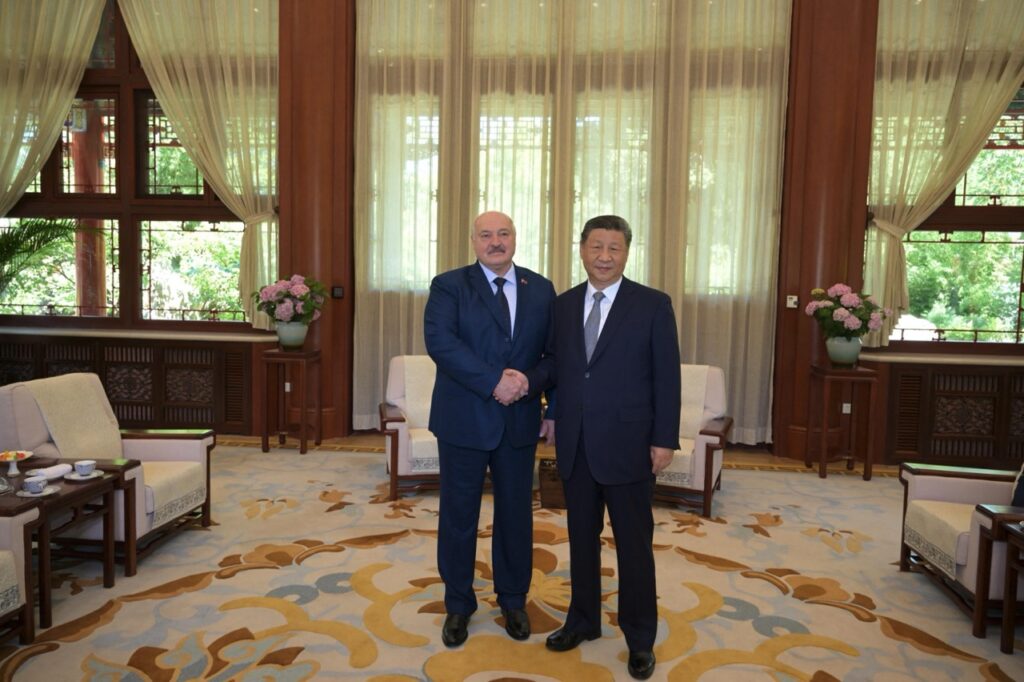
against absolute subordination. Source: Press Service of the President of Belarus.
Days after his closed meeting with Putin, Lukashenko met Xi in Beijing on June 29. According to the official Chinese Foreign Ministry account of the meeting, Xi said China supported Belarus in safeguarding its “national sovereignty, independence, and territorial integrity.”
The language was striking at a moment when Russian pressure and Belarusian autonomy were becoming increasingly public issues.
Neither Washington nor Beijing can shield Lukashenko from Moscow.
Neither can undo Belarus’s structural dependence on Russia. But both give him additional room to manoeuvre and raise the price Moscow may have to pay to close his remaining options.
This is Lukashenko’s old strategy under far more dangerous conditions: give Moscow enough to preserve the alliance and his own regime, while finding just enough external space to avoid complete subordination.
The central question is whether that space still exists.
Ukraine Draws Its Own Red Line
Ukraine has no reason to trust Lukashenko’s balancing act.
From Kyiv’s perspective, Belarus already crossed a fundamental line in 2022 by allowing Russian forces to attack from its territory.
The fact that Belarusian troops themselves did not cross the border does not erase the military consequences of Minsk’s decision.
But Ukraine also has a clear interest in preserving the distinction between the current level of Belarusian involvement and direct participation by its armed forces.
A new northern front would force Kyiv to divert scarce troops, reserve formations and air-defence systems from other theatres.
Even credible preparations for such an attack can benefit Russia by pinning Ukrainian forces away from the main battlefield.
That is why Ukraine is trying to act before a new attack begins.
Zelenskyy’s increasingly direct warnings are part of that strategy. So was the ultimatum over the drone relay stations.
Kyiv is signalling that military assets in Belarus which directly enable Russian attacks may become targets, while simultaneously making clear what Minsk must do to prevent further escalation.
Lukashenko has responded by insisting that it is Ukraine, not Russia, that risks dragging Belarus into the war.
The Kremlin has rejected claims that it is pressuring Minsk to widen the conflict. But the deeper strategic reality remains.
Putin is seeking more from Belarus: more military infrastructure, more industrial support, more pressure on Ukraine’s northern border and potentially deeper participation in the war.
Lukashenko is trying to give Moscow enough to preserve his alliance and his regime while avoiding the final step of sending Belarusian troops into combat.
Ukraine, remembering the assault launched from Belarus in February 2022, is no longer prepared simply to watch and wait.
The contest is no longer over whether Belarus is involved in the war. It already is.
The question is whether Putin can erase the remaining distinction between Belarus as Russia’s military platform and Belarus as a direct combatant — whether Lukashenko still has enough room to resist him, and how far Ukraine is prepared to go to prevent that threshold from being crossed.