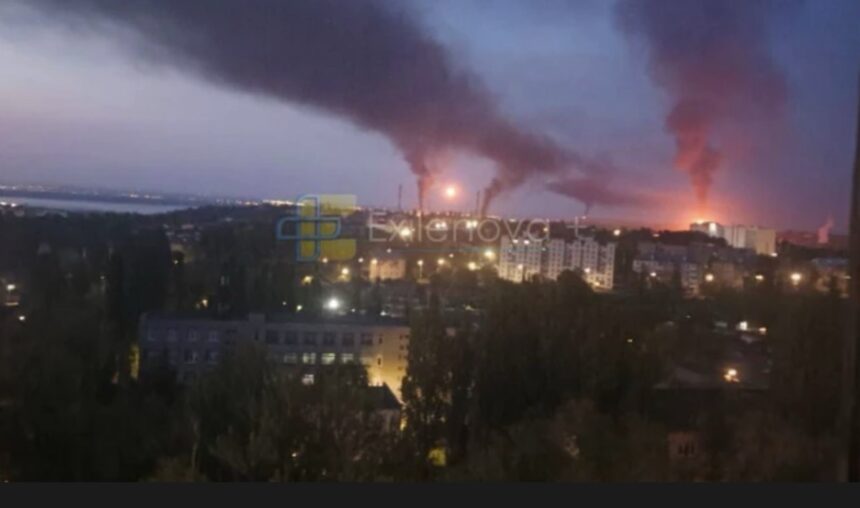
Russia has suspended diesel exports until at least the end of July after months of Ukrainian drone strikes disrupted refineries, fuel depots and fuel transport infrastructure, forcing Moscow to prioritize domestic supply over overseas sales. The suspension is not a routine market intervention. Russian refiners have historically produced roughly twice as much diesel as the domestic market consumes, exporting about half their annual output. A country built on structural fuel surplus is now importing petroleum products while restricting exports—one of the clearest signs yet that Kyiv’s long-range drone campaign is fracturing Russia’s internal energy logistics, not merely reducing export revenue.
Deputy Prime Minister Alexander Novak announced the export suspension during a televised government meeting chaired by President Vladimir Putin, saying the measure would redirect more diesel to the domestic market. Novak said Russia would begin importing petroleum products this month while increasing output at operating refineries by allowing the use of fuels that meet lower environmental standards. In practice, that means refiners may blend fuel closer to the older Euro-3 specification rather than the Euro-5-equivalent standard used at Russian filling stations for more than a decade—a quality trade-off Moscow is now accepting to stabilize domestic fuel supplies under mounting pressure on its logistics network.
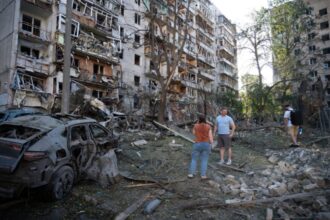
The restrictions follow months of increasingly ambitious Ukrainian strikes targeting Russia’s energy infrastructure. Ukrainian officials say attacks on refineries, storage facilities and fuel logistics are intended to weaken Moscow’s ability to sustain military operations while reducing the energy revenues that help finance the war.
The economic impact is becoming more specific than simply “damage.” The International Energy Agency cut its Russian oil supply outlook for both this year and next by 85,000 barrels per day and 150,000 barrels per day respectively, lowering expected production to an average of 8.8 million barrels per day across the forecast period. In its July Oil Market Report, the agency cited continued attacks on refineries, storage facilities and transport infrastructure as a growing constraint on Russia’s energy sector. At the same time, the IEA reported that Russian crude exports from western ports reached nearly 3 million barrels per day in June, the highest level on record. Refining capacity is shrinking while exports of unprocessed crude are rising—evidence that Russia is increasingly being pushed down the value chain, from exporting higher-value refined fuels toward selling raw crude instead. For a country whose energy sector has long depended on refining as a source of added value, the shift suggests that processing infrastructure is becoming progressively harder to defend against sustained long-range strikes.
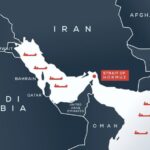
The disruption is also colliding with a separate global shock. Benchmark European diesel refining margins climbed to a record $60.17 per barrel after the export ban, while U.S. ultra-low-sulfur diesel futures rose 11.6% to $154.71 per barrel, their largest daily gain in four years, according to Reuters. The timing is significant. President Donald Trump said this week that the U.S.-Iran ceasefire was “over” following attacks on tankers near the Strait of Hormuz, while Iran threatened to close the strategic waterway to maritime traffic. According to S&P Global, roughly one-fifth of the world’s oil trade normally passes through the strait. The result is an unusual convergence: Ukrainian strikes are constraining Russian refined-fuel exports just as renewed instability around the Strait of Hormuz threatens another major source of global diesel supply.
Russia remains one of the world’s largest diesel exporters, so any sustained reduction in exports carries consequences well beyond its borders. But the more revealing indicator is the rationing now emerging inside the country. Authorities have introduced per-vehicle fuel limits in Murmansk region and Karelia, while other regions, including Astrakhan, have adopted odd-even license plate purchasing systems to manage shortages. Whether the export ban proves temporary or evolves into a longer-term policy, it illustrates a broader shift in the war’s economic dimension. Ukraine’s long-range drone campaign is no longer measured only by damaged refineries, but by its growing ability to force policy decisions inside Russia and reshape energy markets far beyond the battlefield.