More than four years into Russia’s full-scale invasion, the struggle for control of Ukraine’s skies has become one of the defining contests of the war. Moscow is no longer seeking decisive effects from individual missile barrages. Instead, it is using sustained waves of drones and missiles to wear down Ukraine’s air defenses, exhaust Western interceptor production and force Kyiv into a prolonged war of industrial attrition.
The campaign’s scale illustrates that shift. Russia launched a record 8,150 long-range drones against Ukraine in May, according to an AFP analysis of Ukrainian Air Force data. That represented a 24 percent increase from April and reflected Moscow’s growing ability to sustain high-tempo attacks over consecutive months. Ukrainian authorities reported intercepting 7,476 of those drones – 91.7 percent of the total – but the headline figure conceals an increasingly important reality: Russia is no longer trying simply to penetrate Ukrainian air defenses. It is trying to overload them.
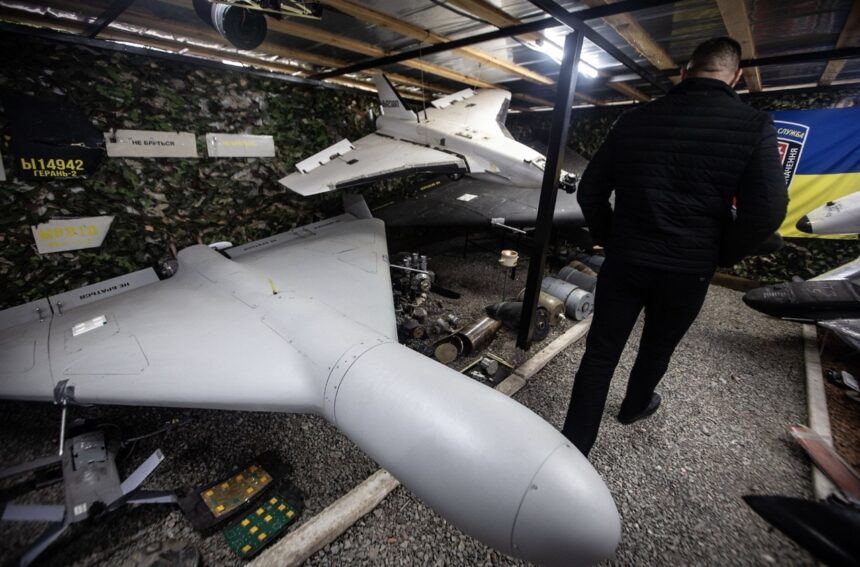
Large strike packages now routinely combine Shahed-type (Geran) attack drones, cruise missiles, ballistic missiles, decoys and electronic-warfare measures. The objective is cumulative rather than immediate. Every interceptor fired, radar activated, repair crew deployed and night spent under air-raid alerts contributes to a broader campaign intended to stretch Ukraine’s military, economic and psychological endurance.
A Campaign Built Around Saturation – and a Growing Capability Gap
Russian strike packages have become markedly more sophisticated than those employed during the invasion’s first years. Rather than relying on a single class of weapon, attacks increasingly arrive in carefully sequenced waves launched from multiple directions and altitudes. Slow-moving drones may force Ukrainian defenders to reveal radar positions and commit interceptor drones before cruise and ballistic missiles arrive on different flight paths. Decoys further complicate target identification and resource allocation.
This layered approach compresses Ukraine’s decision cycle. Air-defense commanders must distinguish genuine threats from false targets while deciding which assets deserve scarce high-end interceptors and which can be engaged by cheaper systems.
Aggregate interception statistics also mask a widening divergence between weapon types. Ukraine’s Defense Ministry reported an overall interception rate of roughly 89 percent against drones and missiles in June. Against ballistic missiles, however, the interception rate fell to about 40 percent.
The contrast became especially visible during Russia’s July 6 strike package. Ukrainian forces intercepted nearly every Kh-101 cruise missile and all Kalibr cruise missiles launched that night, but failed to destroy any of the Iskander-M ballistic missiles or Zircon and Onyx missiles included in the same barrage. Air Force spokesman Yurii Ihnat attributed the outcome to shortages of Patriot interceptor missiles, describing it as part of a wider supply problem affecting production rather than a uniquely Ukrainian shortfall.
The disparity reflects physics as much as inventory. Drones and cruise missiles travel at lower speeds and along comparatively predictable flight paths, allowing them to be engaged by layered defenses that include mobile anti-aircraft units, electronic warfare and increasingly capable FPV interceptor drones. Ballistic missiles descend at hypersonic terminal speeds along steep trajectories that leave only seconds for engagement. At present, only systems such as Patriot can reliably defeat them, making each interceptor significantly more valuable than those used against drones.
The Real Battlefield Is Industrial Capacity
The campaign increasingly resembles a competition between industrial systems rather than individual armed forces.
Russia has expanded production of Geran drones at the Alabuga industrial complex while adapting designs to overcome Ukrainian countermeasures. Access to commercially available foreign components, redesigned supply chains and simplified manufacturing have allowed Moscow to increase both production volume and operational tempo despite Western sanctions.
Ukraine, meanwhile, has pursued a different model. Rather than concentrating production in a few large facilities, it has expanded distributed manufacturing through a network of domestic companies capable of rapidly developing and modifying drone systems. This decentralized approach has shortened development cycles and allowed Ukrainian engineers to respond quickly to changes in Russian tactics.
The contest has therefore evolved beyond the battlefield. It now encompasses factories, supply chains, export controls, engineering teams and the ability of each side – and its partners – to innovate faster than its opponent.
Ukraine Adapts – and Russia Responds
Ukraine’s layered air-defense architecture combines Western systems such as Patriot, SAMP/T and NASAMS with Soviet-era platforms, mobile anti-aircraft units, electronic warfare and a growing fleet of domestically produced interceptor drones.
Low-cost FPV interceptor drones have become one of Ukraine’s most significant innovations. Systems such as the Wild Hornets’ Sting have enabled defenders to destroy large numbers of Shahed-type drones at a fraction of the cost of advanced missile interceptors, preserving scarce Patriot missiles for ballistic threats.
Russia has already begun adapting.
The Geran-3 introduced turbojet propulsion capable of speeds approaching 500 km/h. The newer Geran-4 combines similar performance with greater maneuverability, explicitly targeting the speed limitations of first-generation Ukrainian interceptor drones, according to Ukraine’s Defense Intelligence Directorate.
Ukraine’s response has been equally rapid. Developers introduced the STING 2.0 after determining that successful interception generally requires an interceptor to maintain a meaningful speed advantage over its target while retaining sufficient endurance to search for incoming drones. Rather than maximizing speed alone, designers prioritized the balance between velocity, maneuverability and flight time.
The resulting cycle of adaptation is measured not in years but in months. Each innovation rapidly generates a countermeasure, shortening the time between technological breakthrough and battlefield response.
NATO’s Industrial Test
Russia’s campaign is also exposing structural weaknesses within NATO’s defense-industrial base.
The challenge extends well beyond supplying additional Patriot batteries. Sustained missile defense requires continuous production of interceptors, radar components, launch systems, replacement parts and trained personnel. Much of that capacity declined after the Cold War and is only now being rebuilt.
The proposal announced during the NATO summit in Ankara to license Ukrainian production of Patriot interceptors reflects growing recognition that Ukraine’s air defense cannot depend indefinitely on existing Western stockpiles. Yet even optimistic estimates suggest that meaningful domestic production remains years away because of the system’s technical complexity and multinational supply chain.
The broader lesson extends beyond Ukraine. NATO increasingly views the conflict as a large-scale operational laboratory for integrated air and missile defense, electronic warfare, counter-drone operations, dispersed infrastructure protection and the economics of missile interception. Many of the adaptations now occurring over Ukrainian skies are likely to influence allied force planning long after the current war ends.
Civilian Infrastructure Remains a Strategic Target
Civilian infrastructure is not merely collateral damage within Russia’s long-range campaign. Electricity substations, railway junctions, logistics hubs, industrial facilities and repair depots underpin Ukraine’s ability to sustain military operations and civilian life simultaneously.
Even temporary disruptions require authorities to divert engineers, emergency services and financial resources toward repairs rather than military priorities. Frequent overnight attacks also impose cumulative psychological pressure through repeated air-raid alerts, interrupted education, disrupted healthcare and persistent uncertainty for millions of civilians.
International humanitarian organizations continue to warn that damage to energy, water and healthcare systems disproportionately affects older people, children and those requiring continuous medical treatment.
What to Watch
Five developments are likely to shape the next phase of Russia’s long-range strike campaign.
First, whether Russia can continue expanding production of jet-powered Geran variants faster than Ukraine develops effective countermeasures.
Second, whether Ukraine’s stocks of Patriot interceptors can be replenished quickly enough to narrow the widening gap against ballistic missiles.
Third, how rapidly Ukrainian industry can scale next-generation interceptor drones capable of countering increasingly fast and maneuverable Russian systems.
Fourth, whether NATO’s industrial expansion produces sufficient interceptor missiles and air-defense equipment to sustain Ukraine while rebuilding allied stockpiles.
Finally, whether both sides continue accelerating the cycle of technological adaptation, shortening the time between innovation and battlefield deployment.
Taken together, these indicators suggest that neither Russia nor Ukraine is approaching a decisive breakthrough in the air campaign. Instead, the struggle over Ukraine’s skies has become one of the clearest demonstrations of twenty-first-century industrial warfare – a contest in which production capacity, technological adaptation, alliance resilience and operational learning increasingly matter as much as battlefield tactics. Russia may be launching the attacks, but the outcome will depend less on the size of any single strike than on which side can sustain innovation, industrial endurance and access to critical technologies over the years ahead.