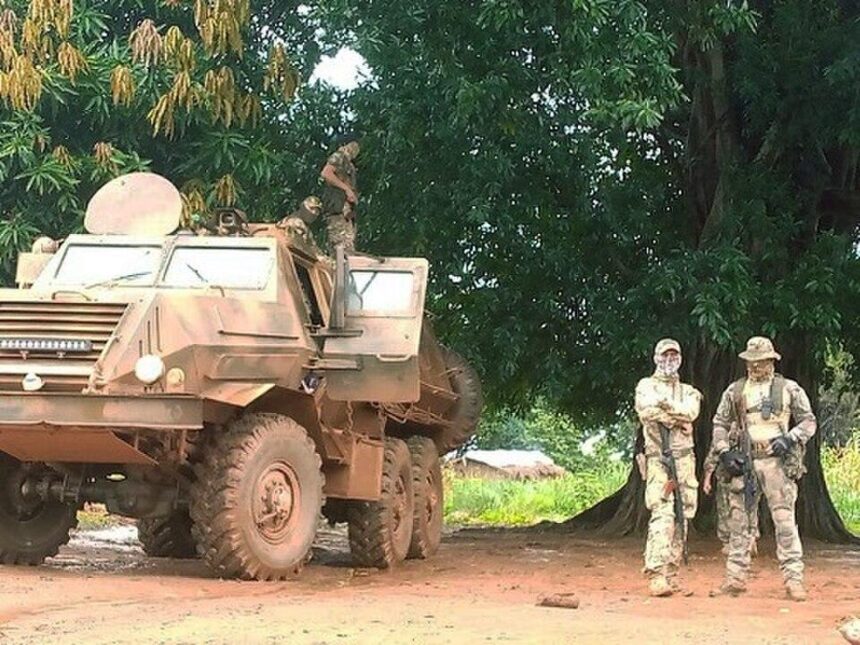
Roughly 500 fighters from Russia’s Wagner Group remain based up the Ubangi River in the Central African Republic, controlling a tramadol trade that lets them exploit the country’s gold and forest resources beyond the reach of local law enforcement or Moscow itself, according to The Wall Street Journal.
Tramadol, an opioid normally used for joint pain, becomes an addictive stimulant at high doses, known locally as “cocaine for the poor.” WSJ reported miners and fighters take doses far above the standard 50-100 milligrams, sometimes 200 milligrams or more, to work long shifts or suppress fear in combat. Researcher Natalia Dukhan of the Global Initiative Against Transnational Organized Crime said combatants enter a “pharmacological trance.”
The trade, run since Yevgeny Prigozhin’s death by his son Pavel, funds Wagner’s militias, including Sharks and Black Russians, which WSJ linked to a February attack that killed about 130 Fulani herders. Uppsala University data cited in the report show resource-related deaths in CAR rose nearly 20 percent over the past year, to about 500.
WSJ put Wagner’s annual gold export earnings at $180 million, though it cautioned the figure is hard to verify.
The timing invites an obvious contrast. As WSJ’s report circulated, Russian Foreign Minister Sergey Lavrov was touring Ethiopia, Niger, Mozambique, and Burundi, framing Moscow’s presence as Africa’s “Second Awakening” from colonial dependency. Whatever that rhetoric is worth, Wagner’s actual model in CAR runs on opioid dependency, extraction, and rising civilian deaths, not liberation. The irony writes itself: an operation selling itself as anti-colonial is, in practice, sustained by criminal enterprise. Whether that counts as an improvement on colonialism is left, deliberately, unanswered.