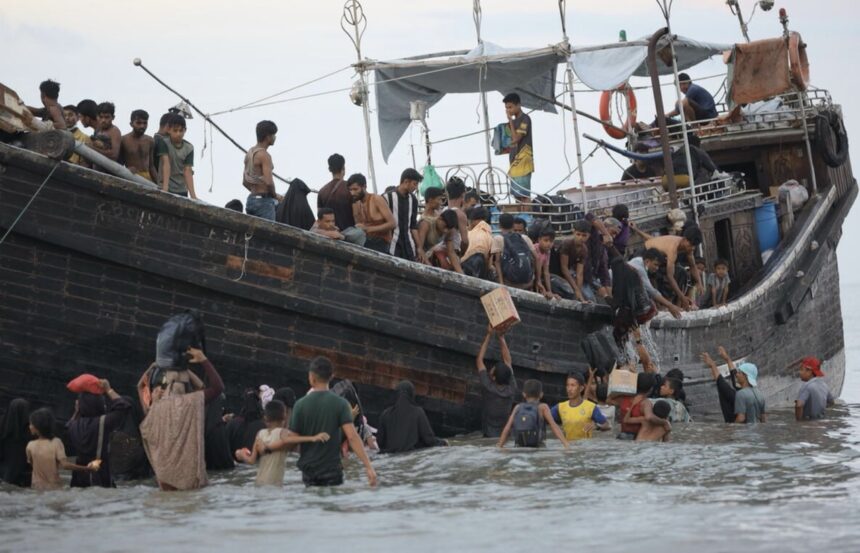
More than 500 Rohingya are feared dead after two boats carrying people fleeing the conflict in Myanmar capsized in the Bay of Bengal, the International Organization for Migration (IOM) and the U.N. refugee agency (UNHCR) said in a joint statement on Thursday. Neither incident has been officially confirmed. One boat, carrying an estimated 250 people, lost contact shortly after departing Myanmar’s Rakhine State in late June. A second vessel, with around 280 people aboard, is believed to have sunk off Myanmar’s Ayeyarwady coast on July 8.
Myanmar’s Ministry of Home Affairs declined to comment, while spokespeople for the country’s president and the Ayeyarwady regional government did not respond to requests for comment, according to the Associated Press.
The disaster cannot be separated from Myanmar’s wider conflict. Fighting between the military junta and the Arakan Army, an ethnic Rakhine armed group, has intensified since a ceasefire collapsed in November 2023, according to Human Rights Watch. The Arakan Army now controls most of Rakhine State, including the border with Bangladesh. That shift has transformed the conflict into a more complex struggle in which Rohingya communities face insecurity, displacement and alleged abuses from multiple armed actors, according to rights organizations. Human Rights Watch says the fighting has internally displaced more than 400,000 people across Rakhine and southern Chin states and forced at least 150,000 Rohingya to flee into Bangladesh since late 2023. Myanmar’s military has also been accused of restricting humanitarian aid to areas under its control, a policy the United Nations says has left more than 2 million people in Rakhine facing acute food insecurity.
Some of those feared dead had taken an unusual route. According to UNHCR and IOM, they traveled from the refugee camps of Cox’s Bazar in Bangladesh back into Rakhine State before boarding the boats. The camps themselves offer few long-term prospects. Nearly one million Rohingya remain confined there, while steep cuts in international humanitarian funding – including from the United States – have forced reductions in food assistance. Rights organizations, including the Burma Human Rights Network, have also documented allegations of forced labor, land confiscation and other abuses committed against Rohingya communities by Arakan Army forces in areas under their control. Caught between an armed group accused of exploiting them and a military government restricting aid, many families increasingly view the risks of a sea crossing as comparable to the dangers they face on land.
The boats departed during the monsoon season, when Rohingya generally avoid maritime crossings because of rough seas. UNHCR and IOM said recent heavy rain and flooding across the region would have made the journey especially dangerous. The agencies did not identify a specific reason the boats sailed during this period, and there is no confirmed evidence that changes in regional maritime patrols influenced the timing.
The latest disaster is part of a rapidly worsening trend. UNHCR says the Bay of Bengal and Andaman Sea corridor now has the highest mortality rate of any major refugee or migrant sea route in the world. More than 6,500 Rohingya attempted the crossing in 2025, and nearly 900 were reported dead or missing, making it the deadliest year on record for the route. Reported figures for 2026 before this latest incident remain inconsistent. Al Jazeera and CNN, both citing the joint UNHCR-IOM statement, reported that nearly 300 people had already died or gone missing this year, while other outlets have published higher estimates. The discrepancy had not been resolved at the time of publication.
The route has resisted international intervention for more than a decade. Human Rights Watch has documented repeated failures by regional governments – including Malaysia, Thailand and Indonesia – to conduct search-and-rescue operations or allow stranded boats to disembark, with some vessels instead being pushed back to sea. Several key transit and destination countries along the route, including Malaysia and Thailand, are not parties to the 1951 Refugee Convention, contributing to inconsistent regional approaches to refugee protection.
IOM and UNHCR renewed their call on Thursday for stronger search-and-rescue operations, access to asylum, protection for refugees, and tougher action against smuggling and human trafficking networks. Similar appeals have followed nearly every major Rohingya maritime disaster since 2015.
The repeated warnings point to a broader regional failure. For more than a decade, governments around the Bay of Bengal and Andaman Sea have responded to successive Rohingya boat crises without establishing a permanent regional search-and-rescue or protection mechanism. As fighting in Rakhine intensifies and conditions inside refugee camps continue to deteriorate, humanitarian agencies warn that more Rohingya are likely to attempt the same journey – making further mass-casualty disasters increasingly likely unless safer alternatives emerge.