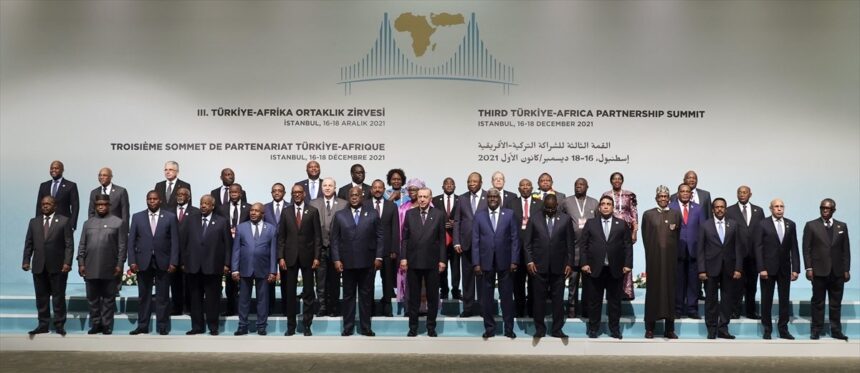
Turkey’s growing presence in Africa is often described as another foreign power crowding onto a busy continent. That understates what Ankara is doing. Africa has become the proving ground for Turkey’s emergence as a consequential middle power – a state without the global resources of the United States or China, but strong enough to influence wars, protect governments, broker disputes and build networks larger powers cannot ignore.
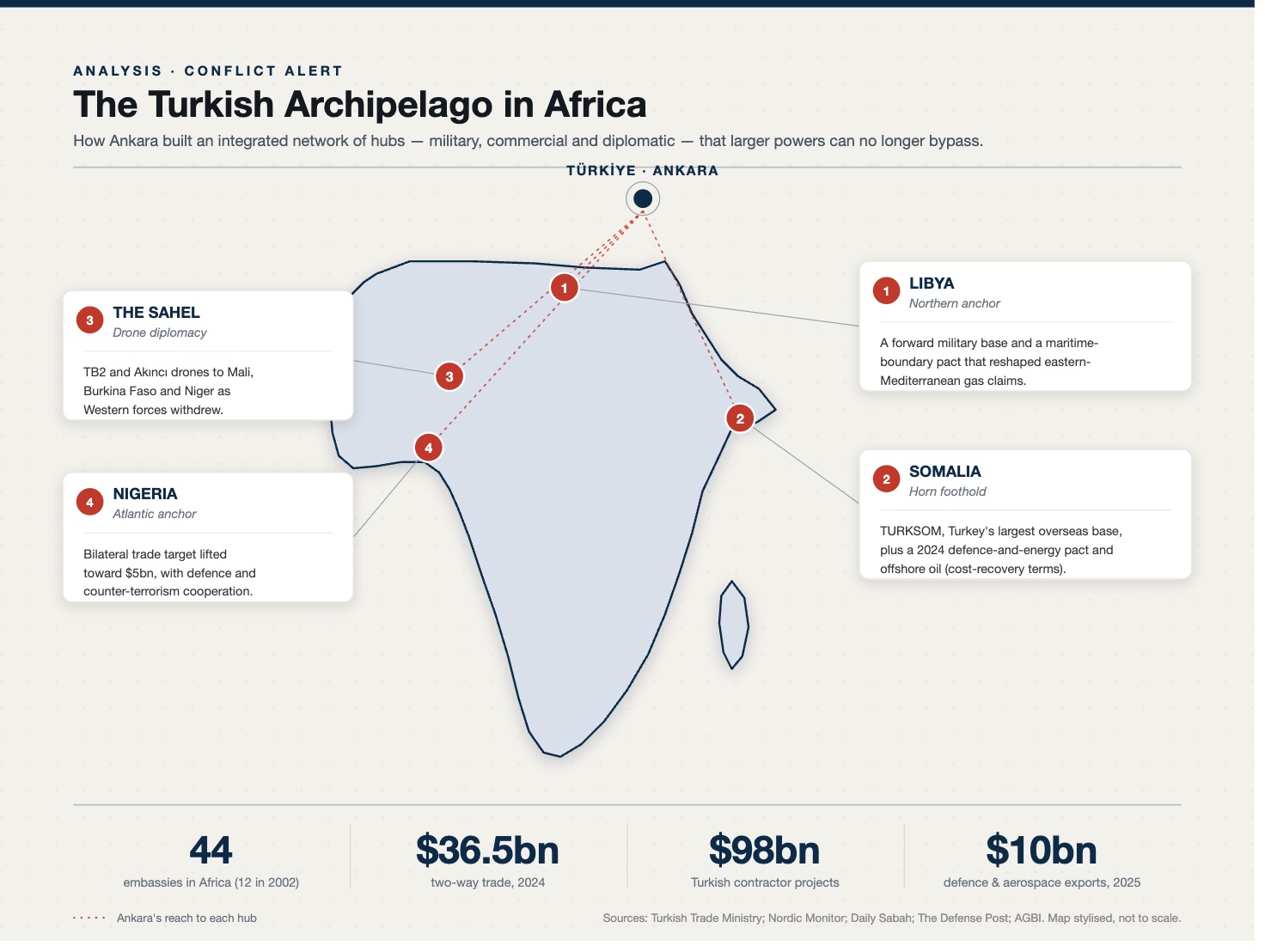
The approach is neither primarily military nor purely commercial. It fuses embassies, airlines, construction firms, aid agencies, schools, defence manufacturers, military trainers and direct presidential diplomacy. Turkish–African trade rose from about $5.4 billion in 2003 to $36.5 billion in 2024; the embassy network grew from 12 in 2002 to 44. Turkish contractors are now building more than 2,300 projects across the continent worth some $98 billion.
Those numbers do not make Turkey a superpower. They show something more durable than a stack of arms contracts: an integrated system of access.
Africa as Turkey’s Strategic Laboratory
Somalia is the clearest test case. Turkey entered the country during the 2011 famine with humanitarian aid, then built hospitals, schools and roads, opened its largest embassy and, in 2017, its largest overseas military base, TURKSOM, training thousands of Somali troops.
That footprint has since become a resource stake. Under a 2024 defence and economic pact, Turkey’s seismic vessel Oruç Reis spent 234 days off the Somali coast, mapping three offshore blocks across 4,464 square kilometres. The commercial terms have drawn criticism: according to documents reported by Nordic Monitor, the Turkish operator may recover up to 90 percent of annual production as costs before the remaining profit petroleum is divided, with royalties owed to Somalia. It is a potentially valuable energy position, though returns hinge on whether commercially recoverable reserves are found. Security assistance became an energy stake.
The same relationship powers Ankara’s diplomacy. When President Recep Tayyip Erdoğan brokered the December 2024 accord easing Ethiopia’s push for sea access through Somaliland, Turkey was no detached referee: it was already one of Somalia’s most important security partners. That access and leverage let it seat both sides at the same table – a demonstration of how Ankara’s military and diplomatic roles reinforce one another.
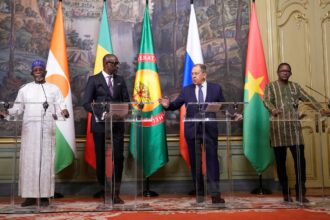
The pattern runs west. As France and its allies were expelled from the Sahel, Turkey filled the vacuum as a “third way.” Where Russia’s Africa Corps supplies regime protection, Turkey supplies the hardware: Turkish combat drones have spread across Mali, Burkina Faso and Niger, giving governments a relatively affordable means of surveillance and long-range strike. Their use has made defence exports one of Ankara’s most visible instruments of influence – even in countries where Russia remains the principal provider of regime security.
Ankara needs no territorial corridor. It is assembling hubs – Libya in the north, Somalia in the Horn, Nigeria on the Gulf of Guinea, and deepening ties across the Sahel – linked by air routes, bilateral pacts and commercial infrastructure. In Nigeria, Erdoğan aims to lift bilateral trade from roughly $2 billion to $5 billion while deepening cooperation on defence, intelligence and counter-insurgency.
The Middle Power That Cannot Be Bypassed
“Middle power” can sound like a polite word for a country that matters, but not much. Turkey proves the reverse. A successful middle power need not dominate a region; it needs enough military capacity, economic reach and diplomatic access to change other actors’ calculations. Turkey’s defence industry anchors that rise. Its drones drew global attention in Libya, Syria, Ukraine and Nagorno-Karabakh, and defence and aerospace exports reached about $10 billion in 2025, up 48%in a year and roughly triple their 2021 level – with about $1.8 billion of the 2024 total from the drone maker Baykar alone.
For African governments, Turkey offers a package rivals cannot match in one relationship. China brings deeper financing; Russia specialises in regime protection and coercive security; Western states split security, aid and investment across institutions bound by political conditions. Turkey delivers weapons, training, construction, scholarships, flights and presidential attention under a single deal – without a European colonial past and without demanding exclusive alignment.
The offer is transactional, not charitable. Turkish firms win contracts, defence companies enter new markets, Ankara secures energy and geography, and Erdoğan gains diplomatic weight from a bloc of 54 UN votes. African governments keep agency too, using Turkey to diversify partners and reduce dependence on any single patron.
A Rival Model to Russia
Russia is the sharpest contrast. The two trade, negotiate and occasionally coordinate, yet Ankara repeatedly contests Moscow – in Syria, Libya, the South Caucasus, the Black Sea and now Africa.
The models differ at the root. Russia’s African footprint is concentrated around military protection for authoritarian governments – Africa Corps and personnel shielding regimes in Mali, Niger and Burkina Faso that expelled Western forces and now depend heavily on Moscow. Russia and the three states agreed in July to deepen that cooperation.
Turkey enters through a diversified institutional matrix – Maarif Foundation schools, TİKA aid offices, Turkish Airlines logistics, construction and defence supply chains. The military layer matters, but it is one of many. If a regime falls or a contract lapses, Turkey’s structural access survives; Russia’s often does not.
The competition will rarely be head-on. Turkey may arm a government Russia protects, trade with Moscow while backing Ukraine, or bargain with Russia in one theatre while eroding its client in another. That is not incoherence. It is strategic autonomy – and Africa gives Ankara room to practise it, working with NATO without being its instrument and with Russia without following its lead.
That is why Turkey’s expansion matters beyond any single base, drone or contract. Power is no longer the monopoly of states that can dominate the globe; it is shared with those that can make themselves indispensable in a region. Turkey has not become a superpower, but across the arc from Libya to Somalia and the Sahel to the Gulf of Guinea it has become a power others must consult, accommodate or contest – and Africa, where diplomacy, drones, schools and construction cranes advance together, is where that shift is most visible.