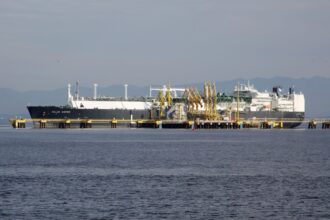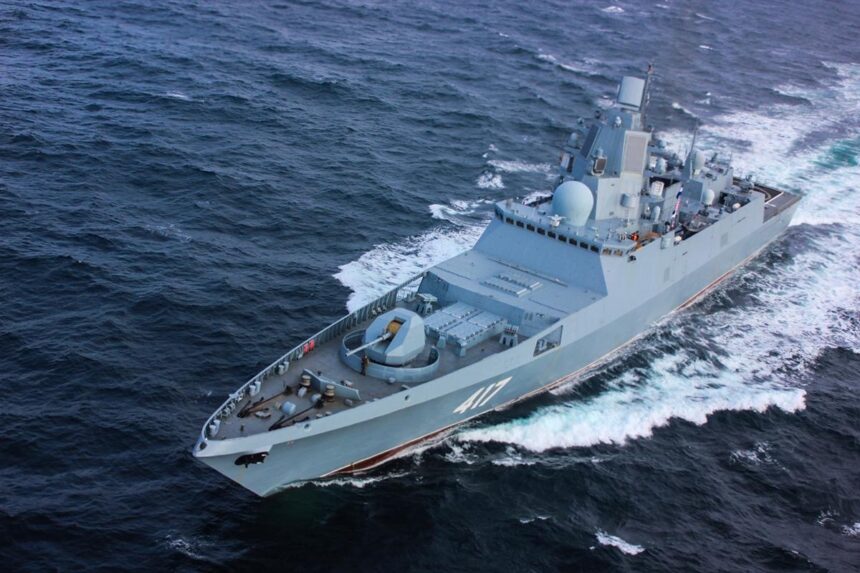
Russia’s deployment of the hypersonic-armed frigate Admiral Kasatonov to the Baltic Sea near Fehmarn, Germany, is not an isolated provocation but the latest instance of a pattern analysts have tracked since mid-2025: the Russian Navy shifting from occasional deterrent gestures to a standing practice of escorting its sanctions-evading “shadow fleet” through contested European waters. The frigate, tracked with its transponder off, followed the destroyer Admiral Levchenko’s deployment to the same waters in late July, according to The Telegraph.
The pattern predates this month. Russian warships escorted the sanctioned tankers Selva and Sierra through the English Channel via the corvette Boikiy in June 2025, and the frigate Neustrashimy has maintained a presence off Britain’s coast escorting tankers since mid-July 2026, according to Army Recognition.
The Atlantic Council assessed in April 2026 that Russian naval vessels have “begun to regularly escort shadow vessels through the Baltic Sea and the English Channel,” describing a deliberate shift toward militarized protection of tanker routes rather than sporadic shows of force, according to the Atlantic Council.
President Vladimir Putin has threatened retaliation against British and EU vessels that seize shadow-fleet tankers, calling recent interdictions “piracy,” while Security Council deputy chairman Dmitry Medvedev asserted Russia’s right to attack merchant ships from “enemy states” in any waters, according to The Telegraph.
Beyond rhetoric, Russia has moved to insulate its fleet financially: by February 2026, roughly one in three tankers crossing the Baltic carried insurance from sanctioned Russian or Russian-linked insurers, narrowing the coverage gap the price-cap sanctions were designed to exploit, per Lloyd’s List data cited by the Atlantic Council.
Naval escorts raise the operational cost and legal risk of Western boarding actions, a dynamic already visible in June, when the UK seized the tanker Smyrtos in the Channel carrying roughly 101,400 tonnes of Russian crude, according to USNI News.
This escalation should be read as grey-zone pressure, not a prelude to territorial war. US and NATO officials say current intelligence assessments center on sub-threshold options — cyberattacks or a small-scale incursion designed to test alliance resolve — without necessarily crossing the threshold that would trigger Article 5, according to CNN. Dark transits, transponder blackouts, and missile-platform posturing near Fehmarn fit that same sub-threshold category: visible, deliberately ambiguous pressure rather than confirmed preparation for direct conflict.
The financial toll is already spreading beyond the shipping lanes. Latvia has requested roughly €7 billion in EU funding to offset defense spending and the cost of severing ties with Moscow, with Prime Minister Andris Kulbergs warning his country was nearing its fiscal limit while “paying for the defence of the whole Europe,” per The Telegraph.
Neither Berlin nor Moscow has commented on the latest deployments. Whether Western states escalate shadow-fleet interdictions despite the escort risk, and whether Russia’s insurance workaround holds up under further sanctions pressure, are the clearest markers of where this standoff moves next — short of, not toward, a direct NATO confrontation.