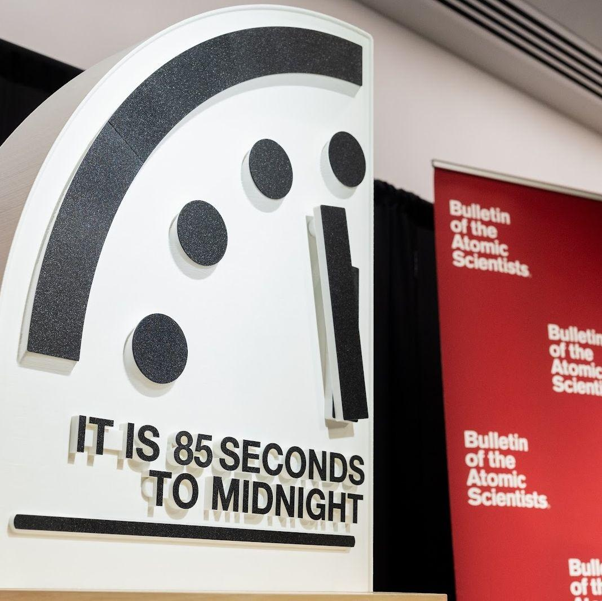
Every January, a small group of scientists in Chicago move the hands of a clock that does not tell time. It measures something closer to mood: how near humanity stands, in the collective judgment of physicists, historians and Nobel laureates, to a catastrophe of its own making. On January 27, 2026, they moved it to 85 seconds before midnight, the closest the Doomsday Clock has come to that hour in its 79-year history.
The clock is not measuring the probability of nuclear war alone. It is measuring the disappearance of the political, legal and institutional barriers that once made that war less likely. Behind the 85 seconds sits the quiet expiration of the last treaty that let Washington and Moscow verify each other’s arsenals, a Kremlin that now discusses nuclear weapons on state television with the casualness once reserved for troop movements, and a widening circle of capitals quietly reconsidering whether they can still rely on someone else’s bomb. For eighty years, nuclear weapons underwrote the most durable peace of the modern era on a paradox: they were too terrible to use, so no one used them. What is eroding now is that paradox.
Where the Rulebook Went
On February 5, 2026, the New Strategic Arms Reduction Treaty formally expired, ending more than five decades of continuous arms-control architecture stretching back to SALT I in 1972. New START, signed in 2010, capped deployed warheads at 1,550 apiece and let each side send inspectors to count the other’s missiles twice a year. That counting mattered less for what it produced than for what it prevented: the guesswork and worst-case planning that fill the vacuum once verification disappears.
The treaty’s lapse does not by itself trigger a buildup; both countries can expand their arsenals only slowly. Its more corrosive effect is informational – neither government must now disclose warhead counts, launcher locations, or whether an exercise is routine. Russia and the US have discussed possible follow-on arrangements, but nothing has emerged without a successor framework entering into force. Russia also suspended New START inspections in 2023 and revoked its test-ban ratification in 2024. SALT, START, the INF Treaty dead since 2019, now New START – the assumption that made those documents possible, that both sides gained more from restraint than competition, is what is actually disappearing.
From Deterrence to Coercion
The second transformation is rhetorical, not institutional: nuclear weapons are migrating from instruments meant to prevent war into instruments used to shape one already under way. Deterrence asks an adversary to hold back from one act. Compellence, its more aggressive cousin, asks someone else entirely to bend under an open-ended threat. Russia has spent three years practicing the second.
For decades, nuclear weapons carried a political taboo separating possession from use: states could gesture at deterrence, but openly advocating a nuclear strike sat outside acceptable strategic discourse. That boundary is now visibly weakening. Voices inside Russia’s strategic establishment illustrate it best. Dmitry Medvedev, the former president now serving as deputy chairman of Russia’s Security Council, has warned European leaders that supplying further military aid to Ukraine “means war with NATO.” Sergei Karaganov, an influential academic and longtime Kremlin adviser, argued in 2023 that Russia should be willing to strike “a group of targets in a number of countries” to restore the West’s lost “fear of hell.” Putin has distanced himself from that specific idea while still sharing platforms with Karaganov – evidence, several analysts argue, that the idea stays useful in circulation without being formally adopted.
The closest the war has come to an actual nuclear crisis took a quieter form than the public threats suggest. In autumn 2022, as Ukrainian forces pressed a faltering Russian position around Kherson, American intelligence detected genuine internal Russian military discussion of tactical nuclear use. Washington’s response was a set of direct, largely unpublicized warnings: Jake Sullivan called Nikolai Patrushev; CIA Director William Burns flew to Ankara to warn Russia’s intelligence chief; and Defense Secretary Lloyd Austin told Russian Defence Minister Sergei Shoigu, per journalist Bob Woodward, that nuclear use would mean “all the restraints that we have been operating under in Ukraine would be reconsidered.” Russia did not use a weapon. It was Washington’s warnings that constrained Moscow, not the reverse – and on the broader rhetoric, Brookings has concluded it slowed Western arms decisions without ever reversing them. That is genuinely unsettling: nuclear threats have not lost their power to move great states. They have simply become a tool for buying time rather than winning outright.
A World Rehedging
The unraveling of predictability has not stayed contained to Washington and Moscow. The American nuclear umbrella is the most effective non-proliferation tool ever built, and it depended on confidence in its permanence. As the guarantee looks more conditional, dormant debates over independent deterrents have resurfaced from fringe positions into serious parliamentary discussion.
That hedging looks least hypothetical in two countries with unusual symbolic weight, and notably absent in a third. Japanese Defense Minister Shinjiro Koizumi has pushed this year for open debate on integrating nuclear weapons into defense planning, reversing the postwar “Three Non-Nuclear Principles” – a striking move in the only nation ever struck by one, pointed enough that Hiroshima’s mayor sharpened his 2026 Peace Declaration in response. Saudi Arabia’s Crown Prince has long said the kingdom would match any Iranian bomb, a position a new US-Saudi nuclear deal this July left more room to act on. Germany is the exception: despite the strongest anti-nuclear public mood of any major economy, strong enough to shut every reactor after Fukushima, talk of a German bomb lives mostly in American think tanks rather than the Bundestag. The asymmetry is its own warning – least appetite where outsiders worry most, most movement where history argued hardest against it.
The Makkah Joint Defence Agreement, signed by Turkey, Saudi Arabia and Pakistan on August 7, extends no nuclear guarantee between them, but its timing, within a year of New START’s collapse, matters more than its text. It is a hedge, not a declaration.
A third fracture runs through civilian nuclear infrastructure. Russia’s occupation of the Zaporizhzhia plant in 2022 built an active battlefield around six operating reactors, exposing a structural gap in the IAEA’s safety framework: the agency can monitor, but it cannot enforce, and it cannot physically remove an occupying army. North Korea continues expanding its own arsenal while deepening cooperation with Russia – proof that eroding restraint in one theater rarely stays confined to it.
Not every specialist agrees the sky is falling. Pavel Podvig argued in 2023 that the world’s forceful rejection of Russian threats was itself evidence the nuclear taboo held, and that the Clock should move away from midnight. It is a serious argument. But since he made it, New START has expired and the Clock has moved four seconds closer, not back.
What makes this moment different has little to do with arsenal size, smaller today than in 1986, and everything to do with casualness. Annie Jacobsen, author of “Nuclear War: A Scenario,” has said the most alarming thing she learned was the compression of time: a president would have minutes to decide on retaliation, defended by 44 interceptors against roughly 1,674 Russian warheads kept ready to launch, interceptors that work under ideal conditions only about half the time. That decision would fall to one exhausted person in minutes, on information no better than the moment allows.
For most of the nuclear age, statesmen treated these weapons as something close to sacred – unusable, mentioned mainly to be foresworn. That restraint is dissolving, replaced by a vocabulary in which nuclear weapons are floated as leverage and invoked with the register once reserved for sanctions. The Clock cannot measure warheads with precision, and it is closer to metaphor than science. But what it is naming, second by second, is simple and grave: the world has not built more bombs. In dangerously wide circles, it has forgotten why they were never supposed to be used at all.